Application of the Analogy to Closed Frame Problem - Conventional Form of Flexibility Method
TL;DR
Learn how to analyze closed frames using the column analogy method, converting them into determinate structures and drawing analogous columns and moment diagrams.
Transcript
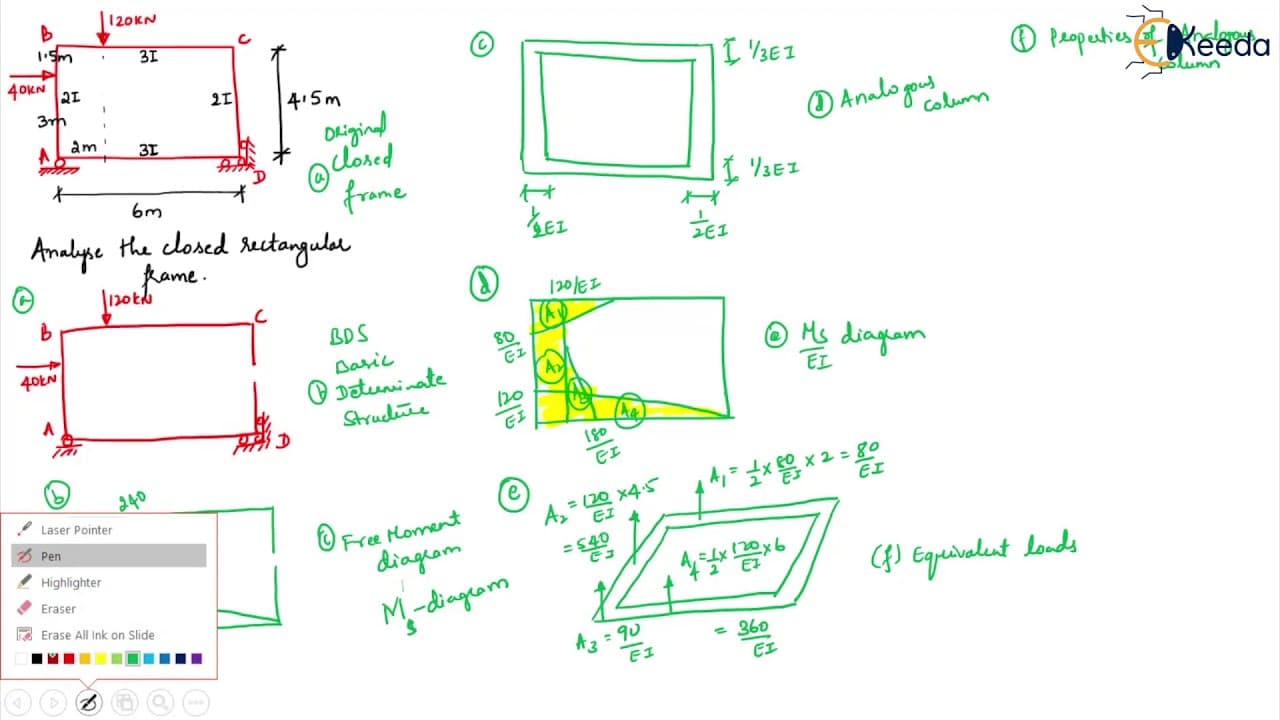
hello students so in this lesson we will study the application of analogy to the closed frames it's always problem related to how to analyze a closed frame using the column analogy method okay it's almost similar to your normal frame symmetric range okay but there is a slight difference now this is the problem given to us it's a rectangular closed ... Read More
Key Insights
- ❤️🩹 Closed frames can be converted into determinate structures by giving a cut in one of the members and treating one portion as fixed end and the other portion as free end.
- 😚 Free bending moment diagrams and analogous columns are used to analyze closed frames.
- ❓ Equivalent concentrated loads are calculated to simplify the analysis process.
- 😚 The properties of the analogous column and load diagram are important in determining the behavior of the closed frame.
Install to Summarize YouTube Videos and Get Transcripts
Explore YouTube Video Summarizer or Get YouTube Transcript Extractor
Questions & Answers
Q: How do you convert a closed frame into a determinate structure using the column analogy method?
To convert a closed frame into a determinate structure, you need to give a cut in one of the members and treat one portion as fixed end and the other portion as free end. This helps in making the structure determinate.
Q: What are the steps involved in analyzing a closed frame using the column analogy method?
The steps involved are: converting the closed frame into a determinate structure, drawing the free bending moment diagram, drawing the analogous column, drawing the moment-shear by flexure (Ms/EI) diagram, calculating the properties of the analogous column, calculating the properties of the load diagram, and calculating the final moments in the frame.
Q: Why are equivalent concentrated loads calculated in the analysis of closed frames?
Equivalent concentrated loads are calculated to avoid repetitive calculations of load terms. By converting the loads into equivalent loads, the analysis becomes simpler and more efficient.
Q: How do you calculate the final moments at different points in the closed frame?
The final moments at different points in the closed frame are calculated using the formula MF = MS - MX, where MF is the final moment, MS is the moment from the moment-shear by flexure diagram, and MX is the moment from the free bending moment diagram.
Summary & Key Takeaways
-
Closed frames are indeterminate structures that need to be converted into determinate structures by giving a cut in one of the members and treating one portion as fixed and the other as free end.
-
Drawing the free bending moment diagram helps in analyzing the frame, followed by drawing the analogous column and the moment-shear by flexure (Ms/EI) diagram.
-
Equivalent concentrated loads are calculated to avoid repetitive calculations of load terms, and the properties of the analogous column and load diagram are determined.
-
Formulae are used to calculate the final moments at different points in the frame, taking into account the signs for accurate results.
Read in Other Languages (beta)
Share This Summary 📚
Summarize YouTube Videos and Get Video Transcripts with 1-Click
Try YouTube Summary with ChatGPT & Claude or YouTube Transcript Generator
Explore More Summaries from Ekeeda 📚

Summarize YouTube Videos and Get Video Transcripts with 1-Click
Try YouTube Summary with ChatGPT & Claude or YouTube Transcript Generator