Priority Based Real Time Sheduling
TL;DR
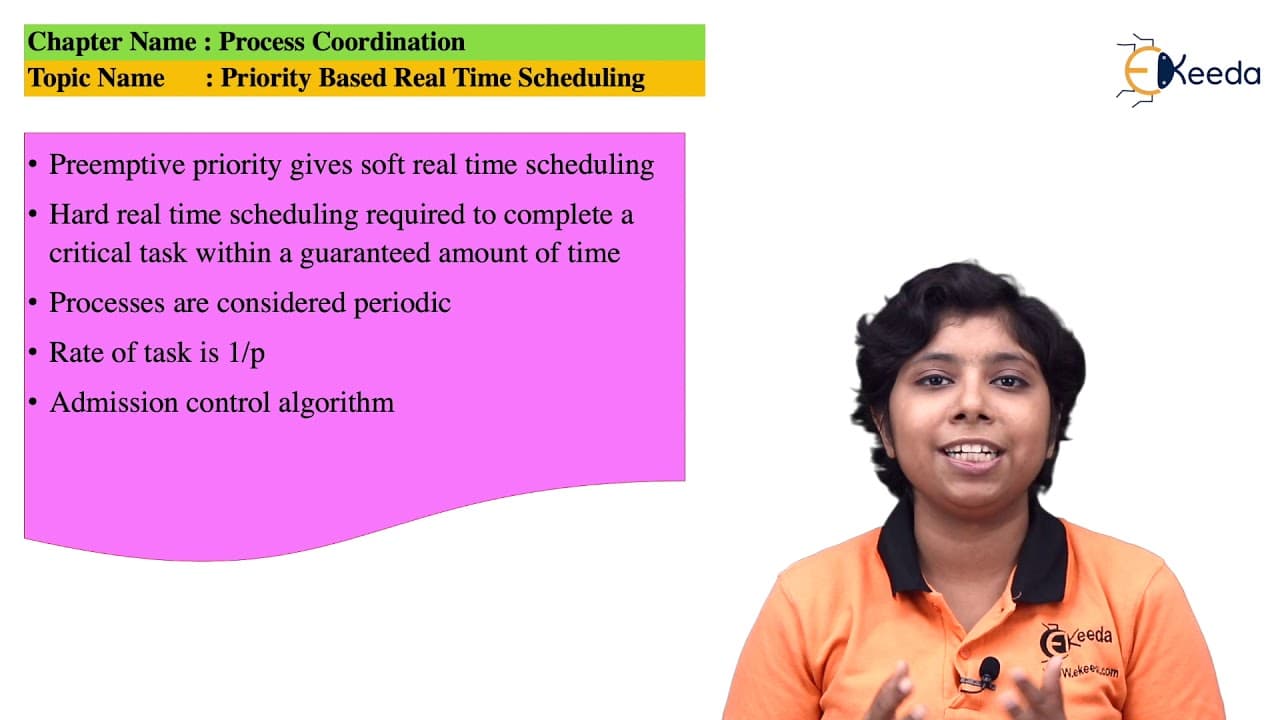
Real-time CPU scheduling requires priority and preemption to ensure critical processes are serviced promptly.
Transcript
click the Bell icon to get latest videos from akira hello friends today we are going to discuss about how a real-time CPU scheduling is done with priority and preemption basis and how this preemption and priority helps in service the critical real-time processes over the non-critical processes what are the advantages what is a periodic process and ... Read More
Key Insights
- 😒 Real-time CPU scheduling uses priority and preemption to service critical processes promptly.
- ⌛ Operating systems like Linux, Windows, MacOS, and Solaris offer priority levels for real-time processes.
- ⌛ Hard real-time CPU scheduling involves a periodic scheme and an admission control algorithm.
- ❓ The deadline requirements of processes must be declared beforehand to ensure proper scheduling.
- ⌛ A priority-based algorithm with preemption ensures efficient scheduling in real-time systems.
- ⌛ Soft real-time scheduling aims to meet deadlines most of the time, while hard real-time scheduling requires meeting all deadlines.
- 🐕🦺 Admission control algorithms determine if a process can be serviced within its declared deadline.
Install to Summarize YouTube Videos and Get Transcripts
Explore YouTube Video Summarizer or Get YouTube Transcript Extractor
Questions & Answers
Q: What is the importance of using a priority-based algorithm with preemption in real-time CPU scheduling?
A priority-based algorithm with preemption ensures that high-priority processes are given preference for CPU allocation, allowing critical processes to be serviced promptly.
Q: How do operating systems like Windows, Linux, MacOS, or Solaris handle real-time processes?
These operating systems provide priority realization schemes, with specific priority levels reserved for real-time processes, ensuring their higher security and priority over other processes.
Q: What is the difference between soft real-time CPU scheduling and hard real-time CPU scheduling?
Soft real-time CPU scheduling focuses on meeting deadlines most of the time, while hard real-time CPU scheduling requires meeting all deadlines. Hard real-time scheduling involves the use of priority, preemption, and admission control algorithm to ensure timely execution.
Q: How does an admission control algorithm contribute to real-time CPU scheduling?
An admission control algorithm determines if a process with its declared deadline requirements can be serviced within its deadline. It either admits the process, guaranteeing its timely execution, or rejects it if meeting the deadline is impossible.
Summary & Key Takeaways
-
Real-time CPU scheduling prioritizes processes based on importance, with high-priority processes preempting lower-priority ones.
-
Operating systems like Linux, Windows, MacOS, and Solaris offer priority levels for real-time processes to ensure higher security and priority.
-
Hard real-time CPU scheduling involves a periodic scheme and an admission control algorithm to guarantee timely execution of processes.
Read in Other Languages (beta)
Share This Summary 📚
Summarize YouTube Videos and Get Video Transcripts with 1-Click
Try YouTube Summary with ChatGPT & Claude or YouTube Transcript Generator
Explore More Summaries from Ekeeda 📚





Summarize YouTube Videos and Get Video Transcripts with 1-Click
Try YouTube Summary with ChatGPT & Claude or YouTube Transcript Generator