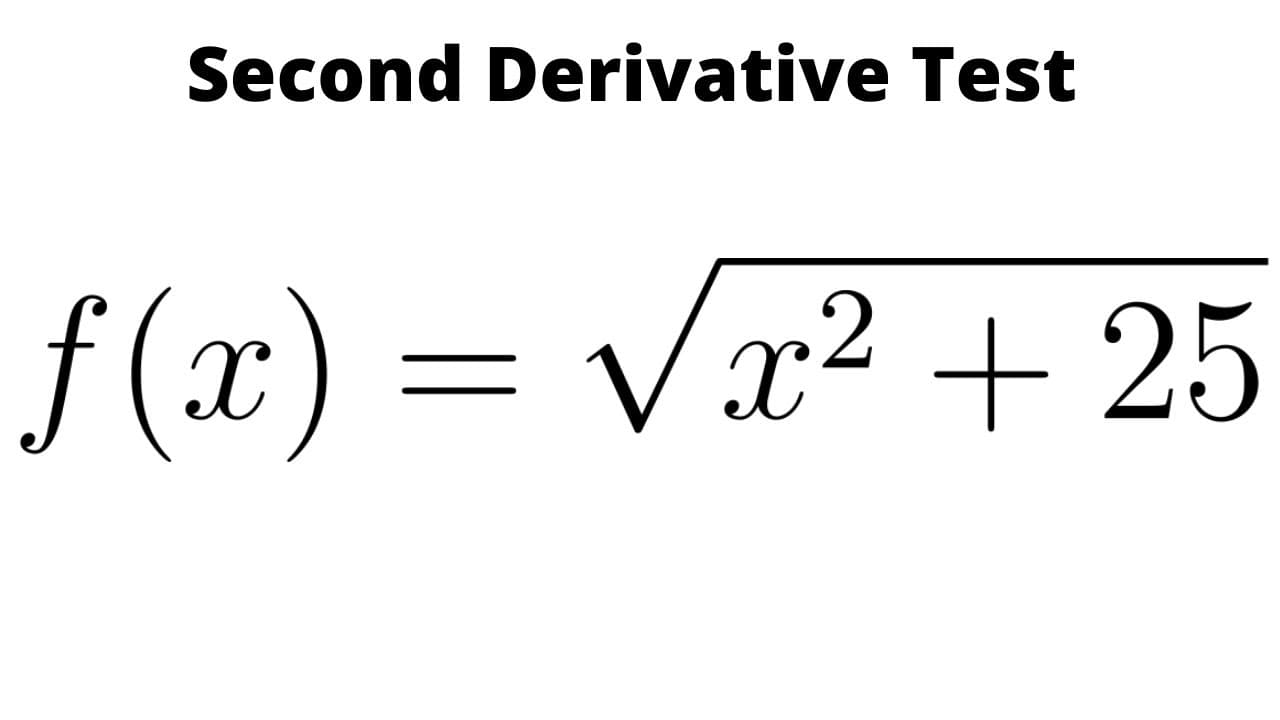
Relative Extrema Using The Second Derivative Test
TL;DR
Use the second derivative test to find relative extrema by finding critical numbers and plugging them into the second derivative.
Transcript
find all relative extrema using the second derivative test so solution so to use the second derivative test you start by finding the critical numbers then you take the critical numbers and you plug them into the second derivative if it's positive you have a min if it's negative you have a max and you're pretty much done so let's start by taking the... Read More
Key Insights
- 😥 The second derivative test can be used to determine the presence of minimum or maximum points in a function.
- 🏆 Finding critical numbers is the first step in using the second derivative test.
- 📏 The second derivative is obtained using the quotient rule in the derivative calculation.
- 🔌 Plugging in the critical number into the second derivative helps determine the concavity and thus the nature of the extremum.
- 🏆 The second derivative test simplifies the process of finding relative extrema by using the properties of concavity.
- 😥 It is important to differentiate between finding the points of extrema and finding their values.
- 🏆 The second derivative test can only be applied if the first derivative of the function exists.
Install to Summarize YouTube Videos and Get Transcripts
Explore YouTube Video Summarizer or Get YouTube Transcript Extractor
Questions & Answers
Q: How do you determine if a critical number is a maximum or a minimum using the second derivative test?
To determine if a critical number is a maximum or a minimum using the second derivative test, plug in the critical number into the second derivative. If the result is positive, it is a minimum, and if it is negative, it is a maximum.
Q: What is the process of finding critical numbers?
To find critical numbers, set the first derivative equal to zero and solve for x. The resulting values of x are the critical numbers.
Q: How can the second derivative be calculated using the quotient rule?
The second derivative can be calculated using the quotient rule, which involves taking the derivative of the numerator multiplied by the denominator minus the numerator multiplied by the derivative of the denominator, all divided by the denominator squared.
Q: What is the purpose of plugging in the critical number into the second derivative?
The purpose of plugging in the critical number into the second derivative is to determine the concavity of the function at that point. If the result is positive, the function is concave up, indicating a minimum, and if it is negative, the function is concave down, indicating a maximum.
Summary & Key Takeaways
-
To find relative extrema using the second derivative test, start by finding the critical numbers and then plug them into the second derivative.
-
The first derivative is found by taking the derivative of the given function using the chain rule.
-
The second derivative is found using the quotient rule and then plugging in the critical number obtained previously.
Read in Other Languages (beta)
Share This Summary 📚
Summarize YouTube Videos and Get Video Transcripts with 1-Click
Try YouTube Summary with ChatGPT & Claude or YouTube Transcript Generator
Explore More Summaries from The Math Sorcerer 📚




Summarize YouTube Videos and Get Video Transcripts with 1-Click
Try YouTube Summary with ChatGPT & Claude or YouTube Transcript Generator