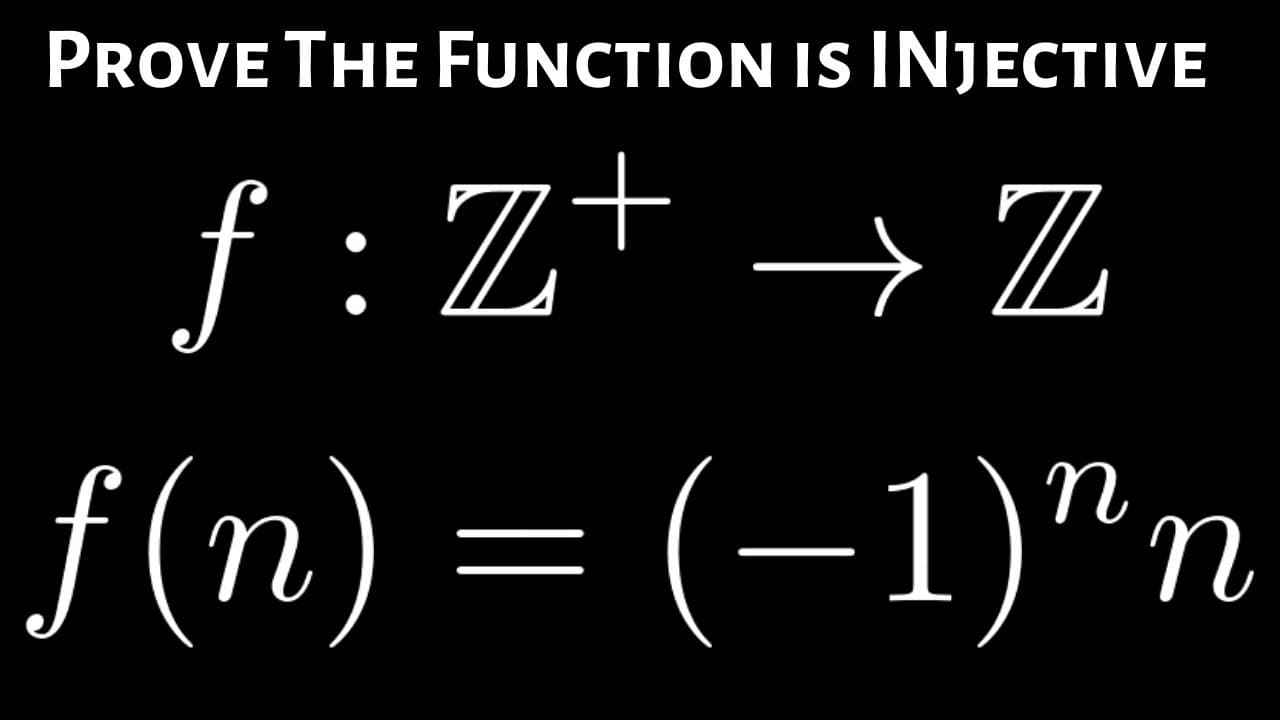
Prove the function f:Z^+ → Z given by f(n) = (-1)^n * n is Injective(one-to-one)
TL;DR
This content provides a step-by-step proof of the injectivity (one-to-one) of a given function.
Transcript
so the function and we're asked to prove if it's injective which is also called one-to-one so this set here this is all the positive integers so this is 1 2 3 and so on and this here is simply all integers so this here is dot dot dot negative 2 negative 1 0 1 2 ech cetera ok and the function is given by f of n equal to negative 1 to the N times n s... Read More
Key Insights
- 🍁 The given function is defined as f(n) = (-1)^n * n, where it maps positive integers to all integers.
- 🛀 Injectivity of a function requires showing that if f(a) = f(b), then a = b.
- 😀 Assumption of f(n) = f(m) leads to the equation (-1)^(n-m) * n = m.
- 🤘 By analyzing the signs involved, it is found that (-1)^(n-m) is equal to 1, leading to the conclusion that n = m.
- 😑 The proof utilizes properties of exponents to simplify and manipulate expressions.
- 🤘 The positive nature of n and m is crucial in establishing the positive sign of (-1)^(n-m).
- 👎 The injectivity of the function is proven by showing that positive integers n and m must be equal.
Install to Summarize YouTube Videos and Get Transcripts
Explore YouTube Video Summarizer or Get YouTube Transcript Extractor
Questions & Answers
Q: What does it mean for a function to be injective?
A function is injective (one-to-one) if every element in its domain maps to a unique element in its codomain. In other words, if f(a) = f(b), then a = b.
Q: How is the function defined in this proof?
The function f(n) = (-1)^n * n maps positive integers to all integers. The value of f(n) alternates between positive and negative based on whether n is even or odd.
Q: How does the proof begin?
The proof starts by assuming f(n) = f(m) for some positive integers n and m. The goal is to show that n = m to prove injectivity.
Q: What steps are involved in the proof?
The proof divides both sides of the equation by (-1)^m and applies properties of exponents to obtain the equation (-1)^(n-m) * n = m. The analysis of signs reveals that n = m, establishing injectivity.
Summary & Key Takeaways
-
The content discusses a function and aims to prove its injectivity, also known as one-to-one.
-
The function maps positive integers to all integers using the formula f(n) = (-1)^n * n.
-
The proof begins by assuming f(n) = f(m) and then derives the equation (-1)^(n-m) * n = m.
-
Through careful examination of the signs and properties of exponents, it is shown that n = m, proving the injectivity of the function.
Read in Other Languages (beta)
Share This Summary 📚
Summarize YouTube Videos and Get Video Transcripts with 1-Click
Try YouTube Summary with ChatGPT & Claude or YouTube Transcript Generator
Explore More Summaries from The Math Sorcerer 📚


Summarize YouTube Videos and Get Video Transcripts with 1-Click
Try YouTube Summary with ChatGPT & Claude or YouTube Transcript Generator