Trench Systems (Cross Section)
TL;DR
Trench warfare in World War One involved the construction of complex trench systems to protect soldiers from enemy fire.
Transcript
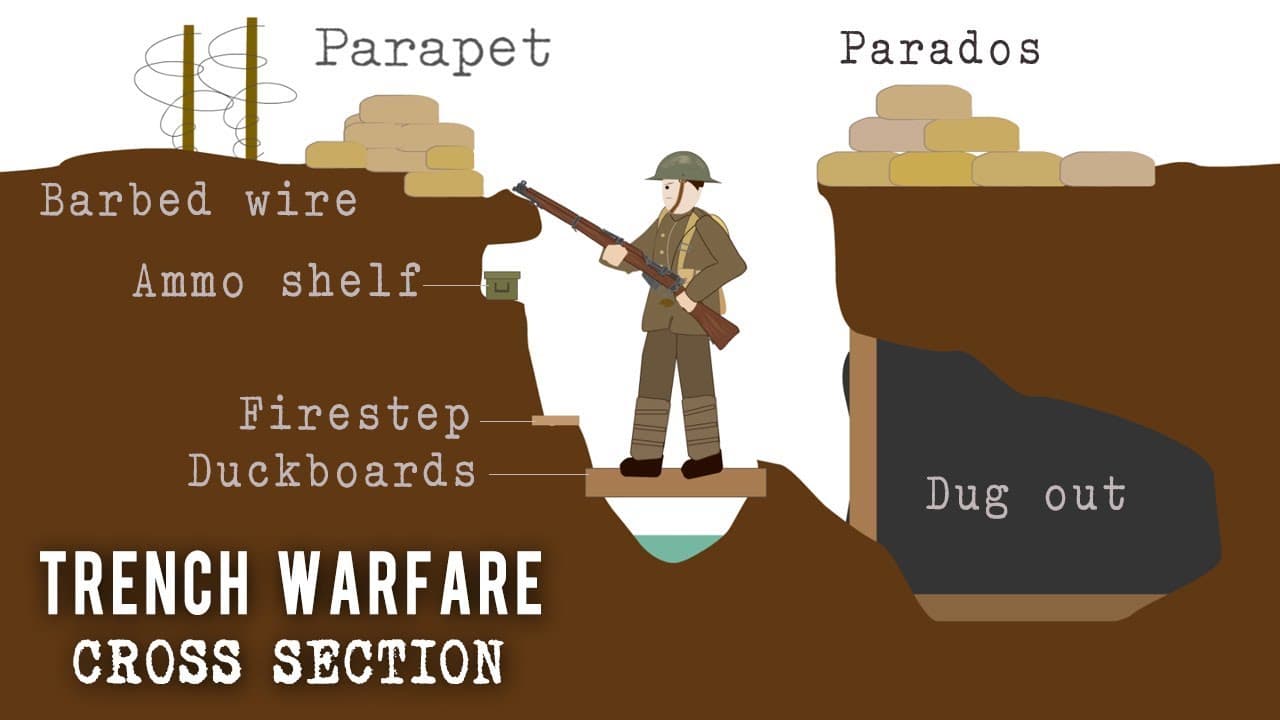
Trench warfare, Trench cross-section, World War one. On The Western Front, trench systems were developed into a sophisticated network. In 1914, trenches were quickly dug out by both sides, parallel to each other from the North Sea through Belgium and France. The trenches would offer some protection for the troops from overwhelming enemy artillery, ... Read More
Key Insights
- ❓ Trenches in World War One were initially dug quickly by soldiers, but later transformed into more complex and permanent structures with sandbags and wooden planks.
- 😋 Underground bunkers served as storage areas for ammunition, food, and weapons, as well as command centers for officers.
- 🫥 Communication trenches connected different lines and facilitated the transport of soldiers, ammunition, and supplies.
- 👷 Zigzag patterns in trench construction prevented the enemy from shooting down the entire length of the trench.
- ✋ The British trenches were at a disadvantage due to poor ground conditions with high water levels and mud, while German trenches were on higher ground.
- 👷 German trench systems were generally better because they accepted the idea of a stalemate and put more effort into their construction.
- 🫥 The first line, known as the fire trench, was the main line of resistance and contained machine-gun nests and barbed wire.
Install to Summarize YouTube Videos and Get Transcripts
Explore YouTube Video Summarizer or Get YouTube Transcript Extractor
Questions & Answers
Q: What was the purpose of constructing trenches in World War One?
Trenches were built to provide protection to soldiers from overwhelming enemy artillery and infantry fire.
Q: How were trench systems transformed into more complex structures?
Soldiers initially dug simple trenches, which were then reinforced with sandbags, wooden planks, and underground bunkers by sappers.
Q: What was the purpose of zigzag patterns in trench construction?
Zigzag patterns in trench construction prevented the enemy from shooting down the entire length of the trench if they managed to enter it.
Q: Why did German trench systems tend to be better than British trenches?
The Germans accepted the idea of stalemate and put more effort into developing better trenches, including deeper bunkers away from artillery fire.
Summary & Key Takeaways
-
Trench systems in World War One were developed as a sophisticated network to protect troops from enemy artillery and infantry fire.
-
Soldiers initially dug simple trenches, which were later transformed into more complex and permanent systems with sandbags, wooden planks, and underground bunkers.
-
Trenches were built with zigzag patterns to prevent the enemy from shooting down them, and communication trenches connected different lines.
Read in Other Languages (beta)
Share This Summary 📚
Summarize YouTube Videos and Get Video Transcripts with 1-Click
Try YouTube Summary with ChatGPT & Claude or YouTube Transcript Generator
Explore More Summaries from Simple History 📚

Summarize YouTube Videos and Get Video Transcripts with 1-Click
Try YouTube Summary with ChatGPT & Claude or YouTube Transcript Generator