UMTS Air Interface Specification
TL;DR
UMTS air interface specifications include frequency bands, spreading factors, chip rates, duplexing techniques, and multi-service capabilities.
Transcript
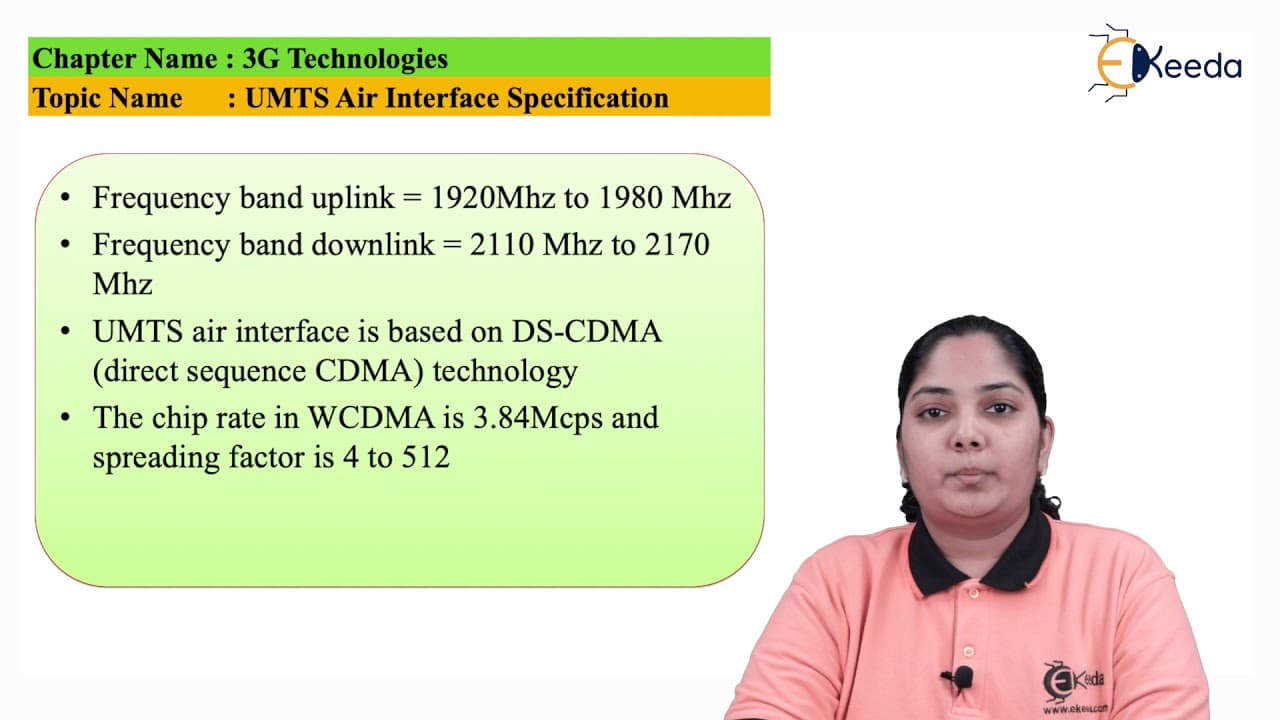
click the Bell icon to get latest videos from akira hello friends in this lecture we are going to study about the UMTS air interface specifications these are nothing but the details of the UMTS channel's bandwidth etc so let us see what are the UMTS air specifications the frequency band that has been used in the UMTS for the uplink is in the range ... Read More
Key Insights
- ♿ UMTS air interface specifications are based on direct sequence code division multiple access (DS-CDMA) modulation.
- 🤕 Frequency bands used for the uplink and downlink channels in UMTS are specific ranges.
- 🧑🏭 Spreading factors determine the extent of signal spreading in UMTS.
- 👱 UMTS air interface utilizes a wideband CDMA (WCDMA) technique.
- 🐿️ Chip rates of 3.8 mega chips per second are used in UMTS.
- ➗ UMTS air interface supports both time division duplexing (TDD) and frequency division duplexing (FDD) techniques.
- ✖️ UMTS air interface allows for multi-rate and multi-service capabilities.
Install to Summarize YouTube Videos and Get Transcripts
Explore YouTube Video Summarizer or Get YouTube Transcript Extractor
Questions & Answers
Q: What is the frequency range used for the uplink and downlink channels in UMTS?
The frequency band for the uplink in UMTS is between 1920 MHz and 1980 MHz, while the downlink uses the range of 2110 MHz to 2170 MHz.
Q: How does the UMTS air interface spread the user data?
The UMTS air interface uses direct sequence spread spectrum modulation, where the user data is multiplied by a spreading sequence, known as a PN sequence. This multiplication spreads the signal in the frequency spectrum.
Q: What is the spreading factor in UMTS?
The spreading factor is a parameter that determines the extent of signal spreading in the frequency. It is the ratio of the new signal bandwidth to the original signal bandwidth. In UMTS, the spreading factor ranges from 4 to 512.
Q: What is the channel bandwidth for UMTS air interface?
The channel bandwidth for UMTS air interface is 5 MHz, which is significantly higher compared to previous generations like GSM and CDMA.
Summary & Key Takeaways
-
UMTS air interface specifications include specific frequency bands for uplink and downlink channels.
-
The UMTS air interface uses direct sequence code division multiple access (DS-CDMA) modulation, which spreads user data using a spreading sequence.
-
The spreading factor, chip rate, channel bandwidth, frame length, duplexing techniques, and service type are important parameters in UMTS air interface specifications.
Read in Other Languages (beta)
Share This Summary 📚
Summarize YouTube Videos and Get Video Transcripts with 1-Click
Try YouTube Summary with ChatGPT & Claude or YouTube Transcript Generator
Explore More Summaries from Ekeeda 📚






Summarize YouTube Videos and Get Video Transcripts with 1-Click
Try YouTube Summary with ChatGPT & Claude or YouTube Transcript Generator