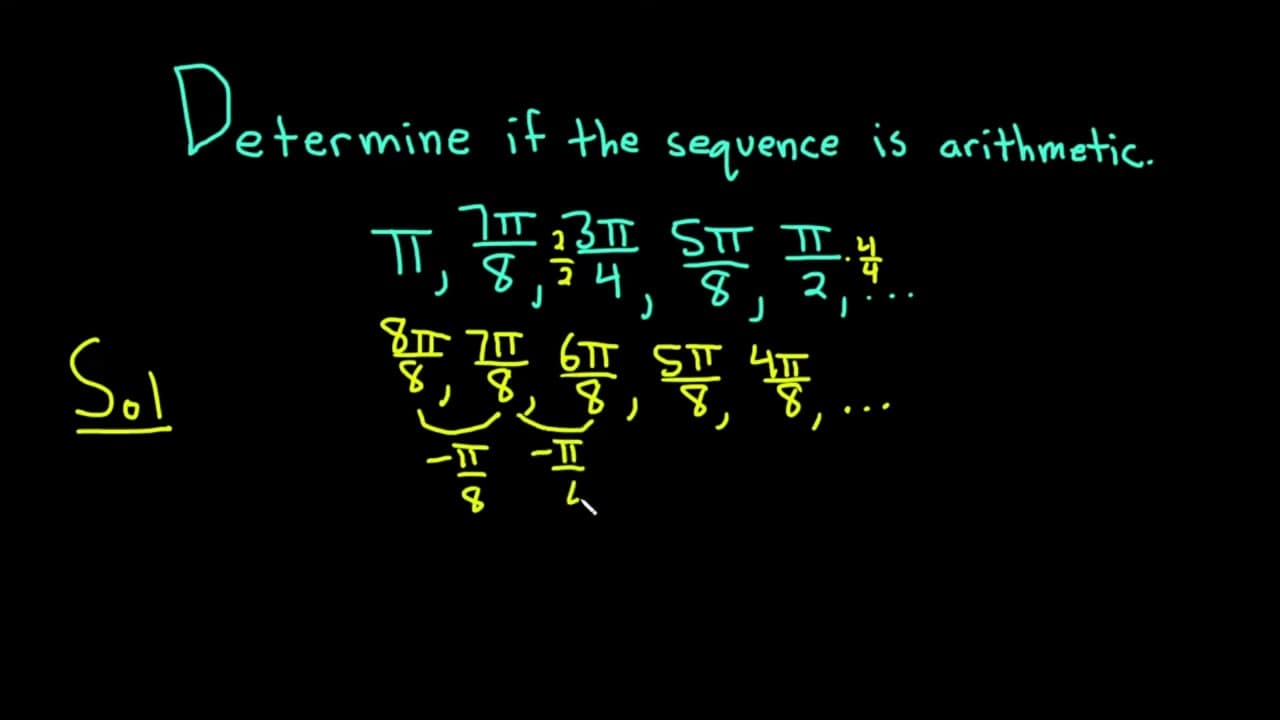
Determine if the Sequence is Arithmetic: pi, 7pi/8, 3pi/4, 5pi/8, pi/2, ...
TL;DR
This video explains how to determine if a sequence is arithmetic by analyzing the pattern and common difference.
Transcript
hello in this video we're going to do a math problem involving what's called an arithmetic sequence an arithmetic sequence is a sequence in which each term except the first term can be obtained by adding a number over and over so for example if you add a number to Pi you should get to 7 pi over 8 and if you add that same number to 7 pi over 8 you s... Read More
Key Insights
- 🍉 Arithmetic sequences involve adding or subtracting a constant value to reach the next term.
- 🆘 Analyzing the pattern and common difference helps determine if a sequence is arithmetic.
- 💄 Rewriting the sequence in a common denominator makes it easier to identify the common difference.
- ⚧️ The common difference is denoted by the symbol "d" and is constant throughout the sequence.
- 🈸 Arithmetic sequences are commonly used in math and have various applications.
- 🆘 Understanding arithmetic sequences helps in solving math problems and identifying numerical patterns.
- 😥 It is essential to consider the starting point in arithmetic sequences to accurately determine the common difference.
Install to Summarize YouTube Videos and Get Transcripts
Explore YouTube Video Summarizer or Get YouTube Transcript Extractor
Questions & Answers
Q: What is an arithmetic sequence?
An arithmetic sequence is a sequence where each term (except the first term) can be obtained by repeatedly adding the same number, called the common difference.
Q: How do you determine if a sequence is arithmetic?
To determine if a sequence is arithmetic, analyze the pattern and check if there is a consistent difference between consecutive terms. If the difference is constant, it is an arithmetic sequence.
Q: How can rewriting the sequence help determine if it is arithmetic?
Rewriting the sequence in terms of a common denominator helps identify the pattern more clearly. If the terms can be obtained by adding or subtracting the same fraction, then it is an arithmetic sequence.
Q: What is the common difference in an arithmetic sequence?
The common difference in an arithmetic sequence is the value that is added or subtracted repeatedly to reach the next term. It is denoted by the symbol "d" and is constant throughout the sequence.
Summary & Key Takeaways
-
An arithmetic sequence is a sequence where each term (except the first term) can be obtained by repeatedly adding the same number.
-
To determine if a sequence is arithmetic, analyze the pattern and check if there is a common difference between terms.
-
By rewriting the sequence in terms of a common denominator, it becomes more evident if the same number is being added or subtracted to reach the next term.
Read in Other Languages (beta)
Share This Summary 📚
Summarize YouTube Videos and Get Video Transcripts with 1-Click
Try YouTube Summary with ChatGPT & Claude or YouTube Transcript Generator
Explore More Summaries from The Math Sorcerer 📚



Summarize YouTube Videos and Get Video Transcripts with 1-Click
Try YouTube Summary with ChatGPT & Claude or YouTube Transcript Generator