Long term supply curve and economic profit | Microeconomics | Khan Academy
TL;DR
Changes in supply and demand curves in the orange juice market affect equilibrium price and quantity in the short and long term.
Transcript
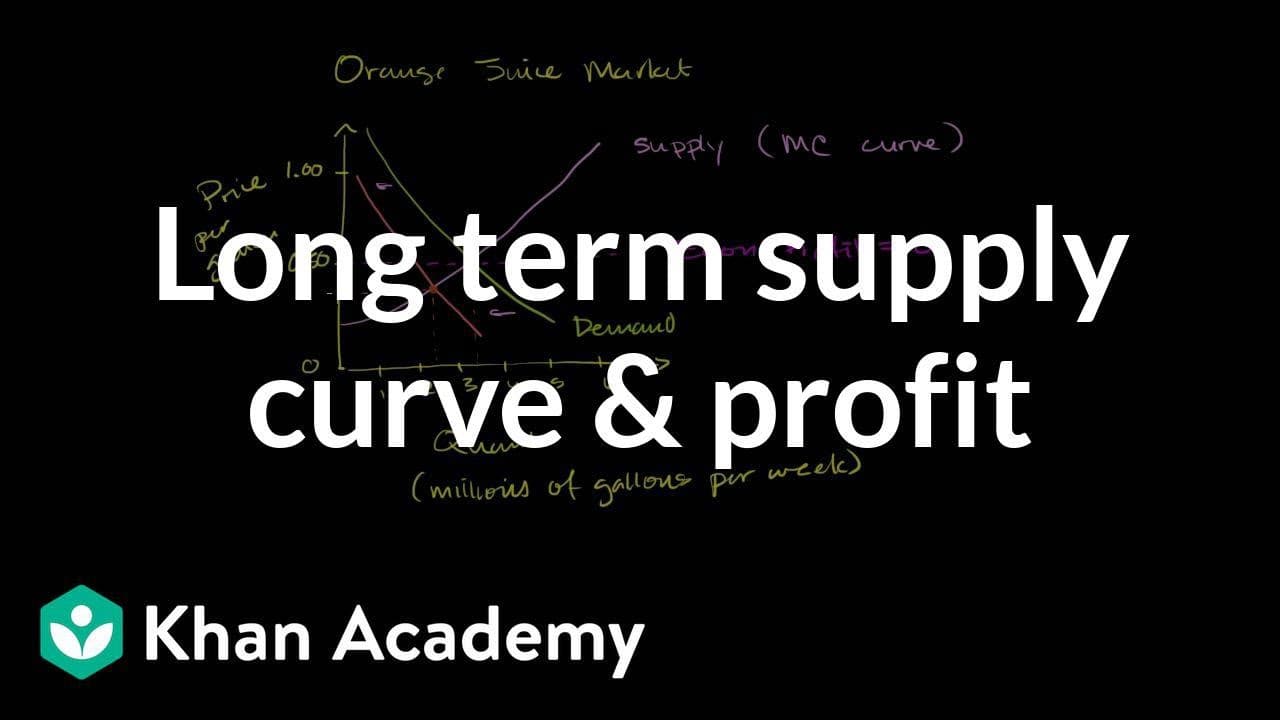
Voiceover: We've now thought a lot about the orange juice market, at least at a firm-specific level within the last few videos. We talked about what our average total costs and average variable costs and marginal costs are, if we are running an orange juice making business. Now let's think about what happens at the market level. We're going to go b... Read More
Key Insights
- 🧡 Supply and demand curves determine the equilibrium price and quantity in the orange juice market.
- 🥺 Negative news decreases demand and leads to lower prices and quantities, while positive news increases demand and leads to higher prices and quantities.
- 👨💼 In the short term, economic profits or losses determine whether businesses continue or shut down.
Install to Summarize YouTube Videos and Get Transcripts
Explore YouTube Video Summarizer or Get YouTube Transcript Extractor
Questions & Answers
Q: How do supply and demand curves impact the orange juice market?
Supply and demand curves determine the equilibrium price and quantity of orange juice. Changes in either curve, due to factors such as changes in production costs or consumer preferences, will lead to shifts and adjustments in price and quantity.
Q: How does negative news about oranges affect the orange juice market?
Negative news that suggests oranges are bad for health will decrease demand for orange juice. This will result in a new, lower equilibrium price and quantity in the short term, as producers face economic losses and some businesses shut down.
Q: What happens if positive news about oranges is reported?
Positive news about oranges, such as claims of health benefits, will increase demand for orange juice. In the short term, this will lead to a new, higher equilibrium price and quantity as producers experience positive economic profits and more businesses enter the market.
Q: How does the market adjust in the long term?
In the long term, the market adjusts to the price at which economic profit is zero. If the market is experiencing economic profit, more businesses will enter, increasing supply and lowering prices. Conversely, if there is economic loss, businesses will exit, reducing supply and increasing prices until reaching the long run equilibrium.
Summary & Key Takeaways
-
The orange juice market is analyzed using supply and demand curves to determine equilibrium price and quantity.
-
Changes in demand, such as negative or positive news about oranges, lead to shifts in the demand curve and corresponding adjustments in price and quantity.
-
In the short term, prices below the equilibrium level result in economic losses and business shutdowns, while in the long term, prices adjust to allow for neutral economic profit.
Read in Other Languages (beta)
Share This Summary 📚
Summarize YouTube Videos and Get Video Transcripts with 1-Click
Try YouTube Summary with ChatGPT & Claude or YouTube Transcript Generator
Explore More Summaries from Khan Academy 📚



Summarize YouTube Videos and Get Video Transcripts with 1-Click
Try YouTube Summary with ChatGPT & Claude or YouTube Transcript Generator