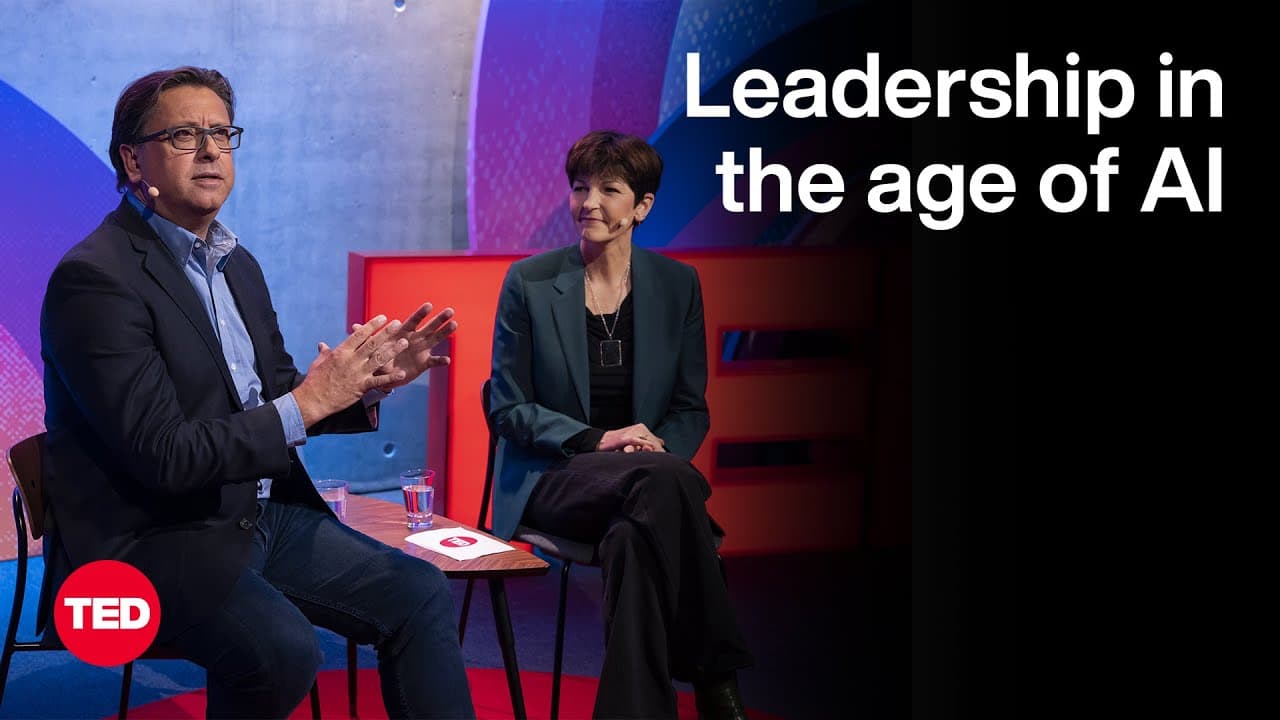
Leadership in the Age of AI | Paul Hudson and Lindsay Levin | TED
TL;DR
The CEO of Sanofi discusses the company's approach to using AI at scale and the importance of embracing AI to stay competitive in the fourth industrial revolution.
Transcript
Lindsay Levin: So we're living in an era with multiple overlapping disruptions that business is facing, and I want to dive straight in and talk about one of the biggest of those, which is AI. How are you approaching AI? Paul Hudson: You know, AI at scale, it's a whole big subject, of course, but for us, at Sanofi, we aim to be the world's leading p... Read More
Key Insights
- 👨💼 AI is a significant disruptor in business, and companies must embrace it to stay competitive in the fourth industrial revolution.
- 🥺 CEOs often face resistance and fear when it comes to adopting AI, but hesitation can lead to missed opportunities.
- 💦 Adopting AI is not about job loss but about creating more meaningful work and empowering employees with deeper insights.
- 😃 AI has the potential to address big social challenges, such as sustainability in healthcare, and requires collaboration and collective responsibility among companies.
- 🥺 Leading in the current era requires resiliency, agility, and openness to learning from experts within the organization.
- 🍂 CEOs are expected to step forward and help society navigate mega transitions, as policy often falls short.
- 🥹 Companies are being held to higher standards by employees, who want to see their values reflected in their workplace.
Install to Summarize YouTube Videos and Get Transcripts
Explore YouTube Video Summarizer or Get YouTube Transcript Extractor
Questions & Answers
Q: How does Sanofi plan to become the world's leading pharmaceutical company using AI?
Sanofi has 23,000 employees using AI on a regular basis, with 9,000 using it daily. The company aims to provide daily decision intelligence and empower employees to be more effective in their work.
Q: How do CEOs typically respond to conversations about AI?
Many CEOs are hesitant or even frightened when it comes to AI. Their first response is often focused on governance, controls, rules, and principles. However, hesitating or being fearful can lead to missed opportunities in the fourth industrial revolution.
Q: What mindset should people in the workforce adopt as AI becomes more prevalent?
The adoption of AI is not about job loss but about creating more meaningful work. People should focus on insights and action, allowing AI to enhance decision-making and provide an advantage over competitors.
Q: Where does the leadership for AI adoption come from in organizations?
Leadership for AI adoption can come from various sources. In Sanofi, the CEO, who has experienced different roles in the company, plays an active role in AI discussions. However, the younger generation, with their fresh insights and direct involvement, is also leading the way.
Key Insights:
- AI is a significant disruptor in business, and companies must embrace it to stay competitive in the fourth industrial revolution.
- CEOs often face resistance and fear when it comes to adopting AI, but hesitation can lead to missed opportunities.
- Adopting AI is not about job loss but about creating more meaningful work and empowering employees with deeper insights.
- AI has the potential to address big social challenges, such as sustainability in healthcare, and requires collaboration and collective responsibility among companies.
- Leading in the current era requires resiliency, agility, and openness to learning from experts within the organization.
- CEOs are expected to step forward and help society navigate mega transitions, as policy often falls short.
- Companies are being held to higher standards by employees, who want to see their values reflected in their workplace.
- AI, particularly large language models, has the potential to transform decision-making, improve efficiency, and create more meaningful work for employees.
Summary & Key Takeaways
-
Sanofi aims to be a leading pharmaceutical company using AI and has thousands of employees using AI on a daily or monthly basis.
-
The CEO highlights the resistance and fear CEOs face when it comes to adopting AI, emphasizing the need to embrace it to avoid missed opportunities.
-
The adoption of AI is not about job loss but about creating more meaningful work and providing deeper insights for better decision-making.
-
The CEO discusses the role of AI in addressing social challenges like sustainability in healthcare and the need for collaboration and shared responsibility among companies.
Read in Other Languages (beta)
Share This Summary 📚
Summarize YouTube Videos and Get Video Transcripts with 1-Click
Try YouTube Summary with ChatGPT & Claude or YouTube Transcript Generator
Explore More Summaries from TED 📚




Summarize YouTube Videos and Get Video Transcripts with 1-Click
Try YouTube Summary with ChatGPT & Claude or YouTube Transcript Generator