Analytical Modelling of Machining Operations - Metal Cutting Theory and Dynamometry
TL;DR
This video introduces the concept of analytical modeling in metal cutting, highlighting its importance in predicting performance and understanding the mechanics of the cutting process.
Transcript
hello students my name is santosh kumar and i am the course instructor for machining sciences and tool design we are in module number one that is metal cutting theory and dynamometry so in this video we will discuss topic analytical modeling of machining operation so that before 1940 there was no attempt made to do any modeling of machining operati... Read More
Key Insights
- 🤘 Before the development of analytical modeling, metal cutting relied solely on experimental results for performance evaluation.
- 🦾 Analytical modeling takes into account various parameters that influence cutting operations for a detailed understanding of the mechanics involved.
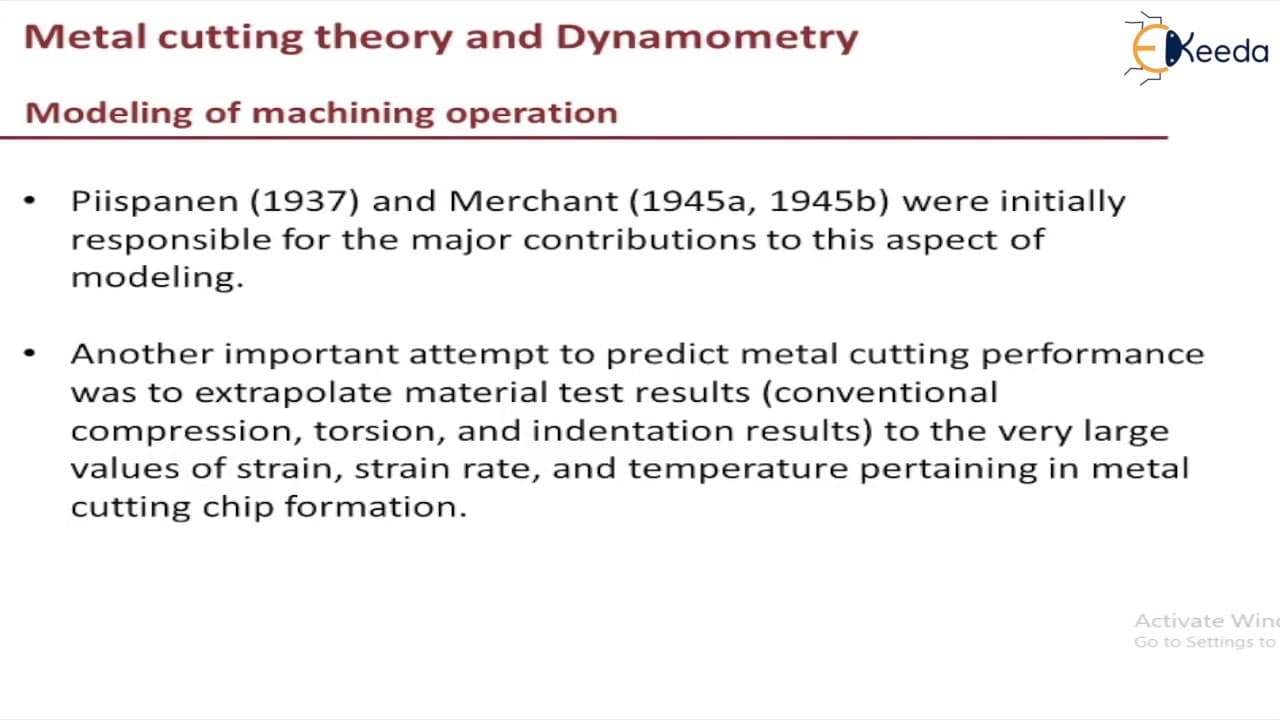
- 🤘 Prisman and Merchant made significant contributions to the development of analytical modeling in metal cutting.
- 🤘 Laboratory tests such as compression, torsion, and indentation were used to predict metal cutting performance.
- 😩 Analytical and numerical modeling methods are applied to study cutting forces, vibration, tool wear, residual stresses, and metallurgical changes.
- 😒 Analytical modeling uses physics-based models and mathematical equations to predict performance and cutting forces accurately.
- 🫥 Slip line field analysis is a commonly used analytical modeling method.
Install to Summarize YouTube Videos and Get Transcripts
Explore YouTube Video Summarizer or Get YouTube Transcript Extractor
Questions & Answers
Q: What was the traditional approach to judging the performance of metal cutting before analytical modeling?
The performance of metal cutting was judged solely based on experimental results, neglecting the detailed mechanics of the process.
Q: How did Prisman and Merchant contribute to the development of analytical modeling in machining?
Prisman and Merchant made significant contributions to the aspect of modeling in machining, taking into account the detailed mechanics of the cutting process.
Q: What is the difference between analytical modeling and numerical modeling in metal cutting?
Analytical modeling involves using physics-based analytical models to predict performance and understand the mechanics, while numerical modeling uses finite element methods to simulate the cutting process, but at a higher computational cost.
Q: How do mechanistic models in analytical modeling calculate cutting forces?
Mechanistic models in analytical modeling calculate cutting forces based on the chip instant area, cutting coefficients obtained empirically, and the type of mathematical equation used.
Summary & Key Takeaways
-
Before 1940, metal cutting operations relied solely on experimental results for performance evaluation.
-
Analytical modeling takes into account various parameters that influence the cutting operation, allowing for a detailed understanding of the mechanics involved.
-
Prisman and Merchant made significant contributions to the development of analytical modeling in machining.
Read in Other Languages (beta)
Share This Summary 📚
Summarize YouTube Videos and Get Video Transcripts with 1-Click
Try YouTube Summary with ChatGPT & Claude or YouTube Transcript Generator
Explore More Summaries from Ekeeda 📚






Summarize YouTube Videos and Get Video Transcripts with 1-Click
Try YouTube Summary with ChatGPT & Claude or YouTube Transcript Generator