71 DSML Advanced Time Series 2
TL;DR
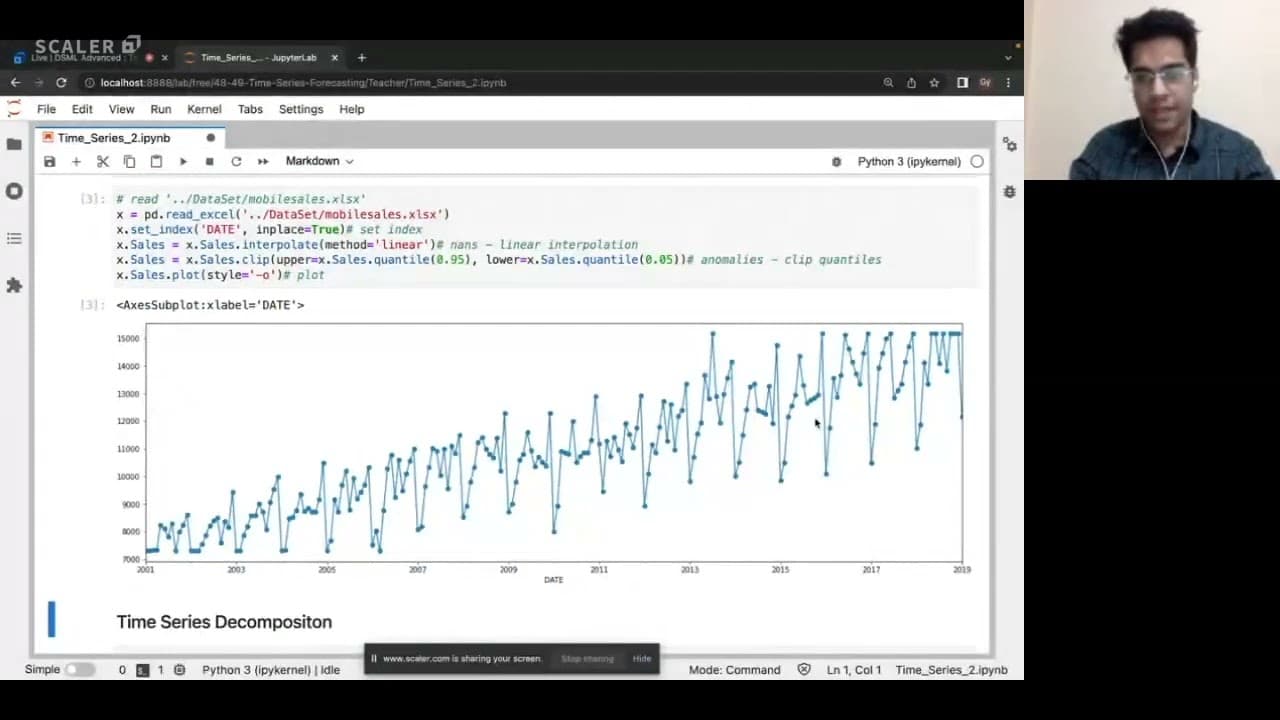
In this content, we will learn about different techniques and concepts for analyzing and forecasting time series data, including stationarity, autocorrelation, and performance metrics.
Transcript
foreign challenge foreign foreign hi everyone can you see my screen all right I think yeah it's been five minutes uh let me see hey Karthik Sumit Vishal dharendra uh nice to see you Karthik and Sumit Vishal welcome I'm not sure if you were there last time um all right how was your weekend mine was okay I hope you had a nice one okay good all right ... Read More
Key Insights
- 📊 The time series data used in the lecture is not stationary based on the Dickey-Fuller test, with a p-value of 0.97.
- 📈 Trend and seasonality can be further analyzed using the autocorrelation and partial autocorrelation plots.
- ⚙️ Differencing can be used to stationarize the time series by removing trend and seasonality.
- 🔍 Autocorrelation plots show the correlation between a time series and its lagged values, while partial autocorrelation plots show the correlation between a time series and its lagged values after removing the effect of intermediate lags.
- 📉 Various performance metrics can be used to evaluate forecast accuracy, including mean error (MAE), mean absolute error (MAE), mean absolute percentage error (MAPE), and mean squared error (MSE).
- 🔄 Different models, such as moving averages, can be used for forecasting, and their performance can be compared using the aforementioned metrics.
Install to Summarize YouTube Videos and Get Transcripts
Explore YouTube Video Summarizer or Get YouTube Transcript Extractor
Questions & Answers
Q: What is stationarity in time series analysis?
Stationarity in time series analysis refers to a series whose parameters (mean, variance, etc.) do not depend on time. It is important for many time series forecasting techniques.
Q: What is autocorrelation?
Autocorrelation measures the correlation between a time series and its lagged values, indicating the degree of similarity between a value and its historical values.
Q: How is partial autocorrelation different from autocorrelation?
While autocorrelation measures the correlation between a series and its lagged values, partial autocorrelation measures the correlation between a series and its specific lagged values after adjusting for the influence of other lagged values.
Q: What are some commonly used performance metrics for time series forecasting?
Some commonly used performance metrics are mean error, mean absolute error, mean absolute percentage error, and mean squared error. These metrics help evaluate the accuracy of forecasts by comparing the predicted values with the actual values.
Summary & Key Takeaways
-
Stationarity is an important concept in time series analysis, and a series is considered stationary if its parameters (mean, variance, etc.) do not depend on time.
-
Autocorrelation measures the correlation between a series and its lagged values, while partial autocorrelation measures the correlation only between a series and its specific lagged values.
-
Performance metrics such as mean error, mean absolute error, mean absolute percentage error, and mean squared error are commonly used to evaluate the accuracy of time series forecasts.
Read in Other Languages (beta)
Share This Summary 📚
Summarize YouTube Videos and Get Video Transcripts with 1-Click
Try YouTube Summary with ChatGPT & Claude or YouTube Transcript Generator
Explore More Summaries from sandeep sahani 📚
Summarize YouTube Videos and Get Video Transcripts with 1-Click
Try YouTube Summary with ChatGPT & Claude or YouTube Transcript Generator