63 DSML Advanced K Means Clustering
TL;DR
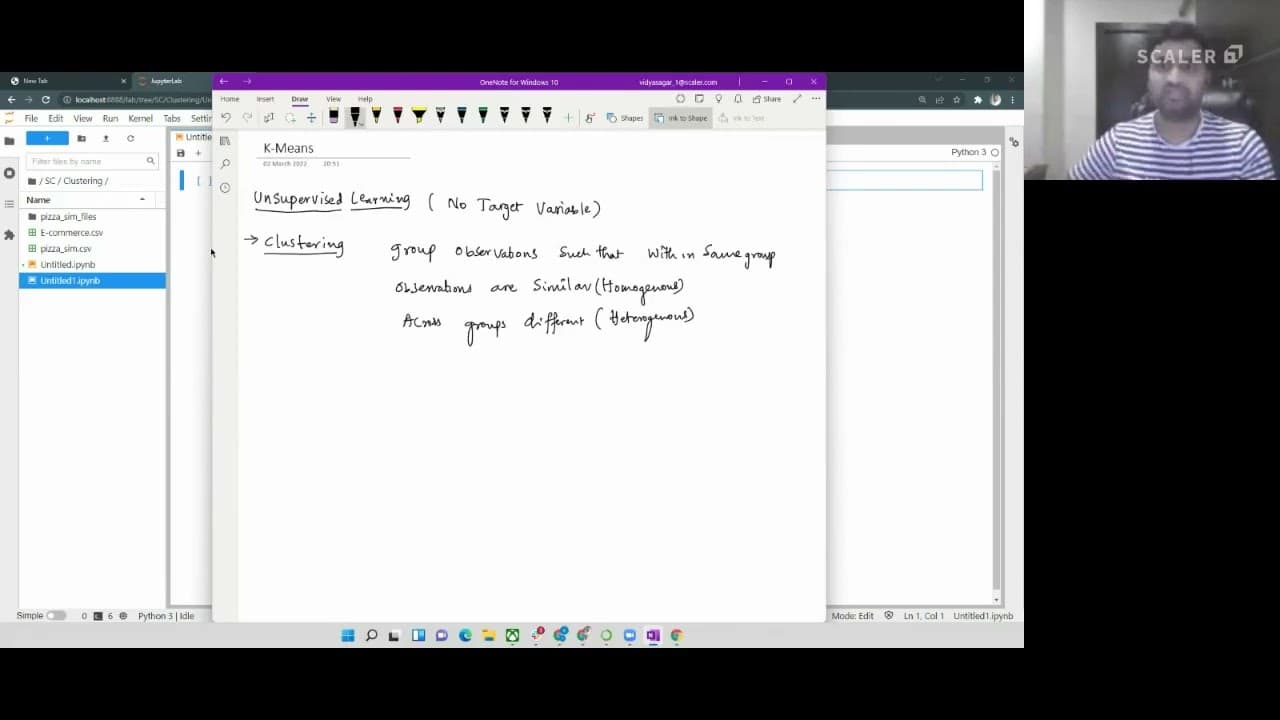
K-Means clustering is an unsupervised learning technique used for customer segmentation and grouping observations into similar clusters based on their features.
Transcript
technology hello good evening good evening everyone welcome back how was your day oh okay sure I'll check Abhijit was busy in the last couple of days I haven't got time stressed it's hectic yeah it is for all of us not only for you from E2 or maybe you got bored of saying the same boring face again again is it so let's wait a few minutes foreign wh... Read More
Key Insights
- 👌 K-Means clustering is a popular unsupervised learning technique used for customer segmentation and cluster analysis.
- 👥 Clustering is used to group observations into smaller subgroups based on their features or characteristics.
- 💯 The number of clusters in K-Means is determined using techniques like the elbow method or silhouette score.
- 👌 K-Means clustering can be used in various industries, such as marketing, customer analytics, and data mining.
- 🔶 K-Means clustering is computationally intensive, especially with larger datasets, but its simplicity and scalability make it useful for a wide range of applications.
- 💄 Clusters obtained from K-Means clustering can be interpreted and used for targeted marketing, personalized recommendations, and decision-making processes.
Install to Summarize YouTube Videos and Get Transcripts
Explore YouTube Video Summarizer or Get YouTube Transcript Extractor
Questions & Answers
Q: How does K-Means clustering work?
K-Means clustering starts by randomly selecting a number of cluster centers. It then iteratively assigns each observation to its closest cluster center and updates the cluster centers by calculating the mean of the assigned observations. This process is repeated until the cluster centers no longer change significantly.
Q: What is the objective of clustering?
The objective of clustering is to group observations into clusters such that observations within the same cluster are similar and observations in different clusters are different. This helps in identifying patterns, segments, or groups within the data.
Q: How can clustering be used in marketing?
Clustering is commonly used in marketing for customer segmentation. By clustering customers based on their characteristics, behavior, or demographics, companies can design targeted marketing strategies for each segment, offering products or services that cater to their specific needs and preferences.
Q: How is the number of clusters determined in K-Means clustering?
The number of clusters, known as K, is typically determined using techniques like the elbow method or silhouette score. These methods analyze the within-cluster sum of squares or the distances between data points and cluster centers to find a balance between cluster homogeneity and separation.
Q: What are the advantages of using K-Means clustering?
Some advantages of K-Means clustering include its simplicity, scalability to large datasets, and ability to handle continuous and numerical data. It also works well when the clusters are well separated and have a similar size.
Q: Can K-Means clustering handle categorical or text data?
K-Means clustering is primarily designed for numerical or continuous data. To apply it to categorical or text data, these features need to be transformed into numerical representations using techniques like one-hot encoding or word embeddings.
Key Insights:
- K-Means clustering is a popular unsupervised learning technique used for customer segmentation and cluster analysis.
- Clustering is used to group observations into smaller subgroups based on their features or characteristics.
- The number of clusters in K-Means is determined using techniques like the elbow method or silhouette score.
- K-Means clustering can be used in various industries, such as marketing, customer analytics, and data mining.
- K-Means clustering is computationally intensive, especially with larger datasets, but its simplicity and scalability make it useful for a wide range of applications.
- Clusters obtained from K-Means clustering can be interpreted and used for targeted marketing, personalized recommendations, and decision-making processes.
- K-Means plus plus initialization improves the convergence and stability of the clustering algorithm.
Summary & Key Takeaways
-
K-Means clustering is an unsupervised learning technique used to group observations into clusters based on similarity.
-
The objective is to divide observations into smaller subgroups so that observations within the same group are similar (homogeneous), while observations in different groups are different (heterogeneous).
-
Clustering is widely used in customer segmentation for marketing purposes to identify different groups of customers and tailor products and services to each group.
Read in Other Languages (beta)
Share This Summary 📚
Summarize YouTube Videos and Get Video Transcripts with 1-Click
Try YouTube Summary with ChatGPT & Claude or YouTube Transcript Generator
Explore More Summaries from sandeep sahani 📚
Summarize YouTube Videos and Get Video Transcripts with 1-Click
Try YouTube Summary with ChatGPT & Claude or YouTube Transcript Generator