Common Source FET Amplifier - Low Power Amplifiers - Applied Electronics
TL;DR
This video explains the working of a common source amplifier and the 180-degree phase shift between input and output signals.
Transcript
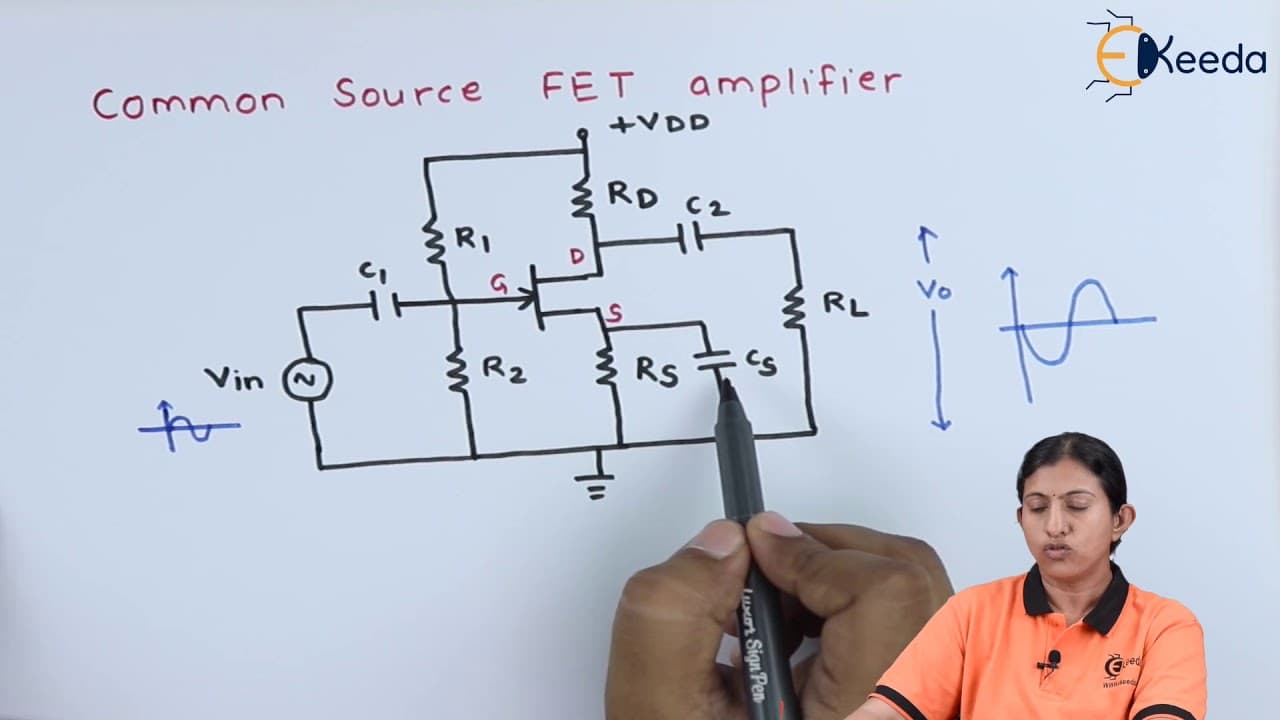
click the Bell icon to get latest videos from akira hello friends today we will discuss about the common source everyday amplifier and the phase shift between the input and the output signal here is the diagram of common source everyday amplifier we are using source terminal common we are using n-channel jfet t which is having terminal drain gate a... Read More
Key Insights
- ℹ️ The common source amplifier utilizes a source terminal as a common connection between input and output signals.
- ⚡ Voltage divider biasing is employed to bias the transistor in the active region for amplification.
- 💦 Capacitors C1 and C2 couple the input and output signals, while a bypass capacitor (C s) reduces voltage drop across the source resistor, increasing voltage gain.
- 🏍️ During the positive half cycle of the input signal, the output exhibits an amplified negative half, while during the negative half cycle, a positive output is obtained.
- 📡 The 180-degree phase shift between input and output signals is a characteristic of the common source amplifier.
- ℹ️ The source bypass capacitor (C s) bypasses source current to the ground, improving voltage gain.
- 💐 The operating current (ID or quiescent current) flows through the transistor even in the absence of an input signal.
Install to Summarize YouTube Videos and Get Transcripts
Explore YouTube Video Summarizer or Get YouTube Transcript Extractor
Questions & Answers
Q: What is the purpose of the source bypass capacitor (C s)?
The source bypass capacitor (C s) bypasses source current to the ground, reducing voltage drop across the source resistor and increasing voltage gain at the output.
Q: How does the common source amplifier exhibit a 180-degree phase shift?
During the positive half cycle of the input signal, the channel width of the JFET decreases, causing the output current to increase, resulting in an amplified negative half at the output. During the negative half cycle, the channel width increases, causing a positive output. This 180-degree phase shift is inherent to the amplifier design.
Q: What happens to the operating current in the absence of an input signal?
In the absence of an input signal, the operating current (ID or quiescent current) flows through the transistor due to voltage divider biasing. This ensures the transistor remains in the active region for amplification.
Q: How is the input signal applied to the common source amplifier?
The input signal is applied to the gate terminal of the JFET through a voltage divider biasing circuit consisting of resistors R1, R2, and Rs.
Summary & Key Takeaways
-
The common source amplifier uses a source terminal as a common connection between the input and output signals.
-
Voltage divider biasing is used to bias the transistor in the active region, allowing it to work as an amplifier.
-
Capacitors C1 and C2 are used to couple the input and output signals, while a bypass capacitor (C s) reduces voltage drop across the source resistor, increasing voltage gain.
Read in Other Languages (beta)
Share This Summary 📚
Summarize YouTube Videos and Get Video Transcripts with 1-Click
Try YouTube Summary with ChatGPT & Claude or YouTube Transcript Generator
Explore More Summaries from Ekeeda 📚




Summarize YouTube Videos and Get Video Transcripts with 1-Click
Try YouTube Summary with ChatGPT & Claude or YouTube Transcript Generator