Proving the SAS triangle congruence criterion using transformations | Geometry | Khan Academy
TL;DR
If two triangles have corresponding sides of equal length and corresponding angles of equal measure, they are congruent.
Transcript
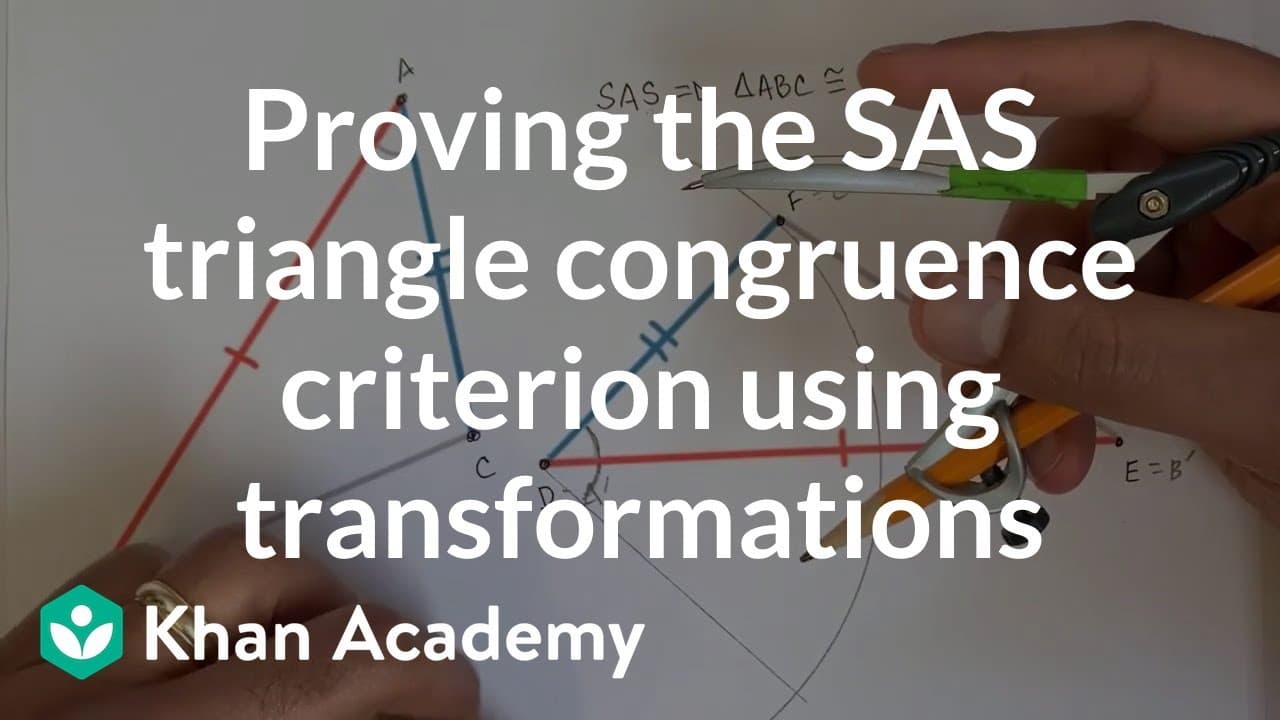
- [Instructor] What we're going to do in this video is see that if we have two different triangles, and we have two sets of corresponding sides that have the same length, for example this blue side has the same length as this blue side here, and this orange side has the same length side as this orange side here. And the angle that is formed between... Read More
Key Insights
- 👍 Congruence between triangles can be proved using the rigid motion definition of congruency.
- 🍁 Rigid transformations such as translation, rotation, and reflection can be used to map one triangle onto the other.
- 🔺 Side lengths and angle measures must be equal for two triangles to be congruent.
- 🧘 If the side lengths are equal but the angle is mapped to a different position, another rigid transformation can be applied to ensure congruency.
Install to Summarize YouTube Videos and Get Transcripts
Explore YouTube Video Summarizer or Get YouTube Transcript Extractor
Questions & Answers
Q: What is the rigid motion definition of congruency in geometry?
The rigid motion definition states that if two triangles have a side, angle, side in common, with the angle between the two sides, they are congruent.
Q: How can rigid transformations be used to prove congruence in triangles?
Rigid transformations such as translation, rotation, and reflection can be applied to one triangle to map it onto the other, preserving side lengths and angle measures. If this is possible, the triangles are congruent.
Q: What happens if the side lengths are equal, but the angle is mapped to a different position?
In such a case, another rigid transformation, such as a reflection, can be applied to correctly map the triangle. The angle measure will still be preserved, ensuring congruence.
Q: How do we know if two triangles are congruent based on the SAS criteria?
If two triangles have a side, angle, side in common, and the included angle is between the two sides, then the triangles are congruent. The angles and side lengths must be equal.
Summary & Key Takeaways
-
If two triangles have corresponding sides with the same length and corresponding angles with equal measure, they are congruent.
-
The rigid motion definition of congruency states that if a side, angle, side is common between two triangles, they are congruent.
-
Rigid transformations such as translation, rotation, and reflection can be used to map one triangle onto the other, confirming their congruency.
Read in Other Languages (beta)
Share This Summary 📚
Summarize YouTube Videos and Get Video Transcripts with 1-Click
Try YouTube Summary with ChatGPT & Claude or YouTube Transcript Generator
Explore More Summaries from Khan Academy 📚



Summarize YouTube Videos and Get Video Transcripts with 1-Click
Try YouTube Summary with ChatGPT & Claude or YouTube Transcript Generator