Example 2: Using the quadratic formula | Quadratic equations | Algebra I | Khan Academy
TL;DR
Learn how to solve a quadratic equation using the quadratic formula and find the solutions by evaluating the formula.
Transcript
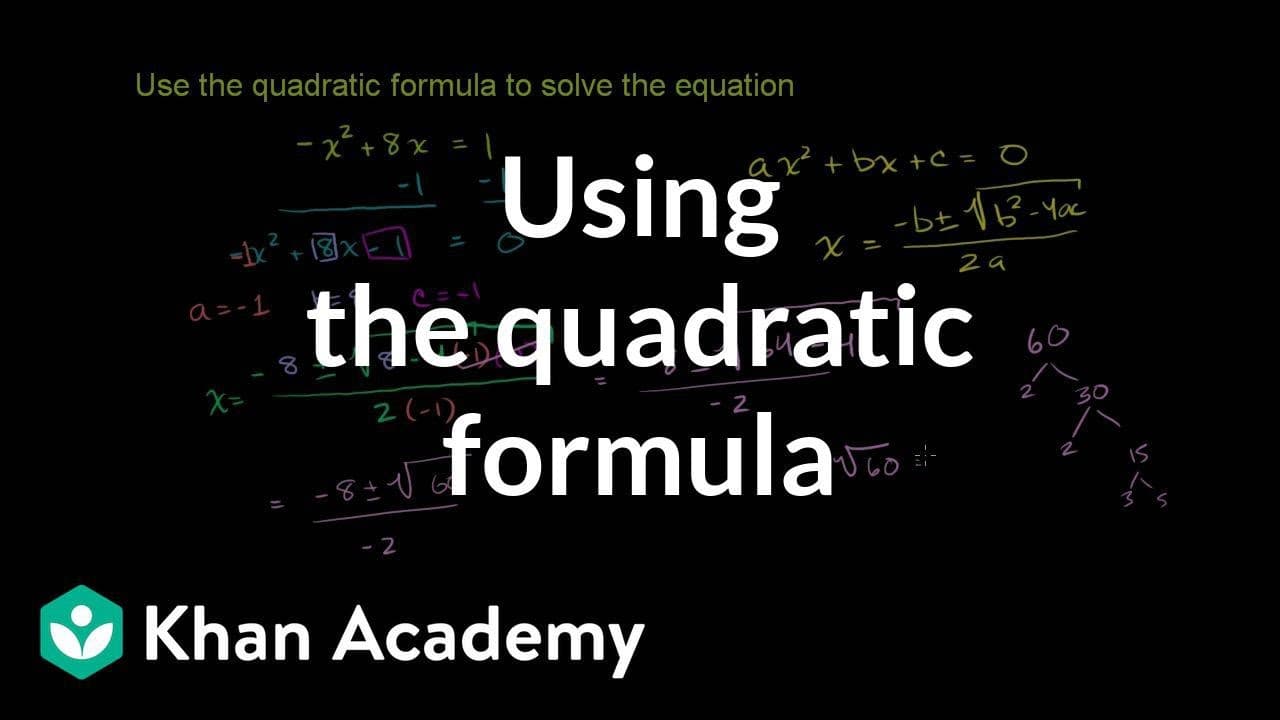
Use the quadratic formula to solve the equation, negative x squared plus 8x is equal to 1. Now, in order to really use the quadratic equation, or to figure out what our a's, b's and c's are, we have to have our equation in the form, ax squared plus bx plus c is equal to 0. And then, if we know our a's, b's, and c's, we will say that the solutions t... Read More
Key Insights
- 😃 Quadratic equations can be solved using the quadratic formula, which provides the solutions in terms of a, b, and c.
- ❎ The quadratic formula is derived from completing the square and can always be applied to any quadratic equation.
- 🥺 The discriminant, b^2 - 4ac, determines the nature of the solutions, with positive values resulting in real solutions, zero indicating one real solution, and negative values leading to complex or imaginary solutions.
- 😃 Substituting the values of a, b, and c into the quadratic formula allows for the calculation of the solutions.
- ❓ The quadratic formula guarantees the correct solutions to quadratic equations, even when factoring is challenging or not possible.
- 😑 Solutions to quadratic equations can be expressed as two separate values, x = (-b + sqrt(b^2 - 4ac)) / 2a and x = (-b - sqrt(b^2 - 4ac)) / 2a, where the +/- represents the plus or minus options.
- ⬛ Simplifying radical expressions, such as the square root of 60, involves finding the largest perfect square that divides evenly into the given number.
- 💁 Division and simplification can be applied to both the numerator and the denominator of the solutions to obtain simplified forms.
Install to Summarize YouTube Videos and Get Transcripts
Explore YouTube Video Summarizer or Get YouTube Transcript Extractor
Questions & Answers
Q: What is the purpose of using the quadratic formula to solve quadratic equations?
The quadratic formula provides a systematic and foolproof method for finding the solutions to any quadratic equation, even in cases where factoring is not possible. It guarantees accurate results and is widely used in algebraic calculations.
Q: How do you identify the values of a, b, and c in a quadratic equation?
In a quadratic equation in the form ax^2 + bx + c = 0, "a" represents the coefficient of x^2, "b" represents the coefficient of x, and "c" represents the constant term.
Q: What are the conditions for the quadratic formula to be applicable?
The quadratic formula can be used when the equation is in the form ax^2 + bx + c = 0, with a not equal to 0. If a is 0, the equation becomes linear, and the quadratic formula is not suitable.
Q: Can the quadratic formula provide complex or imaginary solutions?
Yes, the quadratic formula can yield complex or imaginary solutions if the discriminant, b^2 - 4ac, is negative. In such cases, the solutions will involve the square root of a negative number, resulting in complex numbers.
Summary & Key Takeaways
-
The quadratic formula can be used to solve quadratic equations in the form ax^2 + bx + c = 0.
-
By rearranging the equation and identifying the values of a, b, and c, the quadratic formula can be applied.
-
The formula states that the solutions to the equation are x = (-b +/- sqrt(b^2 - 4ac)) / 2a.
Read in Other Languages (beta)
Share This Summary 📚
Summarize YouTube Videos and Get Video Transcripts with 1-Click
Try YouTube Summary with ChatGPT & Claude or YouTube Transcript Generator
Explore More Summaries from Khan Academy 📚



Summarize YouTube Videos and Get Video Transcripts with 1-Click
Try YouTube Summary with ChatGPT & Claude or YouTube Transcript Generator