Linear Queue using Link List Part 3 | Stack and Queue | Data Structure Using C
TL;DR
This video explains how to implement a queue data structure using a linked list, focusing on the insert operation.
Transcript
hello dear students in this video let's continue implementing queue using link list in the previous video we saw what do you mean by declaring a node and how are you declaring a queue which contains two pointers front and rear now let's take a look at main from main we are going to call two major operations insert and delete of course there are mor... Read More
Key Insights
- 🫷 Stack and queue have different terminology for inserting and removing elements (push/pop for stack, enqueue/dequeue for queue).
- ❓ The front and rear pointers in the queue are initialized as null to indicate an empty queue.
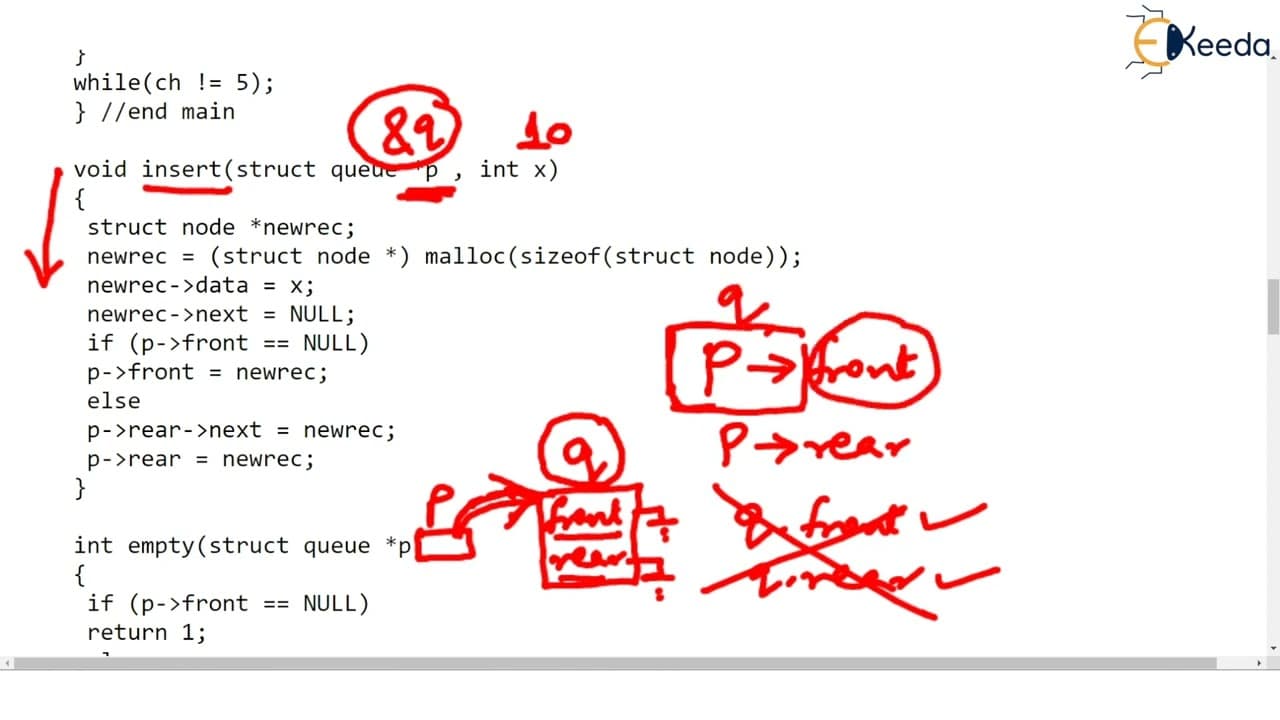
- 🧭 By passing the address of the queue, the insert function can modify the queue and reflect the changes in the main function.
- 👶 The insert function creates a new node, assigns the value, and updates the pointers to maintain the queue structure.
- 😥 The rear pointer always points to the last inserted node in the queue.
- 👂 Each node in the linked list contains data and a next pointer to the next node.
- ❓ The insert function can be used to insert multiple values into the queue.
Install to Summarize YouTube Videos and Get Transcripts
Explore YouTube Video Summarizer or Get YouTube Transcript Extractor
Questions & Answers
Q: What are the main operations performed on a queue?
The main operations performed on a queue are insert (enqueue) and delete (dequeue). In insert, a new element is added to the rear of the queue, while in delete, an element is removed from the front of the queue.
Q: How is a queue implemented using a linked list?
A queue can be implemented using a linked list where each node contains a data field and a next pointer. The front and rear pointers point to the first and last nodes, respectively, of the queue.
Q: Why do we pass the address of the queue to the insert function?
By passing the address of the queue, we can modify the queue in the insert function and reflect the changes in the main function. This allows us to insert elements into the actual queue.
Q: How does the insert function work step-by-step?
The insert function creates a new node, assigns the value to the data field, and updates the pointers. It checks if the front pointer is null, and if so, assigns it to the newly created node. Otherwise, it updates the next pointer of the last node to point to the newly created node and updates the rear pointer.
Summary & Key Takeaways
-
The video introduces the concept of a queue and explains the difference between inserting in a queue (enqueue) and inserting in a stack (push).
-
The main function calls the insert function, passing the address of the queue and the value to be inserted.
-
The insert function creates a new node, assigns the value to the data field, and updates the pointers(front and rear) to the newly inserted node.
-
The video demonstrates the process of inserting two values (10 and 20) into the queue.
Read in Other Languages (beta)
Share This Summary 📚
Summarize YouTube Videos and Get Video Transcripts with 1-Click
Try YouTube Summary with ChatGPT & Claude or YouTube Transcript Generator
Explore More Summaries from Ekeeda 📚






Summarize YouTube Videos and Get Video Transcripts with 1-Click
Try YouTube Summary with ChatGPT & Claude or YouTube Transcript Generator