Patterns in multiplication tables practice | Multiplication and division | 3rd grade | Khan Academy
TL;DR
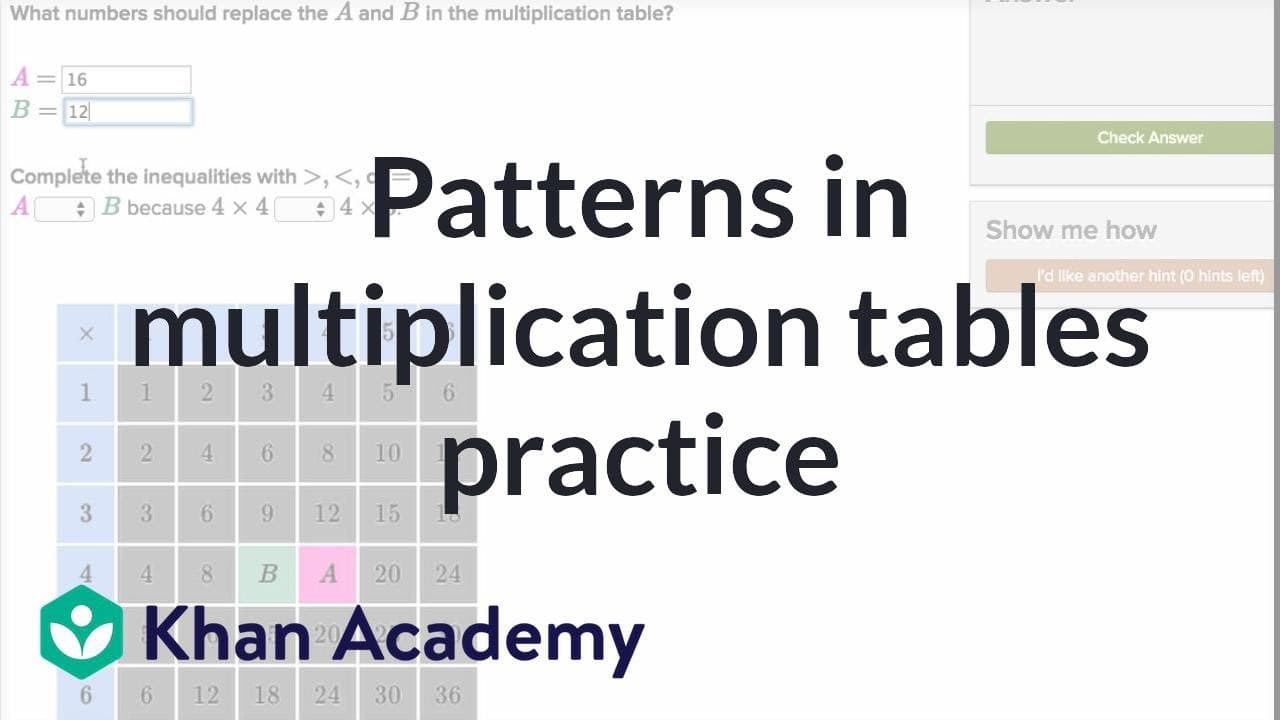
Learn how to read and interpret a multiplication table, determine the missing values, and understand the concept of A equaling B.
Transcript
- [Voiceover] We are asked, "What numbers should replace "the A and B in the multiplication table?" So let's just make sure we can read this multiplication table. The way you think about it is, if you wanted to figure out-- It goes up to six. So if you want to figure out what any number up to six times another number up to six is, this table will t... Read More
Key Insights
- 💨 Multiplication tables provide a quick and visual way to determine the products of two numbers.
- ✖️ The values in a multiplication table can be determined by either using multiplication or counting by the corresponding row or column headers.
- 🚰 A multiplication table can be used to understand the concept of A equaling B, where the product remains the same regardless of the order of multiplication.
Install to Summarize YouTube Videos and Get Transcripts
Explore YouTube Video Summarizer or Get YouTube Transcript Extractor
Questions & Answers
Q: How can a multiplication table be read?
A multiplication table can be read by looking at the intersecting row and column headers, representing the product of those numbers. For example, the intersecting point of row 3 and column 2 would give the product of 3 times 2.
Q: How can the missing values in a multiplication table be determined?
The missing values can be determined by either using multiplication to find the product of the corresponding row and column headers or counting by the values in the row or column. For example, to find the missing value in row 4 and column 4, one can calculate 4 times 4 or count by fours (4, 8, 12, 16) to find that the missing value is 16.
Q: What does it mean when A is equal to B in a multiplication table?
When A is equal to B in a multiplication table, it means that the product of A and B is the same regardless of the order of multiplication. For example, if A is 4 and B is 5, then 4 times 5 is equal to 5 times 4.
Q: How can the inequalities in a multiplication table be completed?
The inequalities in a multiplication table can be completed by determining which product is greater or less than the other. If A represents a larger product than B, the inequality symbol ">" can be used. If B represents a larger product than A, the inequality symbol "<" can be used. If A is equal to B, the equality symbol "=" can be used.
Summary & Key Takeaways
-
Multiplication tables are a visual representation of the multiplication operation, helping to determine the product of two numbers.
-
The numbers in each row and column of a multiplication table represent the multiplication of the corresponding row and column headers.
-
To determine the missing values in the multiplication table, one can either use multiplication or count by the corresponding row or column headers.
Read in Other Languages (beta)
Share This Summary 📚
Summarize YouTube Videos and Get Video Transcripts with 1-Click
Try YouTube Summary with ChatGPT & Claude or YouTube Transcript Generator
Explore More Summaries from Khan Academy 📚



Summarize YouTube Videos and Get Video Transcripts with 1-Click
Try YouTube Summary with ChatGPT & Claude or YouTube Transcript Generator