Gibbs free energy and spontaneous reactions | Biology | Khan Academy
TL;DR
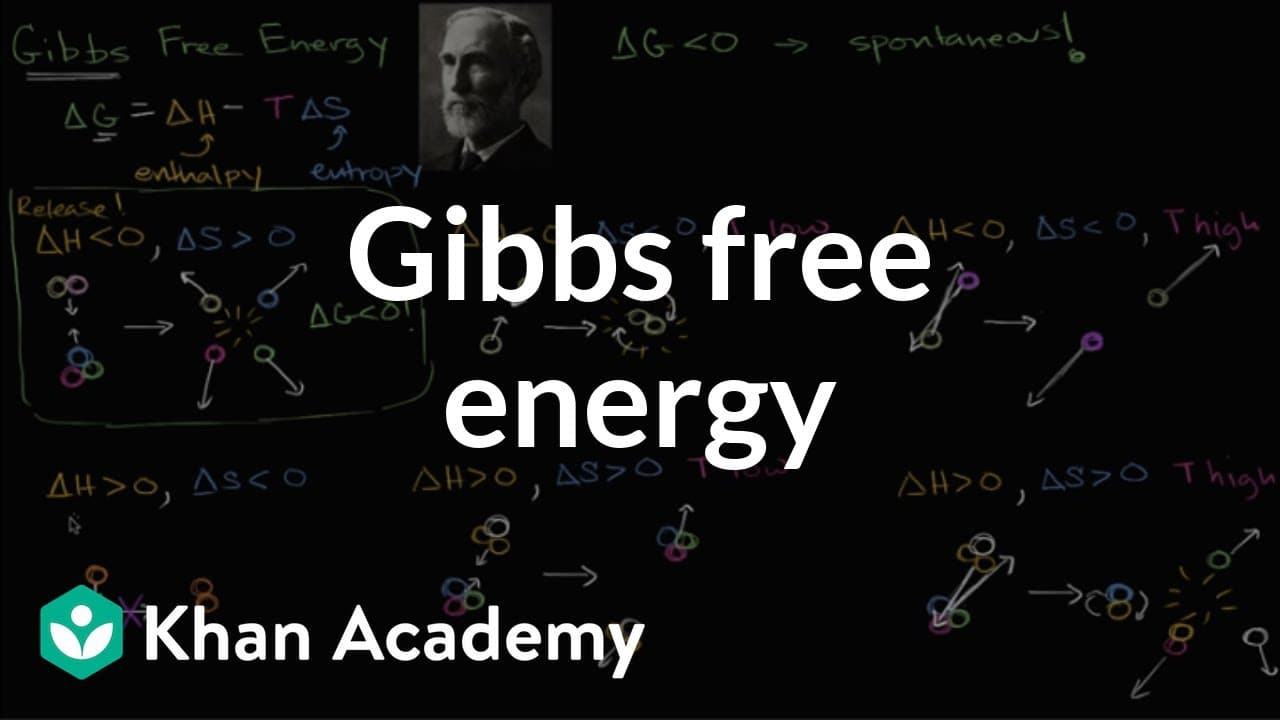
Gibbs Free Energy (Delta G) can determine whether a reaction will be spontaneous or not, with a negative Delta G indicating spontaneity.
Transcript
- [Voiceover] We're going to explore Gibbs Free Energy a little bit in this video. And, in particular, its usefulness in determining whether a reaction is going to be spontaneous or not, which is super useful in chemistry and biology. And, it was defined by Josiah Willard Gibbs. And, what we see here, we see this famous formula which is going to he... Read More
Key Insights
- 🔨 Gibbs Free Energy is a useful tool in chemistry and biology to predict the spontaneity of reactions.
- ♊ A negative Delta G indicates a spontaneous reaction, while a positive Delta G indicates a non-spontaneous reaction.
- 🥵 The formula considers the change in enthalpy (heat content) and entropy (disorder).
- 💱 At low temperatures, a negative change in enthalpy can overcome a negative change in entropy, resulting in spontaneity.
Install to Summarize YouTube Videos and Get Transcripts
Explore YouTube Video Summarizer or Get YouTube Transcript Extractor
Questions & Answers
Q: What is Gibbs Free Energy?
Gibbs Free Energy is a formula that helps determine the spontaneity of a reaction by considering the change in enthalpy and entropy.
Q: How can Delta G predict spontaneity?
If Delta G is less than zero, the reaction will be spontaneous. It indicates that the reaction will release energy and proceed without external intervention.
Q: Can a reaction be spontaneous even if Delta H is positive?
No, if Delta H is positive and entropy decreases, the reaction will require energy and will not be spontaneous. Delta G will be greater than zero in this case.
Q: How does temperature affect spontaneity?
Temperature plays a role in determining spontaneity. At low temperatures, a reaction may be spontaneous even if the change in entropy is negative, as the change in enthalpy dominates the equation.
Summary & Key Takeaways
-
Gibbs Free Energy (Delta G) is a formula that predicts the spontaneity of a reaction based on the change in enthalpy and entropy.
-
If Delta G is less than zero, the reaction will be spontaneous.
-
If Delta H is less than zero and entropy increases, the reaction will release energy and be spontaneous.
Read in Other Languages (beta)
Share This Summary 📚
Summarize YouTube Videos and Get Video Transcripts with 1-Click
Try YouTube Summary with ChatGPT & Claude or YouTube Transcript Generator
Explore More Summaries from Khan Academy 📚



Summarize YouTube Videos and Get Video Transcripts with 1-Click
Try YouTube Summary with ChatGPT & Claude or YouTube Transcript Generator