What Are Colon Polyps and Their Risks?
TL;DR
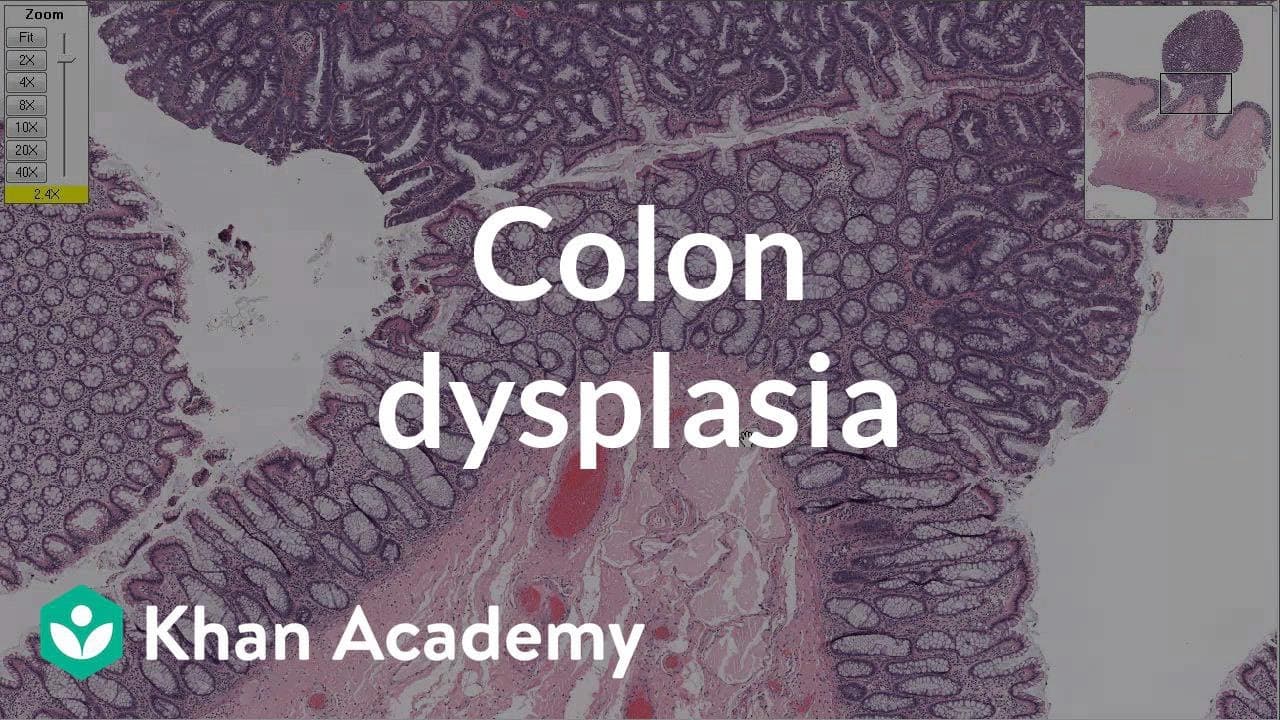
Colon polyps can progress from hyperplasia to dysplasia and neoplasia, which indicates an abnormal growth pattern. Dysplastic cells show irregularities and a lack of proper function, while neoplastic polyps grow independently and can lead to metastasis. Understanding these differences is crucial for assessing cancer risk.
Transcript
SAL: This is Sal, and I'm still at Stanford Medical School with Dr. Connolly. DOCTOR CONNOLLY: Sal, we're going to continue going. You going to get one unit of credit for today. SAL: Excellent. My mother would be proud. DOCTOR CONNOLLY: So what we're going to look at today is a colon polyp. We had said before polyp is something that's going to stic... Read More
Key Insights
- ❓ Polyps in the colon can progress from hyperplasia to dysplasia and eventually neoplasia.
- 🖤 Dysplastic cells in a polyp show abnormal growth patterns, with nuclei of different shapes and sizes, and a lack of commitment to specific functions.
- 💗 Neoplastic polyps grow autonomously and do not respond to neighboring cells, indicating a risk of metastasis.
- ♋ The boundary between dysplasia and normal tissue determines the invasion of cancer.
Install to Summarize YouTube Videos and Get Transcripts
Explore YouTube Video Summarizer or Get YouTube Transcript Extractor
Questions & Answers
Q: What is the difference between a polyp and irritation in the bowel?
Polyps protrude, while irritation affects a small patch. Polyps are abnormal growth, while irritation is a reaction to an irritant.
Q: Can a polyp develop into cancer?
Yes, a polyp can grow into cancer, which is why colon resections are performed when cancer is detected.
Q: How does dysplasia differ from hyperplasia?
Dysplasia is a type of abnormal growth, characterized by cells that are not committed to specific functions and have irregular nuclei. Hyperplasia, on the other hand, is reversible and does not show the same extent of abnormal growth.
Q: What is the significance of crossing the "line in the sand" in cancer?
Crossing the boundary between dysplasia and normal tissue indicates invasive cancer. Carcinoma in situ refers to cancer that has not yet invaded neighboring tissues but shows abnormal growth characteristics.
Summary & Key Takeaways
-
The video discusses the difference between a polyp and irritated bowel, emphasizing that a polyp protrudes while irritation affects a small patch.
-
Dysplasia is the term used to describe abnormal growth of cells in polyps, which do not adhere to normal structural patterns.
-
Neoplasia refers to a polyp that is growing autonomously, without responding to neighboring cells, and has the potential to metastasize.
Read in Other Languages (beta)
Share This Summary 📚
Summarize YouTube Videos and Get Video Transcripts with 1-Click
Try YouTube Summary with ChatGPT & Claude or YouTube Transcript Generator
Explore More Summaries from Khan Academy 📚



Summarize YouTube Videos and Get Video Transcripts with 1-Click
Try YouTube Summary with ChatGPT & Claude or YouTube Transcript Generator