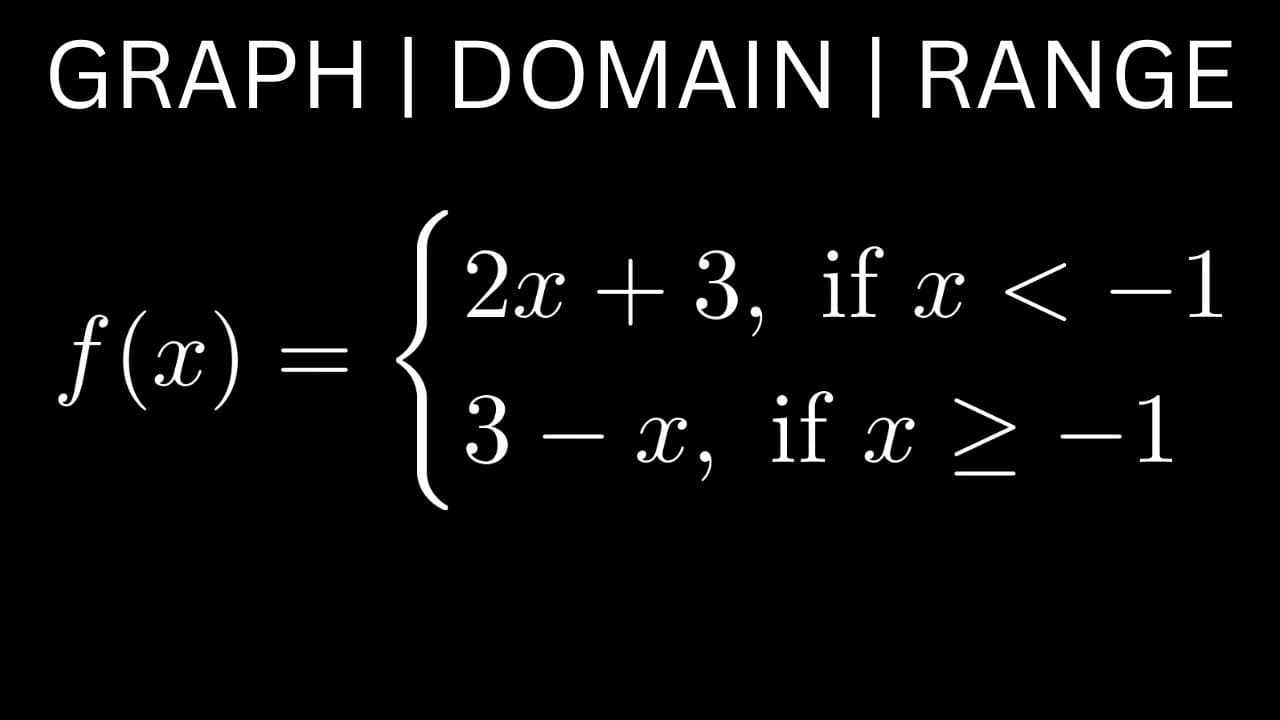
Graphing a Piecewise Function and Finding the Domain/Range || Example with Two Lines
TL;DR
Learn how to graph piecewise functions, find the domain and range, and interpret the graph.
Transcript
hello in this problem we have a piecewise function and we're going to graph it we're going to find the domain and we're going to find the range so I'm going to show you how I do it and hopefully it is helpful so solution so we'll start by drawing the y-axis and the x-axis so there's X there's y okay so just a rough sketch and let's start by graphin... Read More
Key Insights
- ☺️ Piecewise functions can have both holes and intercepts, which are identified by evaluating the function at specific x-values.
- 📈 Determining the slope of the function helps in accurately graphing it.
- ❣️ The x-intercept is found by setting the y-value equal to zero, and the y-intercept is found by setting the x-value equal to zero.
- ❣️ The domain of a piecewise function includes all possible x-values, while the range includes all possible y-values.
Install to Summarize YouTube Videos and Get Transcripts
Explore YouTube Video Summarizer or Get YouTube Transcript Extractor
Questions & Answers
Q: How do you determine if a point on the graph is a hole or an intercept?
To determine if a point is a hole, you need to evaluate the function at the x-coordinate of the hole. Using this x-value, substitute it into the function and find the corresponding y-value. If the strict inequality is involved, there will be a hole. If it is a point of intercept, simply substitute the x-coordinate into the function to find the y-value.
Q: How do you find the x-intercept of a piecewise function?
To find the x-intercept, set the y-value equal to zero and solve for the x-coordinate. This involves either setting the whole function equal to zero or writing an equation using just the relevant piece of the function and solving algebraically for x.
Q: How do you find the y-intercept of a piecewise function?
To find the y-intercept, set the x-coordinate to zero and evaluate the function to find the corresponding y-value. This represents the point where the graph intersects the y-axis.
Q: How do you determine the domain and range of a piecewise function?
The domain of a piecewise function is determined by the x-values that produce a valid output, or y-value. In other words, you consider every x-value in the function and find the corresponding y-value. The range of the function is all the possible y-values that can be obtained by evaluating the function for different x-values.
Summary & Key Takeaways
-
The content explains the process of graphing a piecewise function, demonstrating how to find holes and intercepts on the graph.
-
The video provides step-by-step instructions on how to determine the domain and range of the function.
-
The content emphasizes the importance of correctly evaluating the function and identifying strict inequalities for accurate graphing.
Read in Other Languages (beta)
Share This Summary 📚
Summarize YouTube Videos and Get Video Transcripts with 1-Click
Try YouTube Summary with ChatGPT & Claude or YouTube Transcript Generator
Explore More Summaries from The Math Sorcerer 📚


Summarize YouTube Videos and Get Video Transcripts with 1-Click
Try YouTube Summary with ChatGPT & Claude or YouTube Transcript Generator