2-dimensional momentum problem | Impacts and linear momentum | Physics | Khan Academy
TL;DR
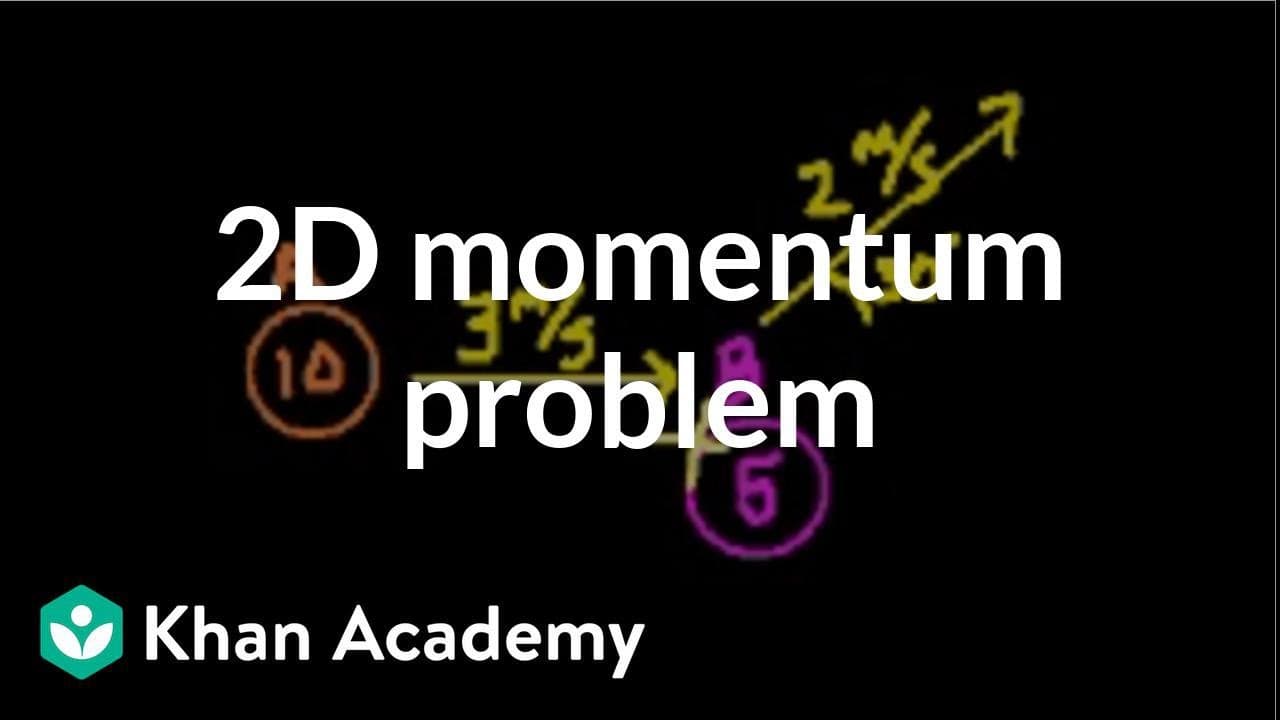
A ball A with a mass of 10kg and velocity of 3m/s collides with ball B, and after the collision, ball A moves in a new trajectory. The problem is to determine the velocity of ball B.
Transcript
Welcome back. We will now do a momentum problem in two dimensions. So let's see what we have here. So we have this ball A and we could maybe even think of it as maybe what's going on on the surface of a pool table. We have ball A and it's moving with its 10 kilograms. So these numbers are the mass of the balls. This is a 10 kilogram ball and it's m... Read More
Key Insights
- 💥 Momentum is conserved in both magnitude and direction in a collision.
- ❣️ Breaking down momentum into x and y components helps solve problems in multiple dimensions.
- ❣️ The x and y components of velocity can be found using trigonometry.
Install to Summarize YouTube Videos and Get Transcripts
Explore YouTube Video Summarizer or Get YouTube Transcript Extractor
Questions & Answers
Q: How do you determine the momentum in each direction in a two-dimensional collision?
In a two-dimensional collision, you break down the momentum into the x and y components. The initial momentum in each direction must be equal to the final momentum in each direction.
Q: What is the initial momentum of ball B in the x direction?
Since ball B has no initial velocity in the x direction, its momentum in the x direction is zero.
Q: How do you find the x and y components of ball A's velocity?
To find the x component, use the cosine of the angle between the x-axis and the velocity vector. To find the y component, use the sine of the angle.
Q: What is the velocity of ball B in the y direction after the collision?
The momentum of ball B in the y direction is 10 kg m/s. Dividing this by its mass of 5kg gives a velocity of 2 m/s.
Summary & Key Takeaways
-
Ball A with a mass of 10kg and velocity of 3m/s collides with ball B, which has a mass of 5kg.
-
After the collision, ball A moves at a 30-degree angle with a velocity of 2m/s.
-
The problem is to determine the velocity of ball B after the collision.
Read in Other Languages (beta)
Share This Summary 📚
Summarize YouTube Videos and Get Video Transcripts with 1-Click
Try YouTube Summary with ChatGPT & Claude or YouTube Transcript Generator
Explore More Summaries from Khan Academy 📚



Summarize YouTube Videos and Get Video Transcripts with 1-Click
Try YouTube Summary with ChatGPT & Claude or YouTube Transcript Generator