Tricky L'Hopital's Rule problem | Derivative applications | Differential Calculus | Khan Academy
TL;DR
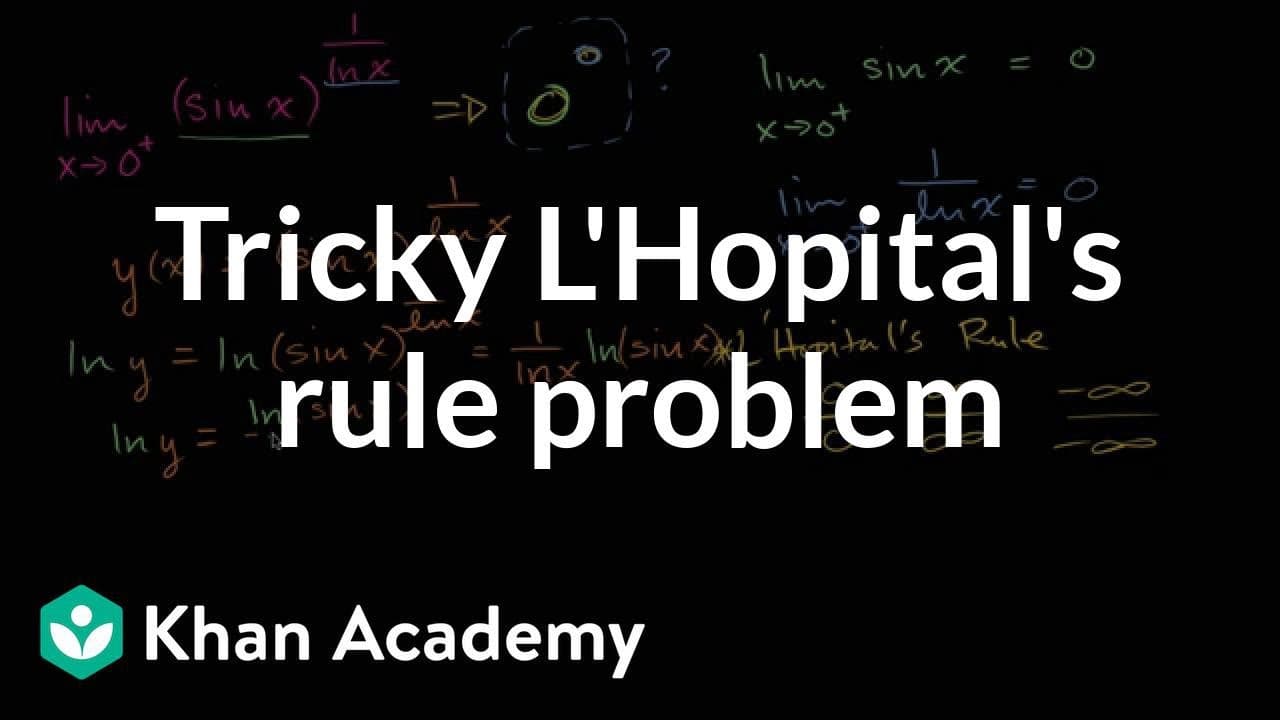
The limit of sine(X)^((1/ln(X))) as X approaches zero from the positive direction is equal to E.
Transcript
- [Voiceover] What I would like to tackle in this video is what I consider to be a particularly interesting limits problem. Let's say we want to figure out the limit as X approaches zero from the positive direction of sine of X. This is where it's about to get interesting. Sine of X to the one over the natural log of X power and I encourage you to ... Read More
Key Insights
- 0️⃣ The limit of sine(X) as X approaches zero from the positive direction is zero, while the limit of 1/ln(X) as X approaches zero from the negative direction is negative infinity.
- 🧑💻 By taking the natural log of both sides and applying L'Hopital's rule, we can find the limit of the natural log of Y as X approaches zero from the positive direction.
- 🇾🇪 The limit of the natural log of Y is found to be equal to one, indicating that Y must be approaching E.
- 📏 This analysis provides a fascinating example of how different functions and techniques, such as L'Hopital's rule, can be combined to solve complex limit problems.
- 😮 The involvement of E, the base of the natural logarithm, adds an element of surprise and interest to the problem.
- ⛔ The problem highlights the importance of considering domain restrictions and different approaches when evaluating limits.
- 🈸 The application of logarithmic properties and the recognition of patterns are crucial steps in solving the problem.
Install to Summarize YouTube Videos and Get Transcripts
Explore YouTube Video Summarizer or Get YouTube Transcript Extractor
Questions & Answers
Q: What is the limit of sine(X) as X approaches zero from the positive direction?
The limit of sine(X) as X approaches zero from the positive direction is zero. This is because sine(X) approaches zero when X approaches zero.
Q: Why do we have to approach the limit as X approaches zero from the positive direction?
We approach the limit from the positive direction because the natural logarithm is not defined for negative numbers. Therefore, it is not meaningful to evaluate the natural log of a negative number.
Q: How do we apply L'Hopital's rule to this problem?
Although L'Hopital's rule does not directly apply to the zero to the zero form that we encounter, we can construct a related problem where L'Hopital's rule does apply. By taking the natural log of both sides of the equation and finding the limit of the natural log of Y as X approaches zero from the positive direction, we can use L'Hopital's rule to solve for Y.
Q: What is the significance of the limit of the natural log of Y approaching one?
The natural log of Y approaching one implies that Y must be approaching the value of E, which is approximately 2.71828. This is a significant result as E is an important constant in mathematics and appears in various contexts.
Summary & Key Takeaways
-
The limit of sine(X) as X approaches zero from the positive direction is zero.
-
The limit of 1/ln(X) as X approaches zero from the negative direction is negative infinity.
-
Applying L'Hopital's rule by taking the natural log of both sides allows us to find the limit of the natural log of Y as X approaches zero from the positive direction, which is equal to one.
-
By solving for Y using the fact that the natural log of Y approaches one, we can determine that Y approaches E.
Read in Other Languages (beta)
Share This Summary 📚
Summarize YouTube Videos and Get Video Transcripts with 1-Click
Try YouTube Summary with ChatGPT & Claude or YouTube Transcript Generator
Explore More Summaries from Khan Academy 📚



Summarize YouTube Videos and Get Video Transcripts with 1-Click
Try YouTube Summary with ChatGPT & Claude or YouTube Transcript Generator