Laplace Transform of Periodic Signals | Laplace Transform | Signals and Systems Problem 6
TL;DR
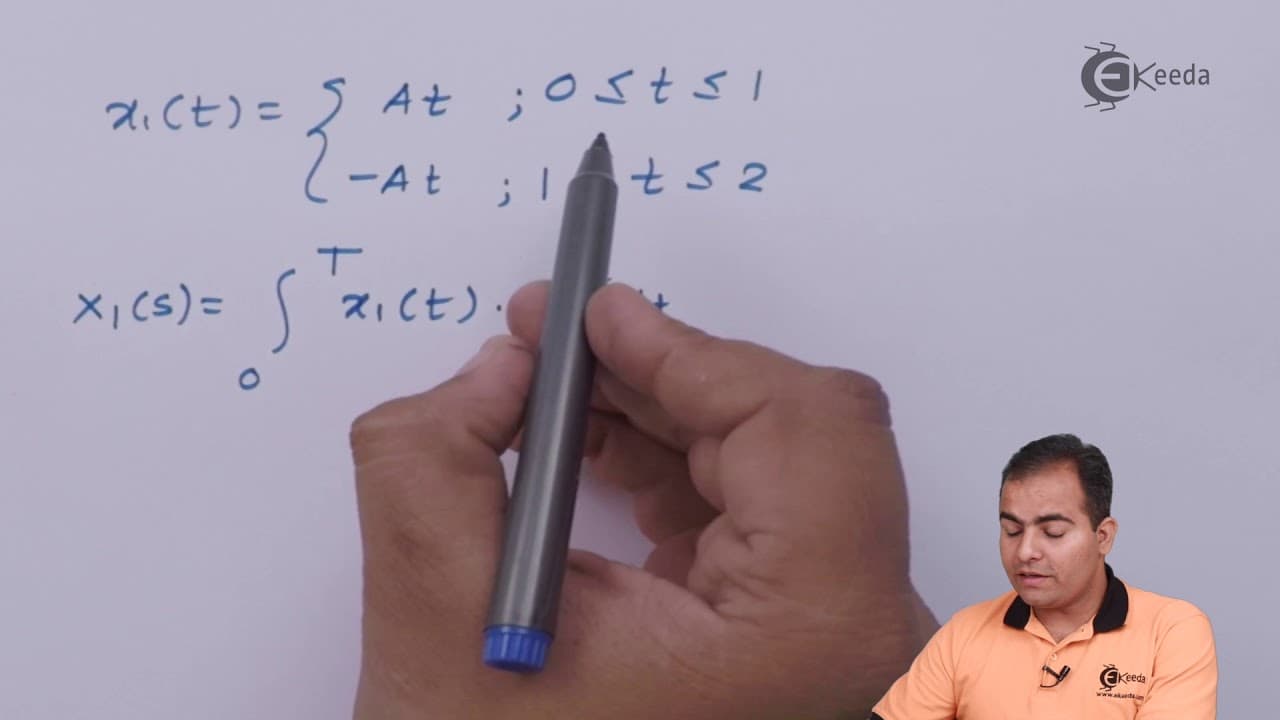
The video explains how to obtain the Laplace transform of a periodic function with alternating increasing and decreasing slopes.
Transcript
click the bell icon to get latest videos from akira hello friends in previous video we have studied a ramp and the slope of that ramp is decreasing now the net current in numerical is also depends on or you can say similar type of RAM phase but here we have increasing slope as well as decreasing slope and this sit repeat itself after a given time i... Read More
Key Insights
- ⌛ The video demonstrates how to calculate the slope values for a graph with alternating increasing and decreasing slopes in different time intervals.
- 📈 The time period of the graph is defined as the interval in which the graph repeats itself.
- 📈 The Laplace transform of the graph can be obtained by integrating the product of the graph and the exponential term.
- 🥳 The different amplitudes of the graph are handled by splitting the integration into separate parts for each amplitude range.
- 📈 Understanding the periodicity and amplitude variation of a graph is crucial in solving Laplace transform problems.
- ⌛ The formula for calculating the slope of a graph in a given time interval is (final amplitude - initial amplitude) / (final time - initial time).
- 🏑 The Laplace transform can simplify the analysis of periodic functions and is used in various fields, including engineering and physics.
Install to Summarize YouTube Videos and Get Transcripts
Explore YouTube Video Summarizer or Get YouTube Transcript Extractor
Questions & Answers
Q: How do you calculate the slope values for the graph in the given time intervals?
The slope value for each time interval can be calculated using the formula: slope = (final amplitude - initial amplitude) / (final time - initial time).
Q: What is the time period of the graph?
The graph repeats itself in intervals of 2 units, starting from 0 to 2, 2 to 4, 4 to 6, and so on.
Q: How do you calculate the Laplace transform of the graph?
By integrating the product of the graph and the exponential term, and applying the Laplace transform formula, the Laplace transform of the graph can be obtained.
Q: How do you handle the different amplitudes of the graph in the Laplace transform?
The Laplace transform calculation considers the different amplitudes by splitting the integration into separate parts for each amplitude range.
Summary & Key Takeaways
-
The video discusses the problem of obtaining the Laplace transform of a graph with alternating slopes.
-
The graph has an increasing slope from 0 to 1 and a decreasing slope from 1 to 2, which repeats in intervals.
-
The video explains how to calculate the slope values and derive the equation for the graph.
Read in Other Languages (beta)
Share This Summary 📚
Summarize YouTube Videos and Get Video Transcripts with 1-Click
Try YouTube Summary with ChatGPT & Claude or YouTube Transcript Generator
Explore More Summaries from Ekeeda 📚





Summarize YouTube Videos and Get Video Transcripts with 1-Click
Try YouTube Summary with ChatGPT & Claude or YouTube Transcript Generator