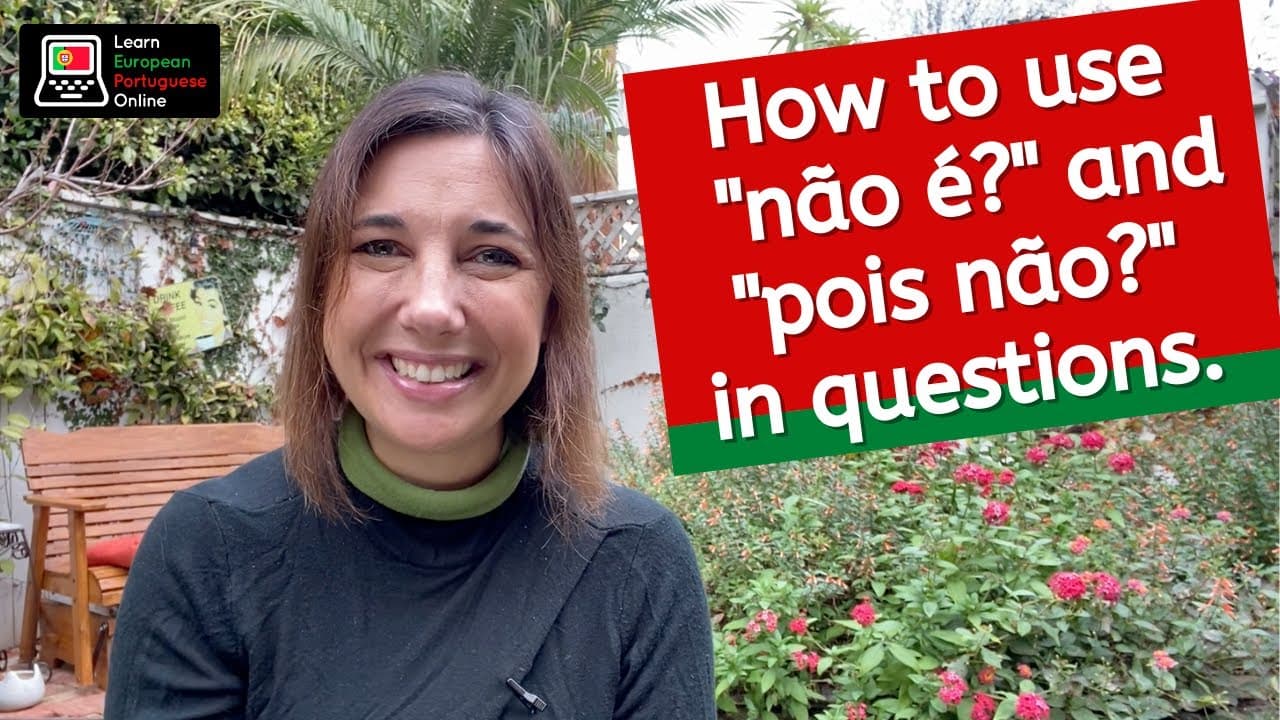
Question Tags in European Portuguese. Turn a Sentence into a Question!
TL;DR
Learn how to use question tags in European Portuguese.
Transcript
hola in this video i want to walk you through how to use tag questions in european portuguese we call these integrative confirmation a question tag is a small question at the end of a statement these are used when asking for agreement or confirmation it is so important to learn how to ask questions so you can feel more comfortable when speaking to ... Read More
Key Insights
- Question tags in European Portuguese are crucial for gaining confidence in conversations by seeking confirmation or agreement.
- The video emphasizes the importance of learning question tags to feel more comfortable while speaking European Portuguese.
- European Portuguese uses the same verb in question tags as in the statement, unlike English which often uses auxiliary verbs.
- Negative sentences in Portuguese use a double negative for question tags, making it simpler compared to English.
- Common question tags in Portuguese include 'não é' and 'pois não', applicable in various sentence types.
- Intonation plays a significant role in how question tags are perceived in European Portuguese.
- The video encourages viewers to practice writing sentences with question tags and share them for feedback.
- The content creator thanks patrons for their support and encourages advocacy for more subtitled European Portuguese content.
Install to Summarize YouTube Videos and Get Transcripts
Explore YouTube Video Summarizer or Get YouTube Transcript Extractor
Questions & Answers
Q: What are question tags in European Portuguese?
Question tags in European Portuguese are small questions added to the end of a statement to seek agreement or confirmation. They are essential for conversational fluency and differ from English in that they use the same verb from the initial sentence rather than auxiliary verbs.
Q: How do question tags differ between English and Portuguese?
In English, question tags often use auxiliary verbs like 'have' or 'be', whereas in Portuguese, the same verb from the statement is used. Additionally, Portuguese employs a double negative in negative sentences, simplifying the structure compared to English.
Q: What are some common question tags in Portuguese?
Common question tags in Portuguese include 'não é', which is versatile and easy for beginners, and 'pois não', which is used in negative contexts. These tags help in forming questions and seeking confirmation in conversations.
Q: Why is intonation important in using question tags?
Intonation is crucial when using question tags in European Portuguese as it affects how the question is perceived. Proper intonation ensures that the question tag conveys the intended meaning, whether seeking agreement or confirmation.
Q: How can learners practice using question tags?
Learners can practice using question tags by writing sentences and incorporating different question tags. Sharing these sentences for feedback, as encouraged in the video, helps in refining their understanding and application of question tags in conversations.
Q: What advocacy efforts are discussed in the video?
The video discusses efforts to advocate for more subtitled content in European Portuguese, highlighting the challenges learners face in finding such resources. The creator encourages viewers to join this advocacy to enhance language learning opportunities.
Q: How can viewers support the content creator?
Viewers can support the content creator by becoming patrons on Patreon, which helps in developing more educational content. Patrons gain access to exclusive videos and audios, contributing to the sustainability of the learning platform.
Q: What additional resources are offered in the video?
The video provides links to additional resources, including videos on asking questions in Portuguese and a template for advocating more subtitled content. These resources are designed to enhance the learning experience and provide practical tools for language practice.
Summary & Key Takeaways
-
The video teaches how to use question tags in European Portuguese to seek agreement or confirmation, highlighting their importance in building conversational confidence.
-
It explains the grammatical structure of question tags, noting that European Portuguese uses the same verb from the statement, differing from English.
-
The creator discusses efforts to advocate for more subtitled European Portuguese content and thanks patrons for their support.
Read in Other Languages (beta)
Share This Summary 📚
Summarize YouTube Videos and Get Video Transcripts with 1-Click
Try YouTube Summary with ChatGPT & Claude or YouTube Transcript Generator
Explore More Summaries from Learn European Portuguese Online 📚


Summarize YouTube Videos and Get Video Transcripts with 1-Click
Try YouTube Summary with ChatGPT & Claude or YouTube Transcript Generator