What Is Kepler's Third Law of Planetary Motion?
TL;DR
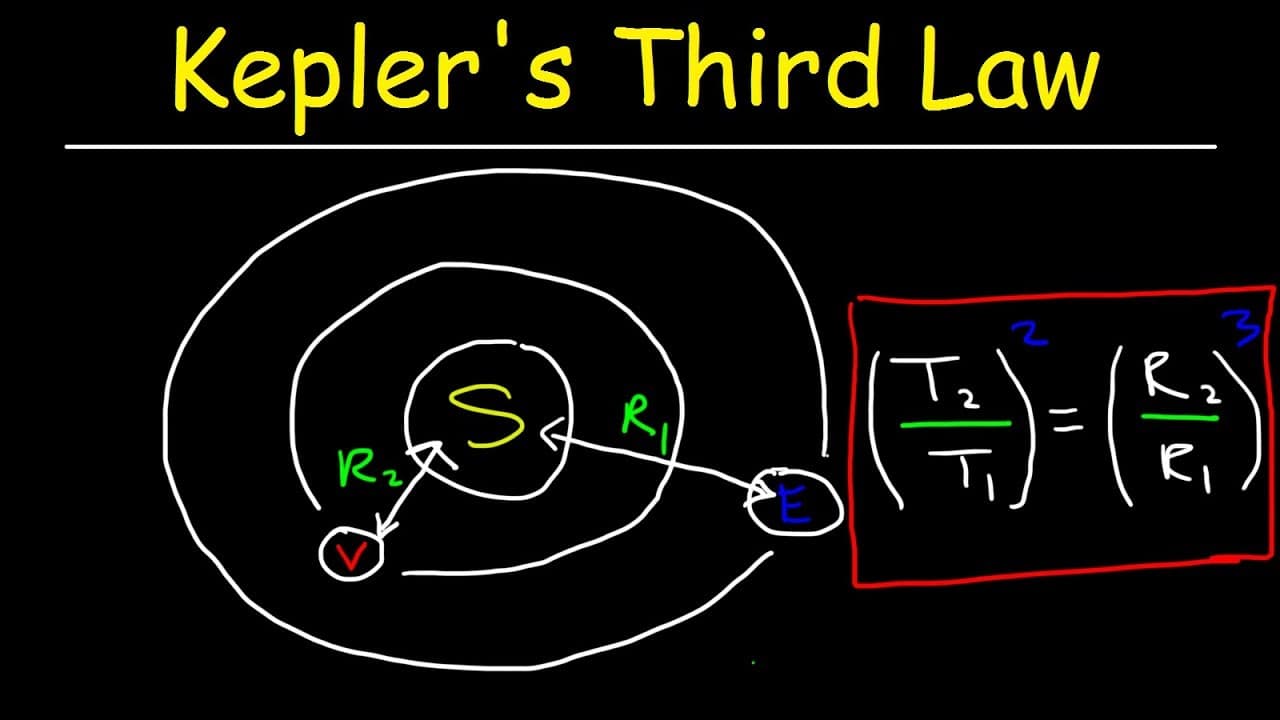
Kepler's Third Law states that the square of the orbital period of a planet is directly proportional to the cube of its mean distance from the Sun. This relationship can be expressed mathematically as T² ∝ R³. It allows for the calculation of planetary periods and distances, helping to understand the gravitational dynamics of the solar system.
Transcript
in this video we're gonna talk about Kepler's third law and the gist of his third law is that the ratio of the squares of the periods of any two planets revolving around the Sun is equal to the ratio of the cubes of their mean distances from the Sun so the ratio of the periods t1 over t2 and that is the square of those periods it's equivalent to th... Read More
Key Insights
- 👮 Kepler's third law relates the periods and distances of planets in their orbits around the Sun.
- 😫 The equation associated with Kepler's third law can be derived by setting gravitational force equal to centripetal force.
- 👮 Kepler's third law can be applied to solve practice problems and calculate unknown variables.
Install to Summarize YouTube Videos and Get Transcripts
Explore YouTube Video Summarizer or Get YouTube Transcript Extractor
Questions & Answers
Q: What is Kepler's third law and how is it derived?
Kepler's third law states that the ratio of the squares of the periods of two planets orbiting the Sun is equal to the ratio of the cubes of their mean distances from the Sun. It is derived by setting the gravitational force equal to the centripetal force.
Q: How can Kepler's third law be applied to solve practice problems?
Kepler's third law can be used to calculate the periods or distances of planets. By setting up the equation with known values, such as the mean distances between planets and the Sun, it is possible to solve for the unknown variables.
Q: What are some key concepts in orbital mechanics discussed in the video?
The video explains the relationship between the period and distance of planets in their orbits around the Sun. It also introduces the concept of centripetal force and the derivation of Kepler's third law using gravitational force.
Q: How can Kepler's third law be applied to different planets?
Kepler's third law is not specific to a particular planet and can be applied to any planet in the solar system. By using the respective distances and periods of different planets, the ratio of their squares and cubes can be calculated.
Summary & Key Takeaways
-
Kepler's third law states that the square of the period of a planet's orbit is proportional to the cube of its mean distance from the Sun.
-
The equation associated with Kepler's third law is derived by setting the gravitational force equal to the centripetal force of a planet orbiting the Sun.
-
Practice problems can be solved using Kepler's third law to calculate the periods or distances of planets.
Read in Other Languages (beta)
Share This Summary 📚
Summarize YouTube Videos and Get Video Transcripts with 1-Click
Try YouTube Summary with ChatGPT & Claude or YouTube Transcript Generator
Explore More Summaries from The Organic Chemistry Tutor 📚



Summarize YouTube Videos and Get Video Transcripts with 1-Click
Try YouTube Summary with ChatGPT & Claude or YouTube Transcript Generator