Momentum (5 of 16) Impulse, Example 1
TL;DR
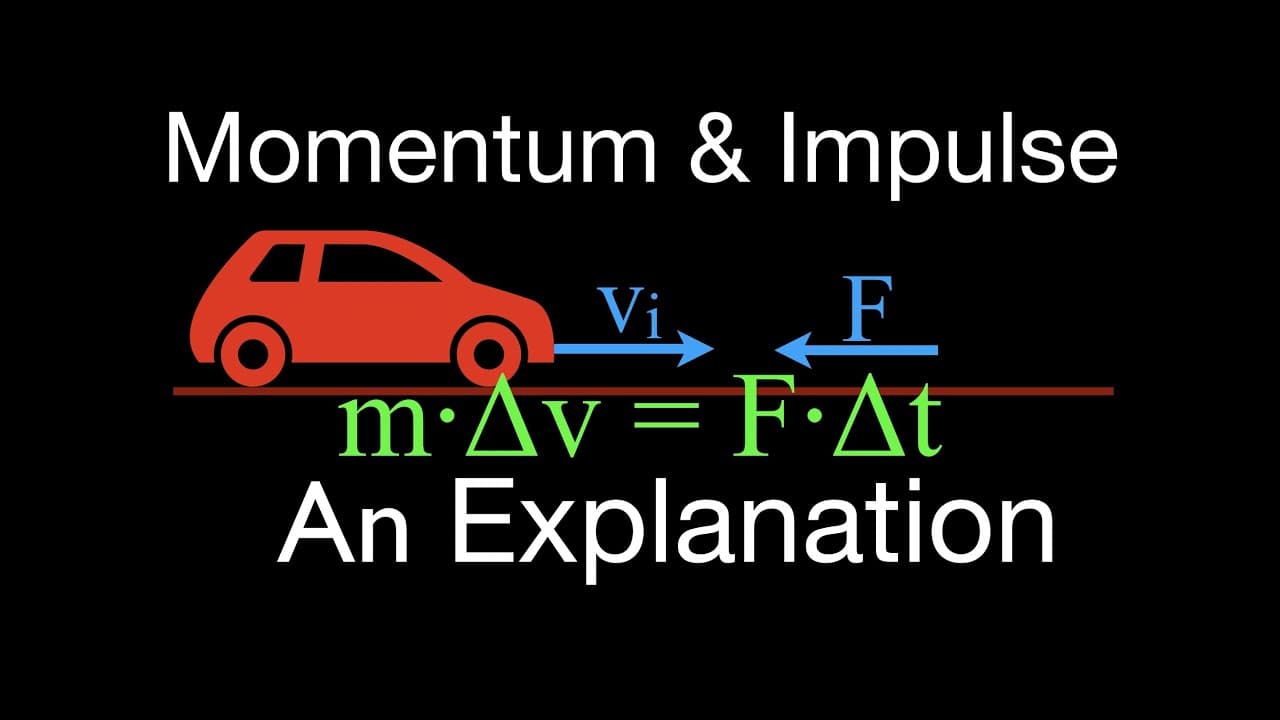
Calculate the new velocity of a car after brakes are applied for 3.5 seconds, using the impulse and momentum equation.
Transcript
okay in today's video we're going to go over an example problem involving impulse and momentum and the situation that we have we have situation with a car that has a mass of 1200 kilograms it's traveling at a speed of 56 miles per hour and at the point then the driver applies the brakes for 3.5 seconds and if the average force applied by the brakes... Read More
Key Insights
- 💱 Impulse is defined as the change in momentum of an object.
- 💆 The momentum of an object is equal to its mass multiplied by its velocity.
- ⌛ The impulse and momentum equation states that the change in velocity is equal to the force applied multiplied by the time.
- 🗂️ In this example, the change in velocity of the car is calculated by dividing the impulse by the mass of the car.
- 😨 The final velocity of the car is determined by subtracting the change in velocity from the initial velocity.
- 🇦🇪 The momentum and impulse have the same units, confirming their equivalence.
- 👮 Newton's second law relates force, mass, and acceleration, while impulse and momentum relate force, time, and change in velocity.
Install to Summarize YouTube Videos and Get Transcripts
Explore YouTube Video Summarizer or Get YouTube Transcript Extractor
Questions & Answers
Q: What is the initial momentum of the car?
The initial momentum of the car is calculated to be 30,000 kg m/s.
Q: What is the final momentum of the car?
The final momentum of the car, after the brakes are applied, is calculated to be 23,520 kg m/s.
Q: What is the change in momentum of the car?
The change in momentum of the car is determined to be 6,480 kg m/s.
Q: How is the impulse related to the change in momentum?
The impulse, which is the force applied over time, is equal to the change in momentum in this example.
Summary & Key Takeaways
-
A car with a mass of 1200 kg is traveling at 56 mph. The driver applies brakes for 3.5 seconds with a force of 1850 N.
-
Using the impulse and momentum equation, the change in velocity is calculated to be 5.4 m/s.
-
The new velocity of the car after the brakes are applied is determined to be 19.6 m/s.
Read in Other Languages (beta)
Share This Summary 📚
Summarize YouTube Videos and Get Video Transcripts with 1-Click
Try YouTube Summary with ChatGPT & Claude or YouTube Transcript Generator
Explore More Summaries from Step by Step Science 📚
Summarize YouTube Videos and Get Video Transcripts with 1-Click
Try YouTube Summary with ChatGPT & Claude or YouTube Transcript Generator