Unemployment rate primer | Current Economics | Finance & Capital Markets | Khan Academy
TL;DR
The unemployment rate is calculated based on the number of unemployed individuals actively looking for work, but it doesn't capture those who have exited or entered the labor force, which affects the accuracy of the rate.
Transcript
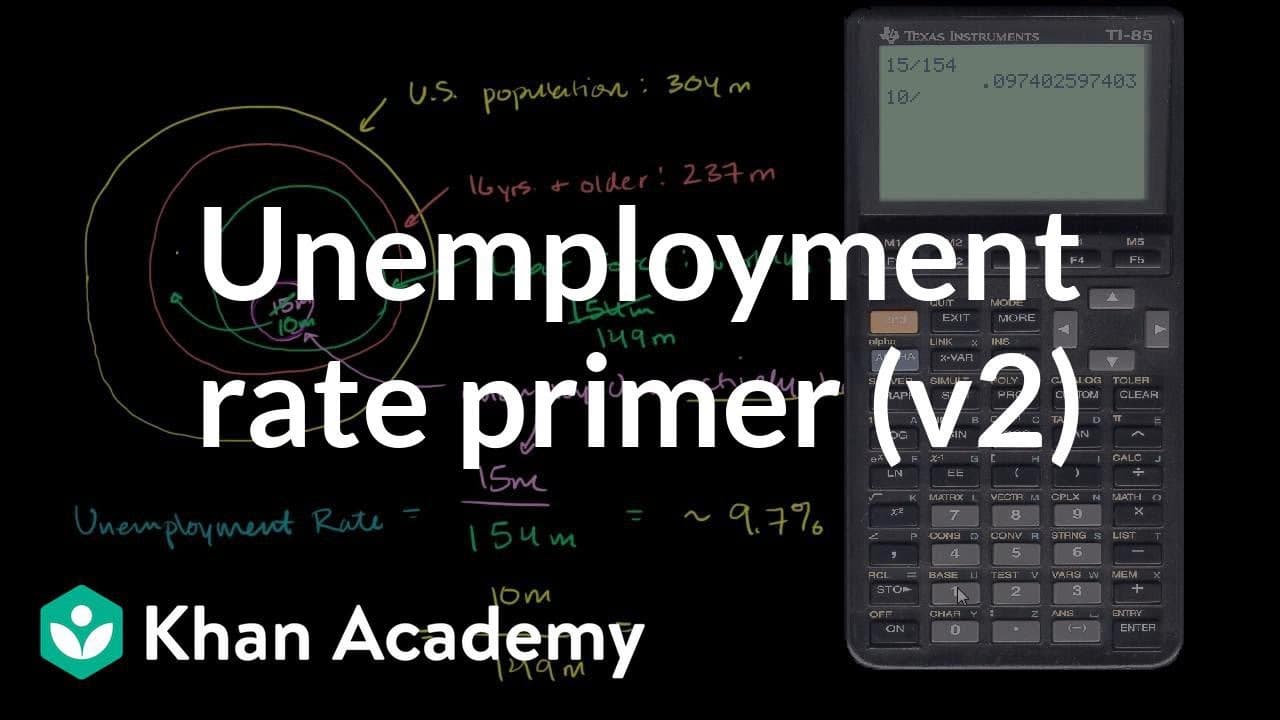
Voiceover: What I want to do in this video is think a little bit about how the unemployment rate is actually computed by the Bureau of Labor Statistics. So to figure that out let's just start off with the entire U.S. population. So let me draw a big circle here that represents the entire U.S. population. U.S. population and right now if my numbers ... Read More
Key Insights
- 🎆 The unemployment rate is derived from the ratio of unemployed individuals actively seeking work to the total labor force.
- 💦 People who have stopped looking for work due to discouragement are not considered part of the labor force and are excluded from the calculation.
- ☠️ The unemployment rate can be affected by both economic conditions and individuals' decisions to enter or exit the labor force.
- ☠️ Changes in the size of the labor force can impact the accuracy of the unemployment rate in reflecting the true state of the economy.
- ☠️ The headline unemployment rate provided in the news may not provide the complete picture and ignores the nuances of those entering or exiting the labor force.
- ☠️ A shrinking labor force can result in a lower unemployment rate, while an expanding labor force can lead to a higher rate.
- ☠️ The unemployment rate alone may not fully capture the severity or improvement of economic conditions.
Install to Summarize YouTube Videos and Get Transcripts
Explore YouTube Video Summarizer or Get YouTube Transcript Extractor
Questions & Answers
Q: How is the unemployment rate calculated in the U.S.?
The unemployment rate in the U.S. is calculated by dividing the number of unemployed individuals actively looking for work by the total labor force. It is expressed as a percentage.
Q: What does it mean to be actively looking for work?
Actively looking for work means that a person has searched for a job or is actively searching in the past four weeks. This information is obtained through surveys conducted by the Bureau of Labor Statistics.
Q: Can the unemployment rate decrease if people exit the labor force?
Yes, if individuals become discouraged and stop looking for work, they are no longer considered part of the labor force. In such cases, the unemployment rate may decrease because the labor force shrinks.
Q: Can the unemployment rate increase if more people enter the labor force?
Yes, if individuals who were previously not part of the labor force start actively looking for work, they will be included in the official unemployed count. This could lead to an increase in the unemployment rate.
Summary & Key Takeaways
-
The U.S. population is around 304 million people, but only a subset of this population is capable of working.
-
The labor force consists of individuals who are working or actively looking for work, which is approximately 154 million people.
-
The unemployment rate is calculated by dividing the number of unemployed and actively looking individuals by the total labor force.
Read in Other Languages (beta)
Share This Summary 📚
Summarize YouTube Videos and Get Video Transcripts with 1-Click
Try YouTube Summary with ChatGPT & Claude or YouTube Transcript Generator
Explore More Summaries from Khan Academy 📚
Summarize YouTube Videos and Get Video Transcripts with 1-Click
Try YouTube Summary with ChatGPT & Claude or YouTube Transcript Generator