Statistical Learning: 7.Py Splines I 2023
TL;DR
Learn how to fit flexible functions using splines in regression models, which are piece-wise smooth functions that can be cubic, quadratic, or linear.
Transcript
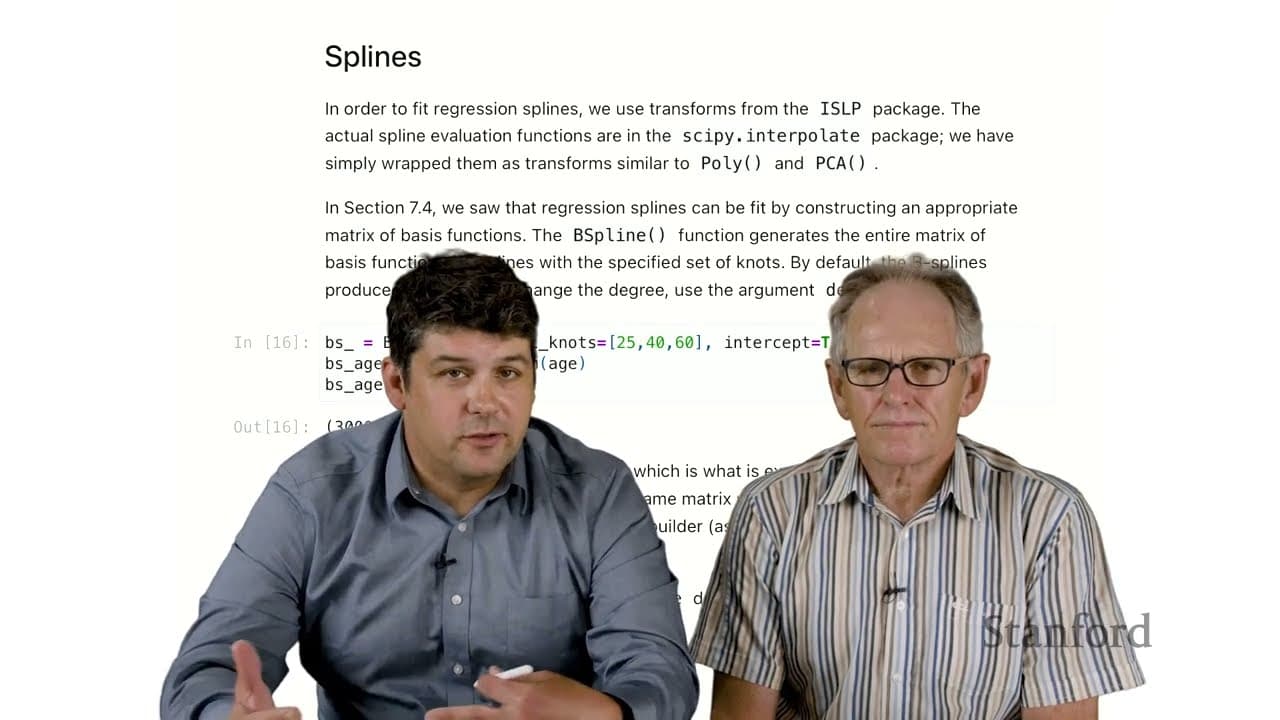
we've seen how to fit regression models with a higher order complexity in terms of the the degree of a polinomial the next topic we're going to look at is how to fit similarly flexible functions but using splines and remember these are piece-wise um smooth functions they can be piecewise constant if it's order zero piecewise cubic if it's a cubic s... Read More
Key Insights
- ❓ Splines provide a flexible alternative to polynomial regression models.
- 👻 BeastBlind in the ISLP library allows for the construction of splines with specified knots and intercept.
- ❓ Splines can be fitted in a regression model using a helper function.
- 🪢 Natural splines have the advantage of linear extrapolation beyond the last knot.
- 🪢 The choice of knots and degrees of freedom in splines affects the flexibility of the fitted function.
- 💨 Splines offer a way to model piece-wise smooth functions in regression analysis.
- 🕰️ Splines can be cubic, quadratic, linear, or piece-wise constant.
Install to Summarize YouTube Videos and Get Transcripts
Explore YouTube Video Summarizer or Get YouTube Transcript Extractor
Questions & Answers
Q: What are splines in the context of regression models?
Splines are piece-wise smooth functions that can be used to fit flexible functions in regression models. They can be cubic, quadratic, linear, or piece-wise constant.
Q: How can splines be constructed using the "BeastBlind" object in the ISLP library?
The "BeastBlind" object in the ISLP library allows for the construction of splines by specifying the number of knots and whether an intercept should be included. The object follows the same interface as the "poly" function.
Q: How are splines fitted in a regression model?
Splines are not directly used as Transformers in a regression model, but rather fitted using a helper function. The individual coefficients of a spline may be less informative compared to the overall form of the function.
Q: What are natural splines and how are they different from regular splines?
Natural splines are a special case of splines that have additional constraints. Beyond the last knot, natural splines are extended linearly instead of cubically. This allows for better extrapolation.
Summary & Key Takeaways
-
Polynomial regression models can be fit with higher order complexity, but splines offer similarly flexible functions that are piece-wise smooth.
-
Splines can be piece-wise constant, cubic, quadratic, or linear, with cubic splines being the default for modeling smooth functions.
-
Splines can be used in a regression setting by constructing them using the "BeastBlind" object in the ISLP library and fitting them with a helper function.
Read in Other Languages (beta)
Share This Summary 📚
Summarize YouTube Videos and Get Video Transcripts with 1-Click
Try YouTube Summary with ChatGPT & Claude or YouTube Transcript Generator
Explore More Summaries from Stanford Online 📚

Summarize YouTube Videos and Get Video Transcripts with 1-Click
Try YouTube Summary with ChatGPT & Claude or YouTube Transcript Generator