How the World Cup’s AI instant replay works
TL;DR
AI technology aids in accurate offside calls at World Cup.
Transcript
50 minutes and 25 seconds into the 1986 World cup match between Argentina and England, Diego Maradona did something infamous. “And Maradona has scored” This moment goes down in history because because of what the commentators could clearly see: “ That is why England is so furious, Maradona has punched it in with his left hand” But in 1986, refer... Read More
Key Insights
- The 1986 World Cup lacked instant replay, leading to controversial calls like Maradona's 'Hand of God' goal, highlighting the need for technological advancements in sports refereeing.
- Modern technology allows referees to review plays from multiple angles, enhancing decision accuracy but still subject to human interpretation.
- The offside rule in soccer is inherently objective but often judged subjectively, leading to disputes over calls, which the new AI technology aims to reduce.
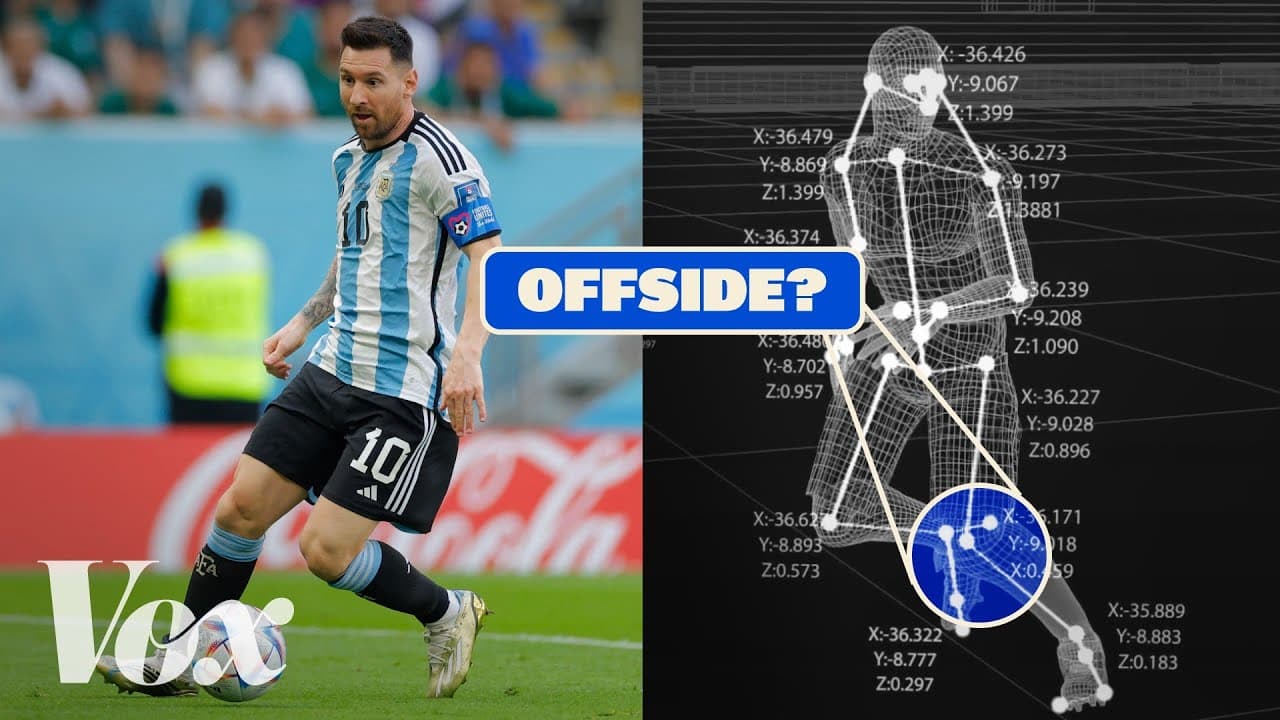
- AI offside technology uses a sensor in the ball and 12 cameras to track player positions, providing real-time data for more accurate decisions.
- The AI system creates 3D visualizations of plays, offering referees and audiences a clear, indisputable perspective on offside calls.
- Despite its accuracy, AI technology still requires human referees to make final decisions, as it cannot assess players' intentions or other subjective elements.
- The introduction of AI in the 2022 World Cup has shown improvements in decision-making speed and clarity, though some delays still occur.
- AI technology is a tool to assist referees, not replace them, and its effectiveness depends on how it is integrated into the decision-making process.
Install to Summarize YouTube Videos and Get Transcripts
Explore YouTube Video Summarizer or Get YouTube Transcript Extractor
Questions & Answers
Q: How did referees make decisions before instant replay technology?
Before instant replay technology, referees relied solely on their perspective and judgment from the field to make decisions. This often led to controversial calls, as their view could be limited or obstructed, and they did not have the benefit of reviewing plays from multiple angles or in slow motion.
Q: What is the main challenge with offside calls in soccer?
The main challenge with offside calls in soccer is the subjective nature of interpreting player positions relative to the offside line. Although the rule is objective, determining whether a player is offside can be difficult due to varying perspectives and angles, which can lead to disputes over the correctness of calls.
Q: How does the new AI offside technology work?
The new AI offside technology uses a sensor in the ball and 12 motion-tracking cameras to monitor player positions on the field. It collects data 500 times per second and uses machine learning to create 3D visualizations of plays, providing referees with a clear and accurate perspective to aid in decision-making.
Q: What role do human referees play in the AI offside system?
Human referees play a crucial role in the AI offside system by making the final decisions based on the technology's output. While the AI provides accurate data and visualizations, referees must interpret this information and consider factors like player intentions, which the technology cannot assess, to make the final call.
Q: How has AI technology impacted decision-making in the World Cup?
AI technology has significantly impacted decision-making in the World Cup by improving the accuracy and clarity of offside calls. It provides referees with detailed data and visualizations, reducing the reliance on subjective judgment. However, the technology's effectiveness depends on its integration into the existing decision-making process.
Q: What are the limitations of the AI offside technology?
The limitations of the AI offside technology include its inability to assess subjective elements such as player intentions or context. While it provides precise data on player positions, human referees are still needed to interpret this information and make the final decision, as the technology cannot fully replace human judgment.
Q: Why is the AI offside technology considered semi-automated?
The AI offside technology is considered semi-automated because, while it provides accurate data and visualizations, human referees are still required to make the final decisions. The technology assists in reducing subjectivity but does not completely eliminate the need for human interpretation and judgment in the decision-making process.
Q: What has been the reaction to the AI technology in early World Cup matches?
The reaction to the AI technology in early World Cup matches has been mixed. While it has improved decision-making speed and clarity, some delays in making calls have been noted, leading to dissatisfaction among fans. However, the technology's ability to provide clear visualizations has generally been seen as a positive development.
Summary & Key Takeaways
-
The 2022 World Cup introduced semi-automated AI technology to improve offside call accuracy. It uses sensors and cameras to track player positions and provides 3D visualizations for referees. While enhancing objectivity, it still relies on human judgment for final decisions.
-
AI technology in soccer aims to reduce subjectivity in offside calls by providing real-time data and 3D visualizations. Despite its precision, human referees are essential for interpreting the technology's output and making the final call.
-
The new AI system at the World Cup has improved the accuracy and clarity of offside calls. However, it cannot completely eliminate human judgment in decision-making, as referees must consider factors beyond the technology's capabilities.
Read in Other Languages (beta)
Share This Summary 📚
Summarize YouTube Videos and Get Video Transcripts with 1-Click
Try YouTube Summary with ChatGPT & Claude or YouTube Transcript Generator
Explore More Summaries from Vox 📚



Summarize YouTube Videos and Get Video Transcripts with 1-Click
Try YouTube Summary with ChatGPT & Claude or YouTube Transcript Generator