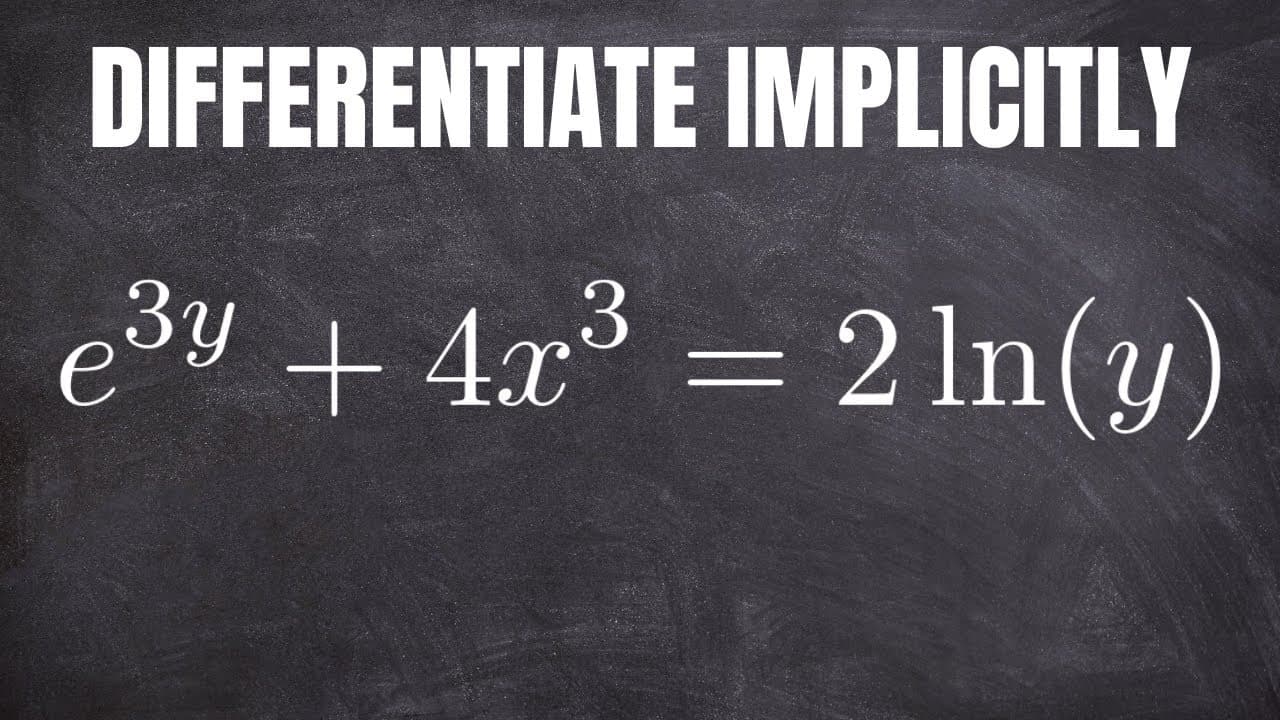
Use Implicit Differentation to Find dy/dx with e^(3y) + 4x^3 = 2ln(y)
TL;DR
Implicit differentiation is used to find dy/dx by differentiating both sides of an equation and solving for dy/dx.
Transcript
i in this problem we have to differentiate implicitly in order to find d y d x what that means is basically you have to start by differentiating both sides of this equation with respect to x so basically we're taking the derivative with respect to x of the left-hand side so e to the 3y plus 4x cubed and we're also doing it to the right hand side so... Read More
Key Insights
- 🙃 Implicit differentiation involves differentiating both sides of an equation to find dy/dx.
- 🍉 The chain rule is used to differentiate terms involving exponential functions, like e^3y.
- ✊ The power rule is used to differentiate terms involving polynomial functions, like 4x^3.
- 🍽️ The derivative of ln(y) is 1/y, considering y as the inner function.
Install to Summarize YouTube Videos and Get Transcripts
Explore YouTube Video Summarizer or Get YouTube Transcript Extractor
Questions & Answers
Q: What is the process of implicit differentiation?
Implicit differentiation involves differentiating both sides of an equation with respect to x. Terms containing y are treated as functions and the chain rule is applied.
Q: How is the derivative of e^3y found?
The derivative of e^3y is found using the chain rule. The outer function, e^x, remains the same, and the inner function, 3y, is multiplied by dy/dx. So, the derivative becomes 3e^3y * dy/dx.
Q: What is the derivative of 4x^3?
The derivative of 4x^3 is found using the power rule. The exponent, 3, is brought down as a coefficient, resulting in 12x^2.
Q: How is the derivative of ln(y) calculated?
The derivative of ln(y) is 1/y. In implicit differentiation, ln(y) is treated as a composition of functions, and the derivative of the inner function, y, is considered.
Summary & Key Takeaways
-
Implicit differentiation involves differentiating both sides of an equation with respect to x to find dy/dx.
-
The derivative of e^3y is found using the chain rule and is equal to 3e^3y * dy/dx.
-
The derivative of 4x^3 becomes 12x^2, while the derivative of ln(y) is 1/y.
-
By rearranging the terms, dy/dx can be solved to be -12x^2 / (3e^3y - 2/y).
Read in Other Languages (beta)
Share This Summary 📚
Summarize YouTube Videos and Get Video Transcripts with 1-Click
Try YouTube Summary with ChatGPT & Claude or YouTube Transcript Generator
Explore More Summaries from The Math Sorcerer 📚

Summarize YouTube Videos and Get Video Transcripts with 1-Click
Try YouTube Summary with ChatGPT & Claude or YouTube Transcript Generator