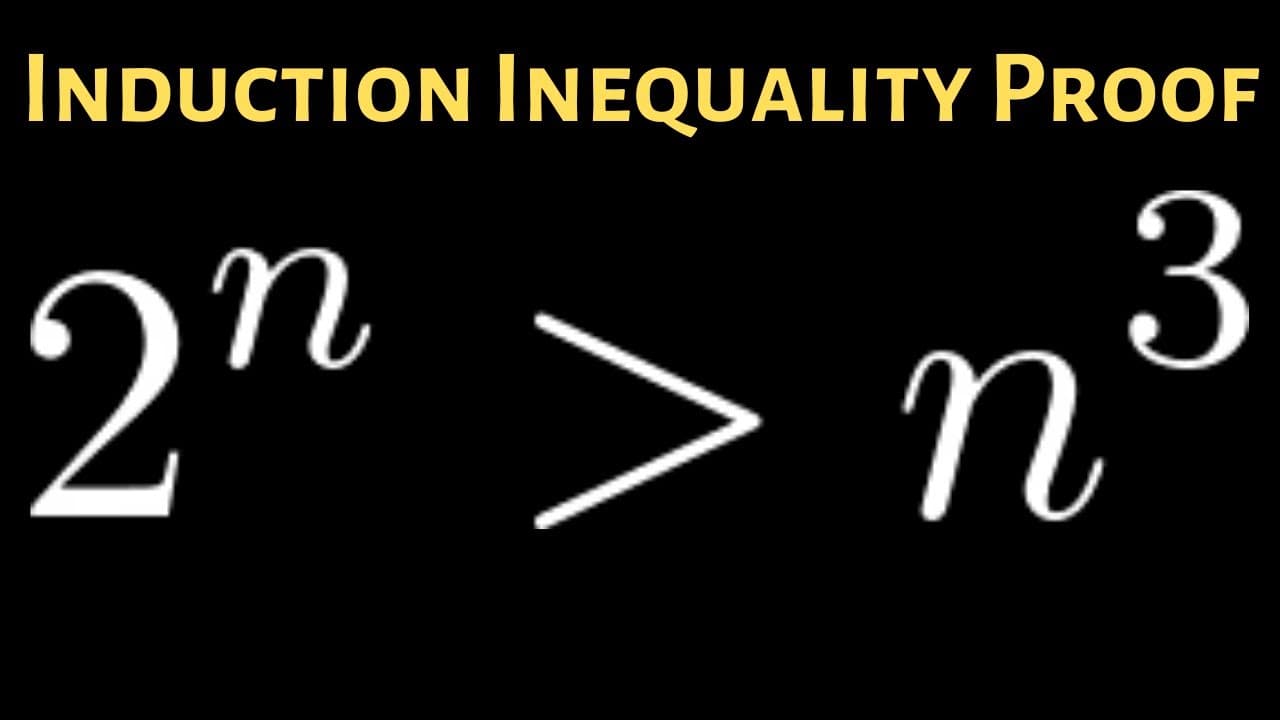
Induction Inequality Proof: 2^n greater than n^3
TL;DR
Using mathematical induction, it is proven that for every integer n greater than or equal to 10, 2 to the n is greater than n cubed.
Transcript
okay in this problem we're going to prove that 2 to the n is greater than n cubed for every integer n greater than or equal to 10 and we're going to do it using the principle of mathematical induction so proof okay so we'll start with the first step which is called the base case i always like to label the steps and so the base case is the starting ... Read More
Key Insights
- 👍 Mathematical induction is a useful method for proving statements about integers.
- 😥 The base case serves as a starting point to verify the truth of the statement.
- 👍 The induction step involves assuming the statement is true for a specific integer, and then proving it for the next integer.
- 🤩 Manipulating inequalities and utilizing conditions are key steps in successfully proving the statement.
- ❓ Careful reasoning and foresight are required to navigate through the proof.
- 🟰 The proof demonstrates that 2 to the n is exponentially greater than n cubed for integers greater than or equal to 10.
- 😑 Pascal's triangle can be used to multiply out expressions.
Install to Summarize YouTube Videos and Get Transcripts
Explore YouTube Video Summarizer or Get YouTube Transcript Extractor
Questions & Answers
Q: What is the base case in the proof?
The base case of the proof is when n is equal to 10. This is where the statement is verified to be true by comparing 2 to the 10th power and 10 cubed.
Q: What is the induction hypothesis?
The induction hypothesis assumes that the statement is true for some positive integer k, which is greater than or equal to 10, represented as 2 to the k > k cubed.
Q: How is the induction step approached?
The induction step involves proving the statement for n = k + 1. By manipulating the inequality using the induction hypothesis and other conditions, it is demonstrated that 2 to the k + 1 is indeed greater than (k + 1) cubed.
Q: What is the significance of involving k squared in the proof?
Involving k squared allows the proof to create an inequality that helps to establish the desired result. By introducing k times k squared to the equation, it becomes possible to incorporate the conditions and ultimately prove the statement.
Summary & Key Takeaways
-
The base case is proved by showing that the statement is true when n is equal to 10.
-
The induction step is broken down into three steps: stating the induction hypothesis, showing the statement is true for n = k + 1, and manipulating the inequalities to prove the statement.
-
By applying mathematical induction, it is concluded that 2 to the n is greater than n cubed for every integer n greater than or equal to 10.
Read in Other Languages (beta)
Share This Summary 📚
Summarize YouTube Videos and Get Video Transcripts with 1-Click
Try YouTube Summary with ChatGPT & Claude or YouTube Transcript Generator
Explore More Summaries from The Math Sorcerer 📚




Summarize YouTube Videos and Get Video Transcripts with 1-Click
Try YouTube Summary with ChatGPT & Claude or YouTube Transcript Generator