2015 AP Biology free response 7
TL;DR
Smell perception in mammals is triggered when odorant molecules bind to receptor proteins on olfactory neurons, transmitting information to the brain. Despite having a limited number of odorant receptor genes, mammals can perceive thousands of odors due to the ability of a single receptor protein to detect multiple molecules and different combinations of receptors.
Transcript
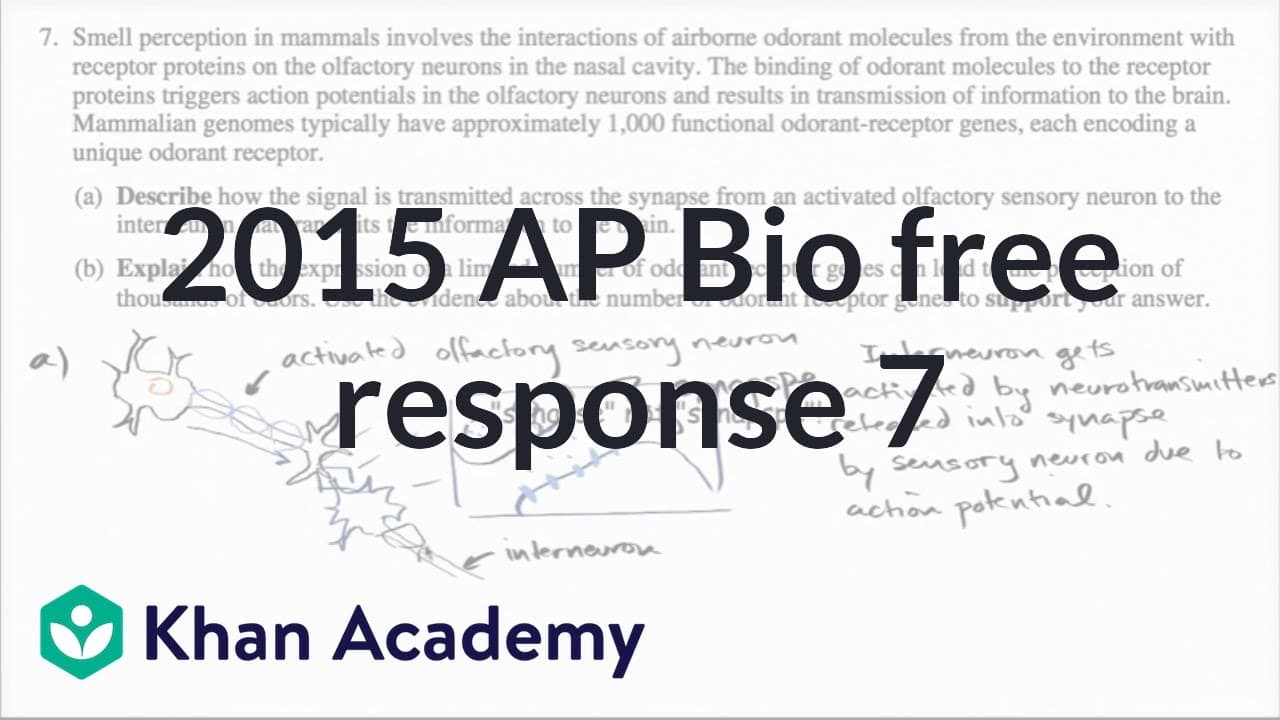
- [Voiceover] Smell perception in mammals involves the interactions of airborne odorant molecules from the environment with receptor proteins on the olfactory neurons in the nasal cavity. The binding of odorant molecules to the receptor proteins triggers action potentials in the olfactory neurons and results in transmission of information to the br... Read More
Key Insights
- 👃 Smell perception in mammals involves the interaction of odorant molecules with receptor proteins on olfactory neurons.
- ❓ Mammals have around one thousand functional odorant receptor genes, each encoding a unique odorant receptor.
- 📡 The signal is transmitted across the synapse through the release of neurotransmitters from the sensory neuron to the interneuron.
- 🥺 A single odorant receptor protein can detect multiple molecules, and different combinations of receptors lead to the perception of different smells.
- 🧡 The brain can perceive a wide range of odors despite the limited number of odorant receptor genes.
- 👃 One molecule can be recognized by multiple odorant receptor proteins, adding to the complexity of smell perception.
- 🖐️ Neurotransmitters play a crucial role in transmitting the signal from the sensory neuron to the interneuron.
Install to Summarize YouTube Videos and Get Transcripts
Explore YouTube Video Summarizer or Get YouTube Transcript Extractor
Questions & Answers
Q: How is the signal transmitted from an activated olfactory sensory neuron to the interneuron that carries the information to the brain?
The signal is transmitted through the release of neurotransmitters from the axon terminal of the sensory neuron. These neurotransmitters bind to proteins on the interneuron, activating it and allowing the transmission of information to the brain.
Q: How can a limited number of odorant receptor genes lead to the perception of thousands of odors?
Each odorant receptor protein can detect multiple odorant molecules, and different combinations of receptors can lead to the perception of different smells. This means that even though there are only a thousand genes, the brain can perceive a wide range of odors.
Q: Can one molecule be recognized by multiple odorant receptor proteins?
Yes, it is possible for one molecule to be bound by multiple receptors. This adds to the complexity of smell perception and allows for a larger number of odors to be detected.
Q: What is the role of neurotransmitters in smell perception?
Neurotransmitters are released into the synapse by the sensory neuron when an action potential is transmitted. These neurotransmitters activate or inhibit the interneuron, allowing the signal to be transmitted to the brain.
Summary & Key Takeaways
-
Smell perception in mammals involves the interaction of odorant molecules with receptor proteins on olfactory neurons, leading to the transmission of information to the brain.
-
Mammals typically have around one thousand functional odorant receptor genes, each encoding a unique odorant receptor.
-
The signal is transmitted across the synapse from an activated olfactory sensory neuron to an interneuron, allowing the information to be transmitted to the brain.
Read in Other Languages (beta)
Share This Summary 📚
Summarize YouTube Videos and Get Video Transcripts with 1-Click
Try YouTube Summary with ChatGPT & Claude or YouTube Transcript Generator
Explore More Summaries from Khan Academy 📚



Summarize YouTube Videos and Get Video Transcripts with 1-Click
Try YouTube Summary with ChatGPT & Claude or YouTube Transcript Generator