Implicit differentiation, product and chain rules at once
TL;DR
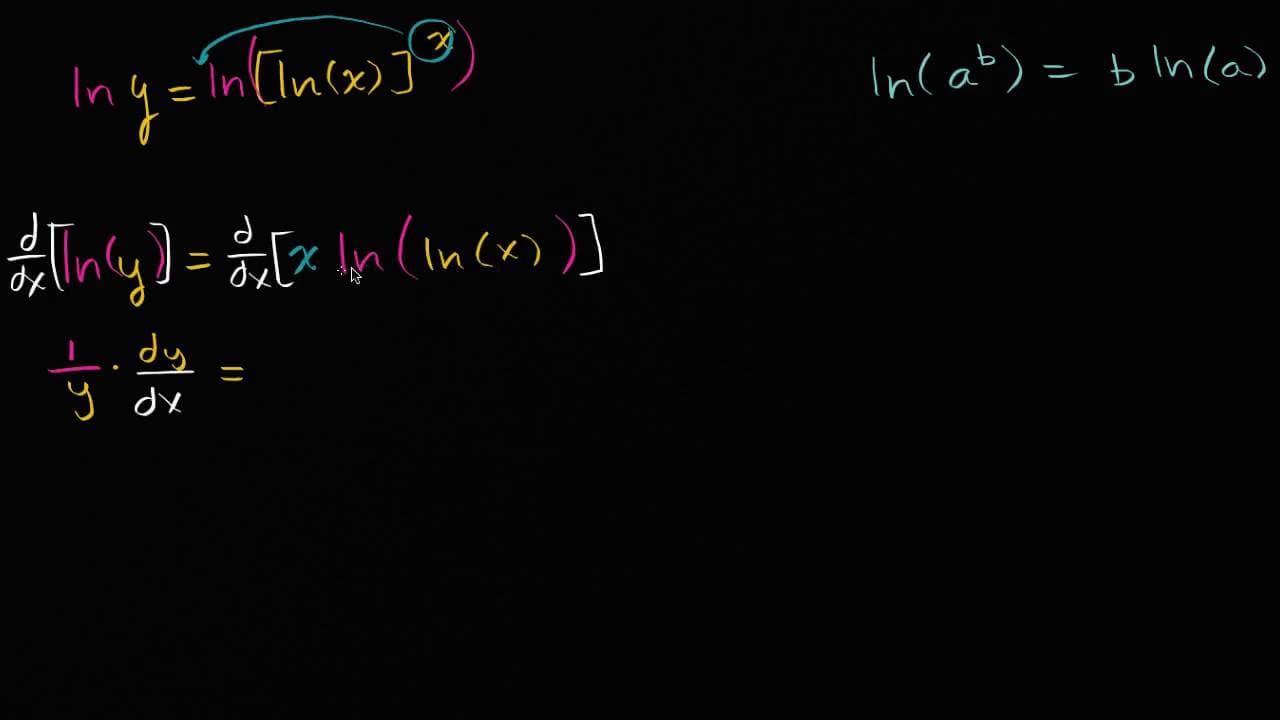
This video explains how to find the derivative of the natural logarithm of x to the xth power using logarithmic properties and implicit differentiation.
Transcript
- [Voiceover] Let's say y is equal to the natural log of x to the xth power, and what we wanna do, we wanna find the derivative of y with respect to x. So I encourage you to pause this video and see if you can do it. So, when you first try to tackle this, this is a little bit daunting. We know how to take the derivative of constants to some x power... Read More
Key Insights
- ❓ The derivative of a complex function can be found by applying logarithmic properties and implicit differentiation.
- 🙃 Taking the natural log of both sides allows manipulation of the exponent and simplification of the expression.
- 🙃 Implicit differentiation involves finding the derivative of both sides with respect to the independent variable.
- 🧑💻 The chain rule is used to find the derivative of the natural log of the natural log of x.
Install to Summarize YouTube Videos and Get Transcripts
Explore YouTube Video Summarizer or Get YouTube Transcript Extractor
Questions & Answers
Q: How do you find the derivative of the natural logarithm of x to the xth power?
To find the derivative, you can first take the natural log of both sides and use the logarithmic property to bring the exponent out front. Then, apply implicit differentiation by taking the derivative of both sides with respect to x.
Q: What properties of logarithms are used in finding the derivative?
The property used is that the natural log of a to the b power is equal to b times the natural log of a. By taking the natural log of both sides, this property allows us to simplify the expression and apply implicit differentiation.
Q: What is the derivative of the natural log of the natural log of x?
The derivative of the natural log of the natural log of x with respect to x is equal to 1 over x times the natural log of x. This is obtained by applying the chain rule and taking the derivative of the inside function.
Q: How can the derivative be calculated when x is equal to e?
When x is equal to e, the derivative of the natural logarithm of x to the xth power is equal to 1. This can be evaluated by substituting e for x in the expression and simplifying the terms.
Summary & Key Takeaways
-
The video teaches how to calculate the derivative of the natural logarithm of x to the xth power by using logarithmic properties and implicit differentiation.
-
By taking the natural log of both sides and using the logarithmic property, the exponent can be brought out front and scaled to the natural log function.
-
Implicit differentiation is then applied by taking the derivative of both sides with respect to x.
Read in Other Languages (beta)
Share This Summary 📚
Summarize YouTube Videos and Get Video Transcripts with 1-Click
Try YouTube Summary with ChatGPT & Claude or YouTube Transcript Generator
Explore More Summaries from Khan Academy 📚



Summarize YouTube Videos and Get Video Transcripts with 1-Click
Try YouTube Summary with ChatGPT & Claude or YouTube Transcript Generator