What are Types of Fluids - Properties of Fluid - Fluid Mechanics 1
TL;DR
This video discusses the five types of fluids - ideal, real, Newtonian, non-Newtonian, and ideal plastic fluid - explaining their characteristics and properties.
Transcript
hello friends in this video we will see the types of fluid and what are they called so let us start with that here are the types of fluid i can say that fluids are classified into five types and those five types are the first one ideal fluid second real fluid third newtonian fluid fourth non-newtonian fluid fifth one and the last one that is ideal ... Read More
Key Insights
- 🚱 Fluids can be classified into five types: ideal, real, Newtonian, non-Newtonian, and ideal plastic fluids.
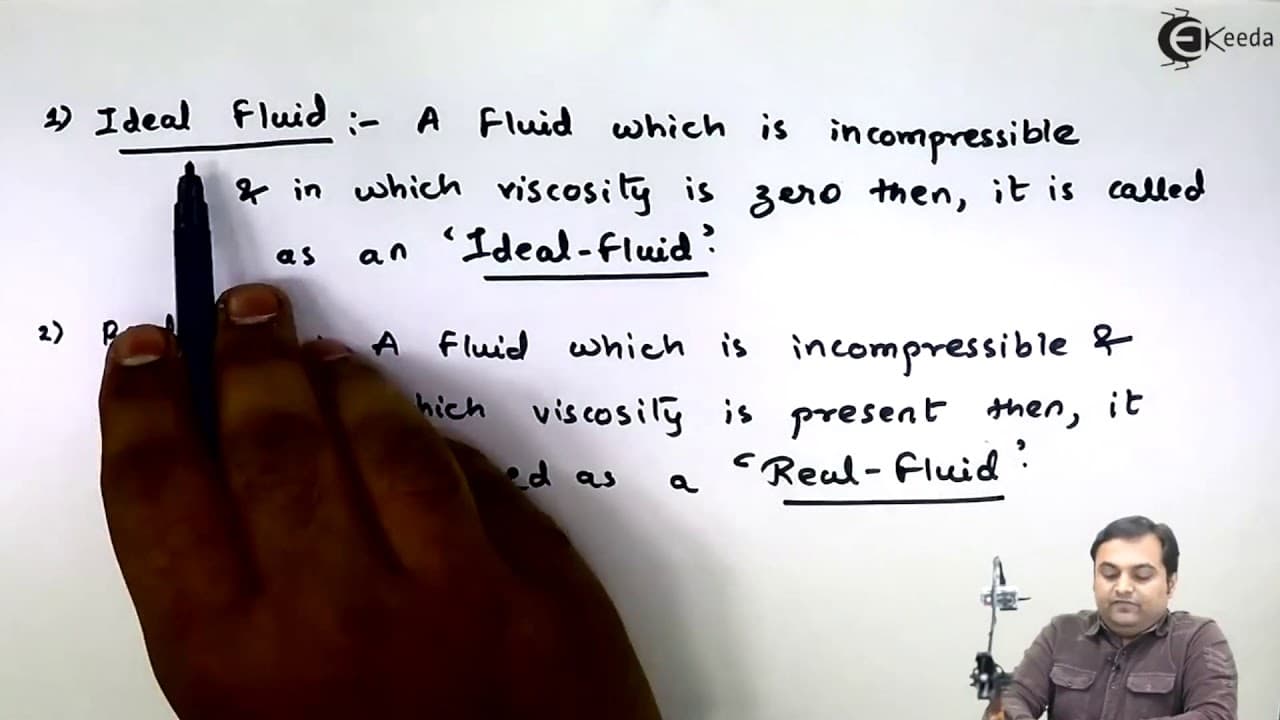
- 0️⃣ Ideal fluids are incompressible and have zero viscosity.
- ❓ Real fluids are incompressible and have viscosity.
- 👮 Newtonian fluids follow Newton's law of viscosity, with a linear relationship between shear stress and velocity gradient.
- ☠️ Non-Newtonian fluids do not follow Newton's law of viscosity, as their viscosity can change with the applied force or shear rate.
- ✋ Ideal plastic fluids have shear stress higher than the yield value and still follow Newton's law.
- ❓ Ideal and real fluids are mutually exclusive.
Install to Summarize YouTube Videos and Get Transcripts
Explore YouTube Video Summarizer or Get YouTube Transcript Extractor
Questions & Answers
Q: What is an ideal fluid?
An ideal fluid is incompressible and has zero viscosity. It includes liquids like water, oil, and petrol. Examples of ideal fluids are imaginary and do not exist in reality.
Q: How is a real fluid different from an ideal fluid?
A real fluid is also incompressible, but it has viscosity. Real fluids include most fluids encountered in the universe, like water and air.
Q: What is a Newtonian fluid?
Newtonian fluids follow Newton's law of viscosity, meaning that shear stress is directly proportional to the velocity gradient. They have a linear relationship between shear stress and shear strain.
Q: Can you provide an example of a non-Newtonian fluid?
Non-Newtonian fluids do not follow Newton's law of viscosity. Examples include ketchup, toothpaste, and blood, as their viscosity can change with the applied force or shear rate.
Q: What is the difference between ideal plastic fluid and other fluids?
Ideal plastic fluids have shear stress higher than the yield value and still follow Newton's law of viscosity. They behave like solids until the yield value is reached, beyond which they flow like fluids.
Q: Is there a fluid that is both ideal and real?
No, an ideal fluid does not have viscosity, whereas real fluids have viscosity. These two types of fluids cannot exist simultaneously.
Summary & Key Takeaways
-
Fluids can be classified into five types: ideal fluid, real fluid, Newtonian fluid, non-Newtonian fluid, and ideal plastic fluid.
-
Ideal fluids are incompressible and have zero viscosity, while real fluids have viscosity but are also incompressible.
-
Newtonian fluids follow Newton's law of viscosity, where shear stress is directly proportional to the velocity gradient.
-
Non-Newtonian fluids do not follow Newton's law of viscosity, as shear stress is not proportional to the rate of shear strain.
-
Ideal plastic fluids have shear stress higher than the yield value and also follow Newton's law of viscosity.
Read in Other Languages (beta)
Share This Summary 📚
Summarize YouTube Videos and Get Video Transcripts with 1-Click
Try YouTube Summary with ChatGPT & Claude or YouTube Transcript Generator
Explore More Summaries from Ekeeda 📚



Summarize YouTube Videos and Get Video Transcripts with 1-Click
Try YouTube Summary with ChatGPT & Claude or YouTube Transcript Generator