Very Common Mole Questions
TL;DR
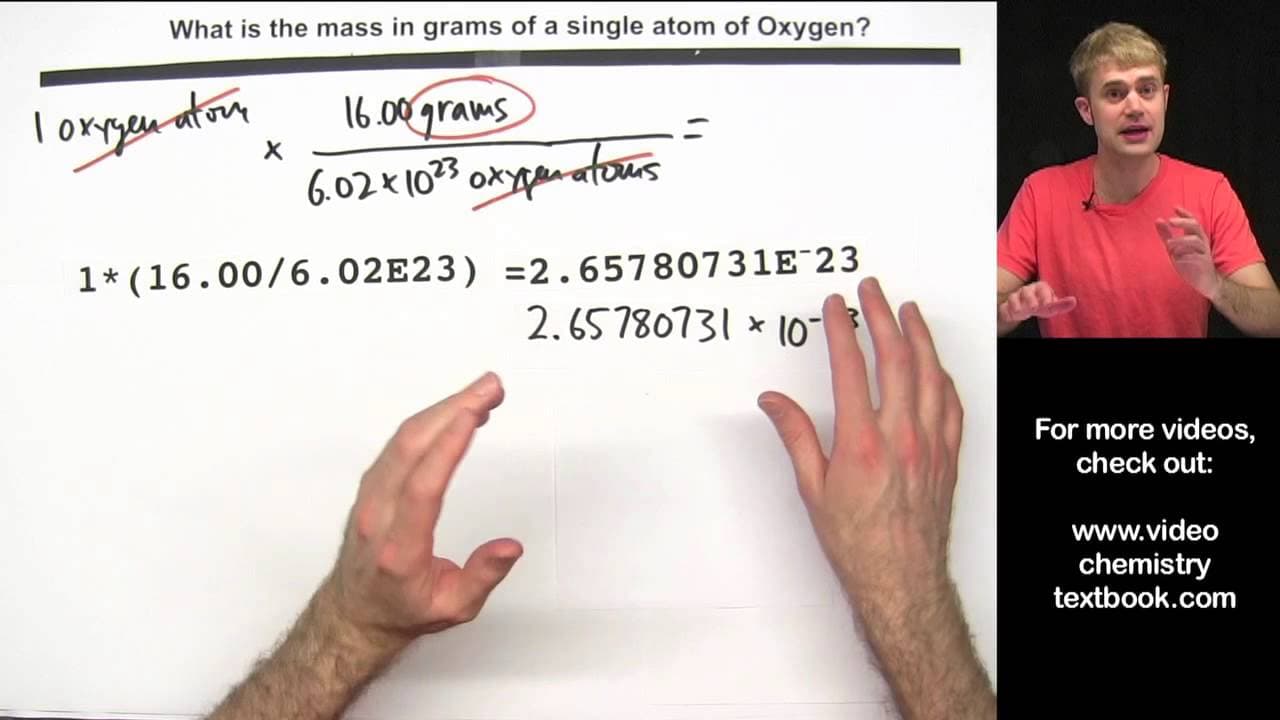
Learn how to calculate the mass of a single atom using conversion factors and the molar mass.
Transcript
In this video, I want to talk about two very common types of questions about moles. These two types of questions don't really fit into the other categories we've talked about but they show up all the time on homework, in textbooks, on quizzes and particularly on tests and exams. Okay, here's the first one. What is the mass in grams of a single atom... Read More
Key Insights
- 💆 The molar mass of an element can be used to calculate the mass of a single atom.
- 🫀 Conversion factors can be created using the molar mass and the number of atoms in a mole to go from atoms to grams.
- 🫀 Even though the masses of different elements may be different, the number of atoms can remain the same.
- 🫀 To compare the masses of different elements with the same number of atoms, conversion factors are used to convert the number of atoms into grams.
- 🛝 Significant figures should be considered when rounding the final answer.
- 😒 Understanding how to use conversion factors is crucial in solving mole-related problems in chemistry.
- 💁 The periodic table provides valuable information such as molar masses of elements.
Install to Summarize YouTube Videos and Get Transcripts
Explore YouTube Video Summarizer or Get YouTube Transcript Extractor
Questions & Answers
Q: How do you calculate the mass of a single atom of an element?
To calculate the mass of a single atom, you need to know the molar mass of the element and the number of atoms in a mole. By setting up a conversion factor, you can go from atoms to grams.
Q: What is the molar mass of oxygen?
The molar mass of oxygen is 16.00 grams per mole. This can be found on the periodic table.
Q: How many oxygen atoms are in a mole?
There are 6.02 x 10^23 oxygen atoms in one mole. It is often abbreviated as 602 hexillion.
Q: How do you compare the masses of different elements with the same number of atoms?
To compare the masses of different elements with the same number of atoms, you need to convert the number of atoms into grams using the molar masses of the elements.
Summary & Key Takeaways
-
The video discusses how to calculate the mass of a single atom using the example of oxygen. It explains that the molar mass of oxygen (16.00 grams) and the number of oxygen atoms in a mole (6.02 x 10^23) can be used to create a conversion factor to go from atoms to grams.
-
The video also addresses a confusing question about comparing the mass of mercury and calcium. It clarifies that the number of atoms remains the same, even though the masses are different, and demonstrates how to solve the problem using conversion factors.
Read in Other Languages (beta)
Share This Summary 📚
Summarize YouTube Videos and Get Video Transcripts with 1-Click
Try YouTube Summary with ChatGPT & Claude or YouTube Transcript Generator
Explore More Summaries from Tyler DeWitt 📚

Summarize YouTube Videos and Get Video Transcripts with 1-Click
Try YouTube Summary with ChatGPT & Claude or YouTube Transcript Generator