Analyzing solutions to linear systems graphically 1 | Algebra I | Khan Academy
TL;DR
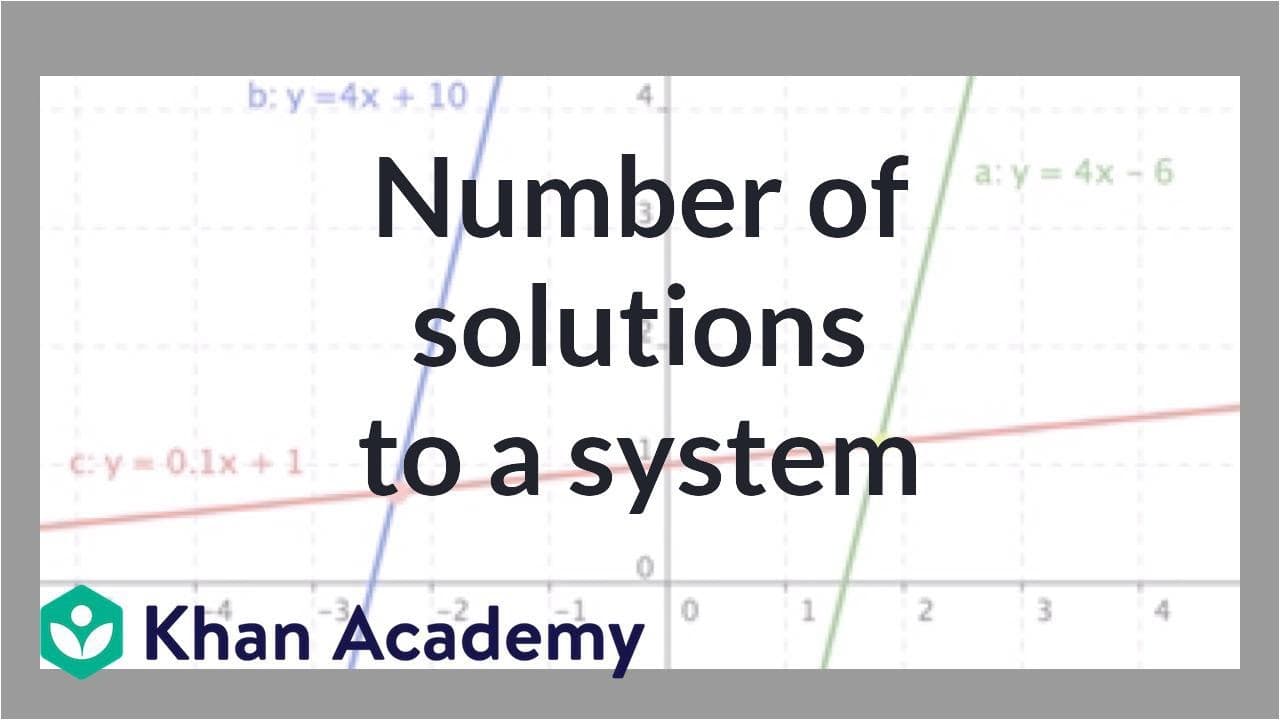
Identify systems of two lines with a single solution and systems with no solution on a coordinate grid.
Transcript
We're told to look at the coordinate grid above. I put it on the side here. Identify one system of two lines that has a single solution. Then identify one system of two lines that does not have a solution. So let's do the first part first. So a single solution. And they say identify one system, but we can see here there's actually going to be two s... Read More
Key Insights
- 🫥 A system of two lines has a single solution when their graphs intersect at a point.
- 🫥 There can be multiple systems of two lines with a single solution.
- 🫥 Two parallel lines in a system will never intersect and have no solution.
- 🫥 The slope and intercept of lines determine whether they have a single solution or no solution.
Install to Summarize YouTube Videos and Get Transcripts
Explore YouTube Video Summarizer or Get YouTube Transcript Extractor
Questions & Answers
Q: What defines a system of two lines with a single solution?
A system of two lines has a single solution when there is a point on the coordinate grid that satisfies both equations simultaneously. This point represents an x and y value that satisfies both constraints.
Q: Can you give an example of a system of two lines with a single solution?
One example is the system y = 0.1x + 1 and y = 4x + 10. The point of intersection between these lines satisfies both equations, resulting in a single solution.
Q: Are there multiple systems with a single solution?
Yes, there can be multiple systems with a single solution. Another example is the system y = 0.1x + 1 and y = 4x - 6. The point of intersection between these lines represents a unique solution.
Q: How can a system of two lines have no solution?
A system of two lines has no solution when the lines are parallel and never intersect. This means there is no point on the coordinate grid that satisfies both equations simultaneously.
Q: Could you provide an example of a system with no solution?
An example of a system with no solution is y = 4x + 10 and y = 4x - 6. These lines have the same slope but different intercepts, so they are parallel and never intersect. Therefore, there is no solution.
Summary & Key Takeaways
-
A system of two lines has a single solution when there is a point of intersection that satisfies both equations.
-
Two systems that have a single solution are y = 0.1x + 1 and y = 4x + 10, and y = 0.1x + 1 and y = 4x - 6.
-
A system of two lines has no solution when the lines are parallel and do not intersect, like y = 4x + 10 and y = 4x - 6.
Read in Other Languages (beta)
Share This Summary 📚
Summarize YouTube Videos and Get Video Transcripts with 1-Click
Try YouTube Summary with ChatGPT & Claude or YouTube Transcript Generator
Explore More Summaries from Khan Academy 📚



Summarize YouTube Videos and Get Video Transcripts with 1-Click
Try YouTube Summary with ChatGPT & Claude or YouTube Transcript Generator