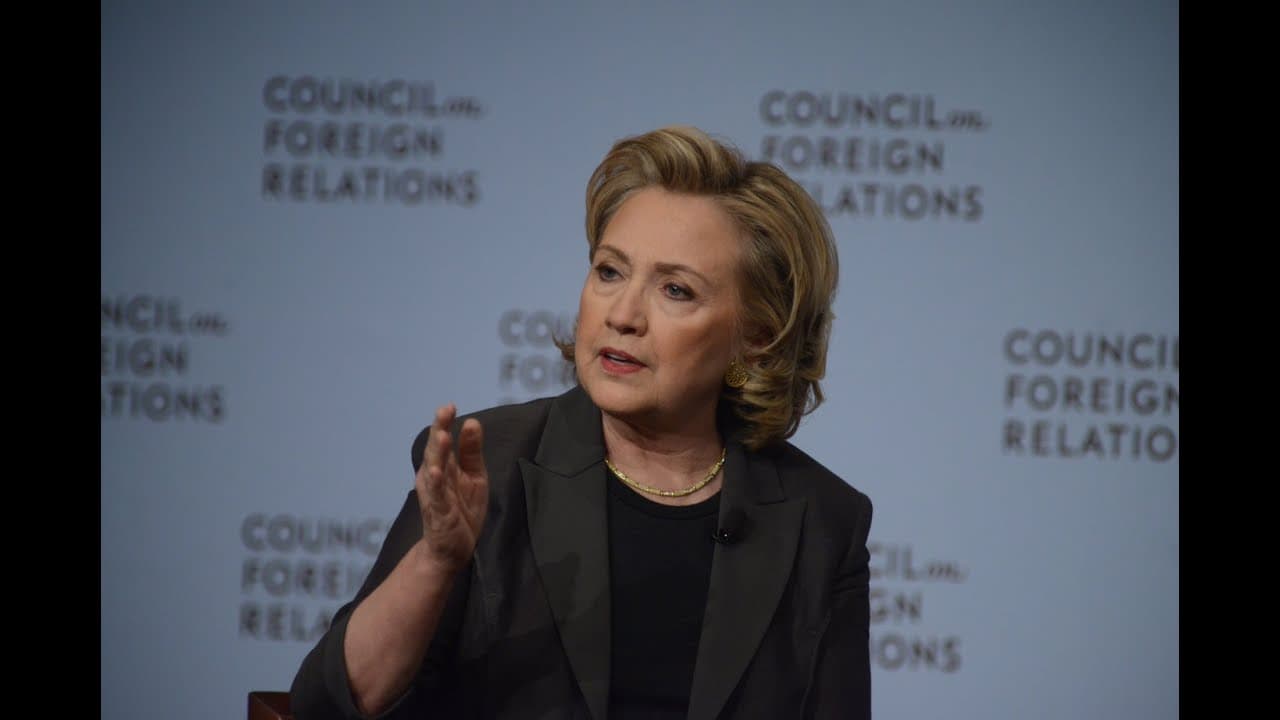
Hillary Clinton on U.S. Foreign Policy Challenges
TL;DR
Hillary Clinton discusses her tenure as Secretary of State, focusing on strategic initiatives like the pivot to Asia and promoting a rules-based international order. She addresses ongoing challenges in the Middle East, the U.S.-Afghan relationship, and the implications of political events. Clinton emphasizes the importance of building relationships and balancing military and diplomatic efforts.
Transcript
HAASS: Well, good morning. I'm Richard Haass, and I want to welcome all of you here, as well as those watching on screens of various sorts, to this meeting of the Council on Foreign Relations. At its core, the Council on Foreign Relations is an independent, nonpartisan organization. We're a think-tank, and we're a publisher dedicated to helping its... Read More
Key Insights
- The pivot to Asia was a significant strategic move to reaffirm U.S. presence in the Asia-Pacific region.
- Building a rules-based international order is crucial for global stability and U.S. interests.
- The Arab Spring's outcomes vary by country, with Tunisia showing promising signs of a successful transition.
- Libya's post-Gadhafi instability highlights the challenges of nation-building without strong institutions.
- The Syrian conflict is a 'wicked problem' with regional implications, exacerbated by extremist groups like ISIS.
- Personal relationships in diplomacy can influence outcomes, but state interests ultimately drive decisions.
- The U.S. embargo on Cuba is seen as counterproductive, potentially benefiting the Castro regime.
- WikiLeaks had tangible impacts on diplomatic relations, leading to increased caution among global leaders.
Install to Summarize YouTube Videos and Get Transcripts
Explore YouTube Video Summarizer or Get YouTube Transcript Extractor
Questions & Answers
Q: How did Hillary Clinton view the pivot to Asia during her tenure as Secretary of State?
Hillary Clinton viewed the pivot to Asia as a critical strategic move to reaffirm U.S. presence and commitment in the Asia-Pacific region. She believed that much of the 21st century's history would be shaped in Asia and emphasized the importance of the U.S. remaining a Pacific power. The pivot aimed to renew the rules-based order and reassure allies of U.S. involvement.
Q: What challenges did the Arab Spring present according to Hillary Clinton?
The Arab Spring presented varied challenges across different countries. In Tunisia, a middle class and moderate Islamist movement facilitated a more stable transition. In contrast, Libya struggled with instability due to Gadhafi's long rule, which left the country without strong institutions. Egypt's leaderless revolution led to political upheaval, with the military eventually regaining control.
Q: How does Hillary Clinton assess the Syrian conflict?
Hillary Clinton describes the Syrian conflict as a 'wicked problem' with regional and global implications. She advocated for arming moderate opposition early on, but the situation has since worsened with the rise of extremist groups like ISIS. The conflict is no longer just a Syrian issue, as foreign fighters and regional instability pose broader security threats.
Q: What role do personal relationships play in diplomacy according to Clinton?
Clinton believes personal relationships in diplomacy are important for building trust and understanding, which can influence negotiations. However, she acknowledges that state interests ultimately drive decisions. Establishing strategic trust through personal interactions is crucial, but leaders will act based on what they perceive as their country's best interests.
Q: Why does Hillary Clinton advocate for ending the U.S. embargo on Cuba?
Clinton argues that the U.S. embargo on Cuba is counterproductive, serving as an excuse for the Castro regime to justify its actions and blame the U.S. for economic difficulties. She believes ending the embargo could improve U.S.-Latin American relations and shift the onus onto the Cuban government to make changes, potentially leading to a more constructive relationship.
Q: What impact did WikiLeaks have on diplomatic relations?
WikiLeaks significantly impacted diplomatic relations by causing leaders to demand more privacy in meetings and reducing trust in written communications. The leak of confidential cables led to security risks for individuals named in the documents and forced the U.S. to engage in damage control, including apologizing to foreign leaders and relocating endangered personnel.
Q: What is Clinton's perspective on balancing military and diplomatic efforts?
Clinton advocates for a balanced approach to foreign policy that emphasizes diplomacy and development alongside defense. She introduced the concept of 'smart power' to highlight the need for using a range of tools, including economic and political strategies, to achieve U.S. objectives. This approach aims to reduce reliance on military interventions and enhance global partnerships.
Q: How does Clinton suggest engaging the American public on foreign policy?
Clinton suggests engaging the American public by emphasizing the interconnectedness of global events and their impact on U.S. jobs and security. She believes in communicating the benefits of international engagement and addressing concerns about military involvement. Leadership requires ongoing dialogue with citizens to explain the importance of maintaining a global presence and the potential risks of isolationism.
Summary & Key Takeaways
-
Hillary Clinton reflects on her strategic initiatives as Secretary of State, such as the pivot to Asia and efforts to support a rules-based international order. She discusses the complexities of the Arab Spring, highlighting Tunisia's progress and Libya's challenges. Clinton also addresses the Syrian conflict, emphasizing the role of extremist groups and the need for strategic patience.
-
Clinton underscores the importance of building personal relationships in diplomacy, though state interests remain paramount. She argues for ending the U.S. embargo on Cuba, citing its counterproductive effects. The impact of WikiLeaks on diplomatic trust and communication is also discussed, illustrating the challenges of maintaining confidentiality in international relations.
-
The conversation covers the balance between military and diplomatic efforts, with Clinton advocating for a comprehensive approach to foreign policy. She stresses the need for U.S. engagement in global affairs, warning against the risks of isolationism. Clinton calls for a renewed consensus on foreign policy between the executive and legislative branches.
Read in Other Languages (beta)
Share This Summary 📚
Summarize YouTube Videos and Get Video Transcripts with 1-Click
Try YouTube Summary with ChatGPT & Claude or YouTube Transcript Generator
Explore More Summaries from Council on Foreign Relations 📚
Summarize YouTube Videos and Get Video Transcripts with 1-Click
Try YouTube Summary with ChatGPT & Claude or YouTube Transcript Generator