What Is Compound Interest and How Does It Work?
TL;DR
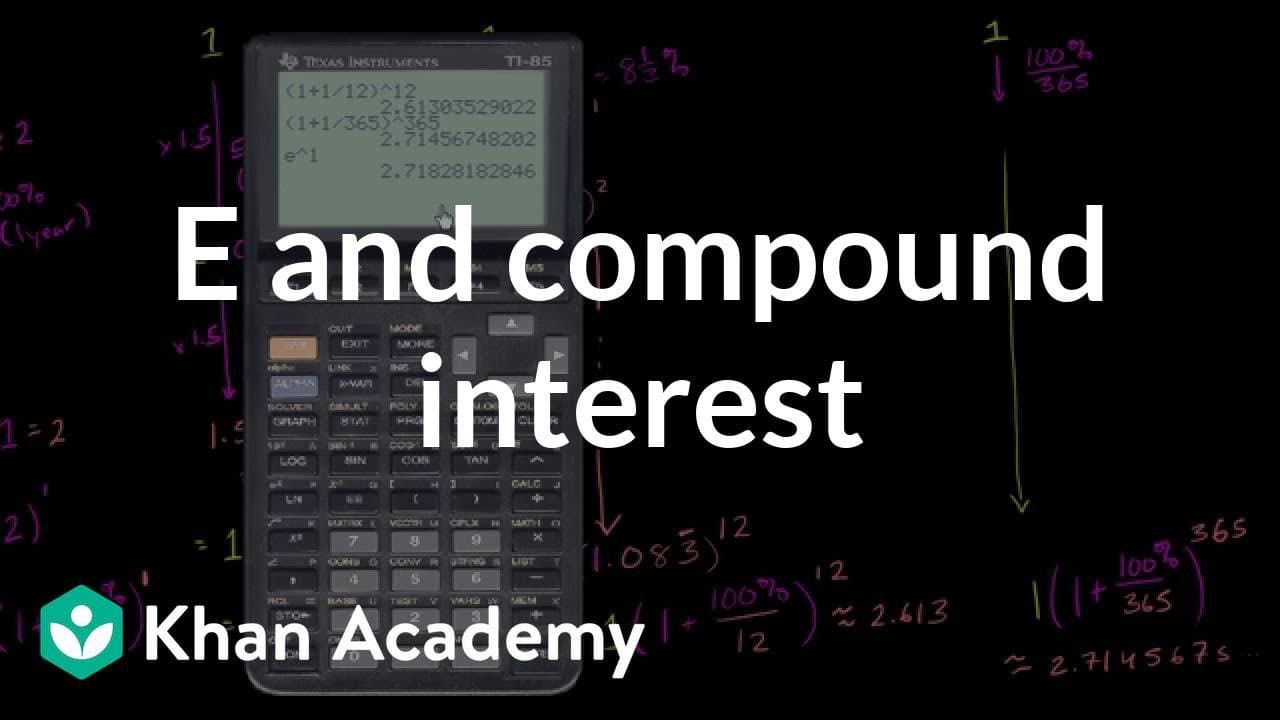
Compound interest refers to earning interest on both the initial principal and the accumulated interest over time. As the compounding frequency increases, the total amount owed approaches Euler's number, 'e', illustrating exponential growth in debt or investments. Understanding this concept is crucial for effective financial decision-making.
Transcript
Let's say that you are desperate for a dollar. So you come to me the local loan shark, and you say hey I need to borrow a dollar for a year. I tell you I'm in a good mood, I willing to lend you that dollar that you need for a year. I will lend it to you for the low interest of 100% per year. 100% per year. How much would you have to pay me in a yea... Read More
Key Insights
- 🥺 Compound interest leads to exponential growth of debt or investment over time.
- ✋ Shorter compounding periods result in higher total repayment amounts.
- 🛩️ Euler's number (e) is a mathematical constant that is approached as compounding periods become infinitesimally small.
Install to Summarize YouTube Videos and Get Transcripts
Explore YouTube Video Summarizer or Get YouTube Transcript Extractor
Questions & Answers
Q: What is compound interest?
Compound interest is interest that is calculated on both the initial amount borrowed (principal) and any accumulated interest from previous periods. It leads to exponential growth of the debt or investment over time.
Q: How does the frequency of compounding affect the amount owed?
The more frequently you compound the interest, the higher the total repayment amount will be. Shorter compounding periods result in a greater accumulation of interest on the principal.
Q: What is the relationship between compound interest and Euler's number?
As the compounding period becomes infinitesimally small, the total amount owed approaches Euler's number (e). Euler's number is a mathematical constant that arises naturally in many areas of mathematics and has a value of approximately 2.71828.
Q: How can compound interest be calculated for different periods?
You can calculate compound interest using the formula A = P(1 + r/n)^(nt), where A is the total amount owed, P is the principal, r is the interest rate, n is the number of compounding periods per year, and t is the number of years.
Summary & Key Takeaways
-
The video explains the concept of compound interest using a loan shark scenario and a borrower who needs to repay a dollar with different interest rates over various periods.
-
It demonstrates that as the compounding period decreases and interest is applied more frequently, the total amount owed approaches the mathematical constant "e."
-
The video shows how the borrower's repayment amount increases with shorter compounding periods and provides a formula for calculating the total repayment based on the principal and interest rate.
Read in Other Languages (beta)
Share This Summary 📚
Summarize YouTube Videos and Get Video Transcripts with 1-Click
Try YouTube Summary with ChatGPT & Claude or YouTube Transcript Generator
Explore More Summaries from Khan Academy 📚



Summarize YouTube Videos and Get Video Transcripts with 1-Click
Try YouTube Summary with ChatGPT & Claude or YouTube Transcript Generator