Breaking up integral interval | Accumulation and Riemann sums | AP Calculus AB | Khan Academy
TL;DR
Breaking up definite integrals into smaller integrals is a useful technique in Calculus, especially for functions with discontinuities or step functions.
Transcript
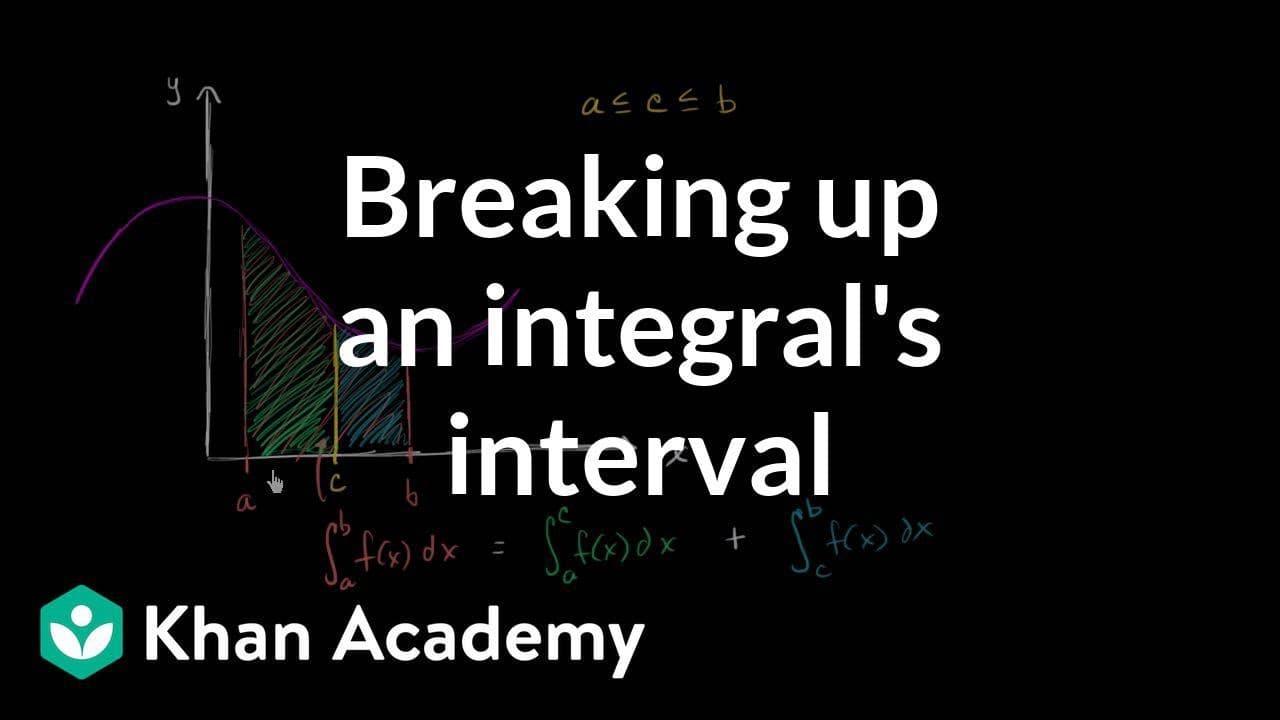
- So we've depicted here the area under the curve F of X above the X-axis, between the points X equals A and X equals B. And we've denote it as the definite integral from A to B of F of X, DX. Now what I wanna do with this video is introduce a third value, C, that is in between A and B. And it could be equal to A or it could be equal to B. So let m... Read More
Key Insights
- 🔙 The definite integral from A to B can be broken up into the sum of integrals from A to C and from C to B, with C being any value between A and B.
- 🍵 Breaking up integrals is particularly useful for handling functions with discontinuities or step functions.
- 👻 This technique simplifies calculations and allows for a better understanding of the behavior of functions.
- 👍 It is a fundamental property in Calculus that has various applications and is crucial for proving the fundamental theorem of Calculus.
- 🤝 Breaking up integrals is a valuable tool in dealing with functions that have different segments or behaviors on different intervals.
- 👻 This property allows for simplifying complex integrals and calculating the total area under the curve of a function.
- ❓ It is a widely used technique in solving mathematical problems related to integration.
Install to Summarize YouTube Videos and Get Transcripts
Explore YouTube Video Summarizer or Get YouTube Transcript Extractor
Questions & Answers
Q: How can the definite integral from A to B be broken up into smaller integrals?
The integral from A to B can be broken up into the integral from A to C and the integral from C to B, where C is any value between A and B. This allows for simplifying complex integrals or dealing with functions that have different behaviors on different intervals.
Q: What types of functions can benefit from breaking up integrals?
Breaking up integrals is especially useful for functions with discontinuities or step functions. By breaking the integral into smaller parts, you can handle the different behaviors of the function separately and make calculations more manageable.
Q: What is the benefit of breaking up integrals?
Breaking up integrals helps to simplify complex calculations and allows for a better understanding of the behavior of the function. It can also be used to calculate the total area under the curve of functions with different segments.
Q: How is this integral property useful in the fundamental theorem of Calculus?
The fundamental theorem of Calculus states that the definite integral of a function can be found by evaluating its antiderivative at the endpoints. Breaking up integrals is essential for proving this theorem as it allows for evaluating the function over smaller intervals and then combining the results.
Summary & Key Takeaways
-
The definite integral from A to B of a function can be broken up into integrals from A to C and from C to B, where C is any value between A and B.
-
Breaking up the integral is useful for functions with discontinuities or step functions.
-
This technique is also crucial for proving the fundamental theorem of Calculus.
Read in Other Languages (beta)
Share This Summary 📚
Summarize YouTube Videos and Get Video Transcripts with 1-Click
Try YouTube Summary with ChatGPT & Claude or YouTube Transcript Generator
Explore More Summaries from Khan Academy 📚



Summarize YouTube Videos and Get Video Transcripts with 1-Click
Try YouTube Summary with ChatGPT & Claude or YouTube Transcript Generator