Statistical Learning: 1.2 Examples and Framework
TL;DR
This content provides an overview of supervised and unsupervised learning, their objectives, and their importance in data science.
Transcript
okay now we're going to talk about the supervised learning problem and set down a little bit of notation so we'll have an outcome measurement y which is goes by various names dependent variable response or target and then we'll have a vector of p predictor measurements which are usually called x they go by the name inputs regressors covariates feat... Read More
Key Insights
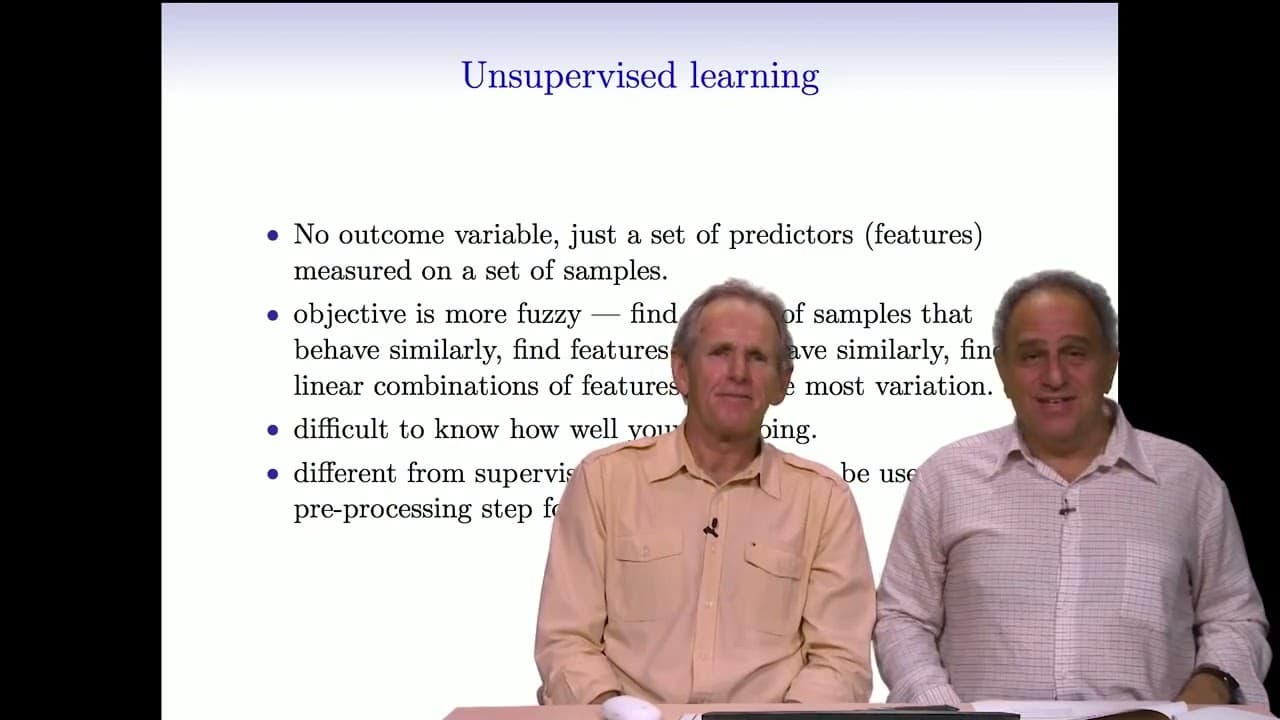
- ⚾ Supervised learning involves predicting outcomes based on training data, while unsupervised learning focuses on organizing data without any known outcome variable.
- 🔠 The objectives of supervised learning are accurate predictions, understanding input-outcome relationships, and assessing prediction quality.
- ❓ Simple methods like linear models can be highly effective in supervised learning.
- 🖐️ Unsupervised learning plays a crucial role as a preprocessor for supervised learning, aiding in feature selection and organization.
- 🏅 It is challenging to assess the performance of unsupervised learning methods, as there is no gold standard for comparison.
- 🥺 The Netflix Prize competition was an example of the application of machine learning in improving the recommender system, leading to significant research advancements.
- 🎰 Statistical learning and machine learning have overlaps, but machine learning tends to work on larger-scale problems and focuses more on pure prediction.
- 📔 The course "Introduction to Statistical Learning" covers the concepts in the book by the same name, introducing the R computing language for data analysis. Both books are available for free.
Install to Summarize YouTube Videos and Get Transcripts
Explore YouTube Video Summarizer or Get YouTube Transcript Extractor
Questions & Answers
Q: What is supervised learning?
Supervised learning is the task of predicting outcomes based on training data, where the outcome is either quantitative (regression) or categorical (classification). The goal is to accurately predict unseen test cases and understand the impact of the input variables on the outcome.
Q: What is unsupervised learning?
Unsupervised learning involves organizing data without any known outcome variable. The objective is to identify common patterns and important features in the data. Clustering and principal components are important techniques in unsupervised learning.
Q: Why is it important to understand the ideas behind different techniques in machine learning?
Understanding the underlying ideas of different techniques enables us to judge which methods are likely to work well in different situations. It is important to try simpler methods first to grasp the more sophisticated ones. Additionally, knowing how well a method is performing allows us to communicate its effectiveness to others.
Q: What are the advantages of unsupervised learning over supervised learning?
Unsupervised learning is useful as a preprocessor for supervised learning, as it helps in organizing features and choosing important ones. Collecting unlabeled data is easier and more common compared to labeled data, making unsupervised learning more practical in many situations.
Summary & Key Takeaways
-
Supervised learning involves predicting outcomes based on training data, where the outcome is either quantitative (regression) or categorical (classification).
-
The objectives of supervised learning are accurate predictions, understanding the relationship between inputs and outcomes, and assessing prediction quality.
-
Unsupervised learning involves organizing data based on common patterns without any known outcome variable, and the objective is to learn how the data is organized and identify important features.
Read in Other Languages (beta)
Share This Summary 📚
Summarize YouTube Videos and Get Video Transcripts with 1-Click
Try YouTube Summary with ChatGPT & Claude or YouTube Transcript Generator
Explore More Summaries from Stanford Online 📚
Summarize YouTube Videos and Get Video Transcripts with 1-Click
Try YouTube Summary with ChatGPT & Claude or YouTube Transcript Generator