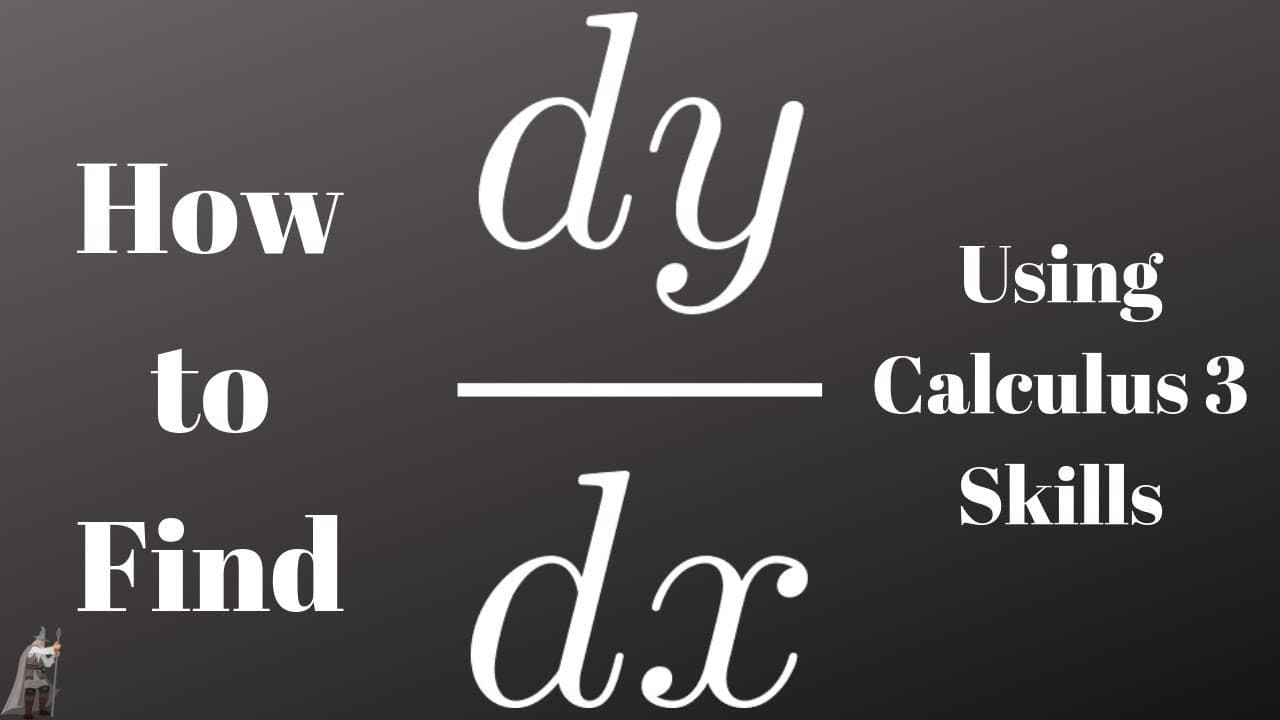
How to Find dy/dx using Calculus 3 Implicit Differentiation
TL;DR
This video explains the implicit differentiation formula to find dy/dx and applies it to solve a trigonometric function problem.
Transcript
in this video we're going to find dy/dx using some calculus 3 so we have the following so if you have a function of two variables say big f of X Y and it's equal to zero so if this defines Y implicitly as a function of X then there is a formula for dy/dx so implicitly as a function of X then then there is a really nice formula for dy/dx which you t... Read More
Key Insights
- 💳 The implicit differentiation formula, dy/dx = -F sub X / F sub Y, is used to find the derivative of a function defined implicitly as a function of another variable.
- ☺️ The formula is applicable when F sub Y is not equal to 0 for any x and y.
- ❣️ The chain rule is used in the proof of the implicit differentiation formula, with the derivatives of x and y with respect to x being substituted into the formula.
- 📏 The implicit differentiation formula can be applied to solve trigonometric function problems, simplifying the process compared to using product rules.
- 🐞 In the example problem solved in the video, the implicit differentiation formula is used to find dy/dx of a function involving secant and tangent functions, resulting in dy/dx = -Y/X.
- 🐞 The implicit differentiation formula saves time and simplifies the process of finding dy/dx for functions defined implicitly.
- 🅰️ The formula can also be applied to other types of functions and equations, not just trigonometric functions.
Install to Summarize YouTube Videos and Get Transcripts
Explore YouTube Video Summarizer or Get YouTube Transcript Extractor
Questions & Answers
Q: What is the implicit differentiation formula for finding dy/dx?
The implicit differentiation formula is dy/dx = -F sub X / F sub Y, where F sub X is the partial derivative of the function with respect to x and F sub Y is the partial derivative with respect to y.
Q: When is the implicit differentiation formula applicable?
The implicit differentiation formula is applicable when the function is defined implicitly as a function of another variable and when F sub Y is not equal to 0 for any x and y.
Q: How can the chain rule be used in implicit differentiation?
The chain rule is used in implicit differentiation to find the derivative of a function defined implicitly. The derivative is calculated by taking the partial derivative with respect to x and y and then substituting them into the formula dy/dx = -F sub X / F sub Y.
Q: How is the implicit differentiation formula applied to solve trigonometric function problems?
To solve trigonometric function problems using the implicit differentiation formula, the function is first rearranged to equal zero. Then, the partial derivatives with respect to x and y are calculated, and the formula -F sub X / F sub Y is used to find dy/dx.
Summary & Key Takeaways
-
The video introduces the implicit differentiation formula for finding dy/dx of a function defined implicitly as a function of another variable.
-
The formula for dy/dx is given as -F sub X divided by F sub Y, where F sub X and F sub Y are the partial derivatives of the function with respect to x and y, respectively.
-
An example problem involving trigonometric functions is solved using the implicit differentiation formula, resulting in dy/dx = -Y/X.
Read in Other Languages (beta)
Share This Summary 📚
Summarize YouTube Videos and Get Video Transcripts with 1-Click
Try YouTube Summary with ChatGPT & Claude or YouTube Transcript Generator
Explore More Summaries from The Math Sorcerer 📚


Summarize YouTube Videos and Get Video Transcripts with 1-Click
Try YouTube Summary with ChatGPT & Claude or YouTube Transcript Generator