How Can We Achieve Sustainable Housing for 11 Billion People?
TL;DR
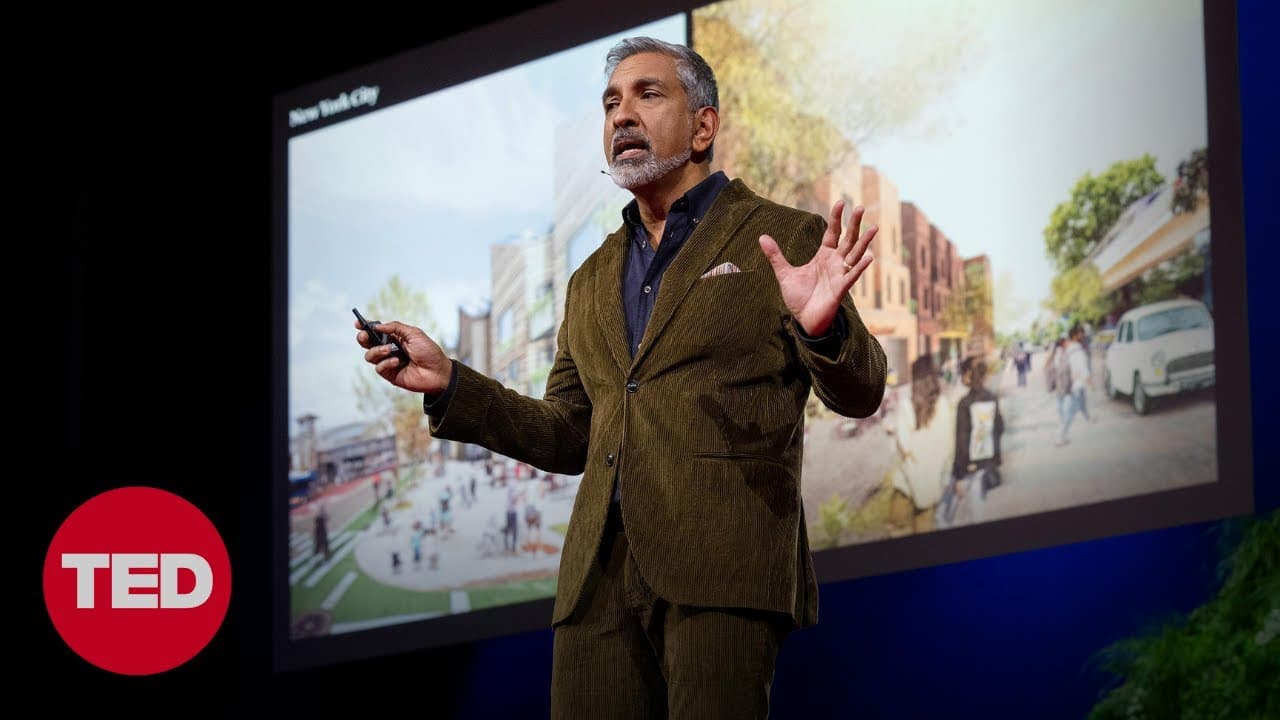
To house the projected 11 billion people by 2100 sustainably, we need to adopt a 'Goldilocks' scale of two- to three-story housing built from eco-friendly materials. This model can create carbon-negative, transit-rich communities while using existing technologies like solar power and effective waste management, ultimately offsetting more carbon emissions than global car usage.
Transcript
So, I was born in India. This is just a small part of my big, beautiful family there. I have, actually, 50, five zero, first cousins. Most of us have a couple of kids. And so all of this leads me to believe the United Nations when they tell us that by 2100, the world will have a population of almost 11 billion people. That is, three billion more pe... Read More
Key Insights
- 🌍 The world population is projected to reach almost 11 billion people by 2100, necessitating the construction of 2.4 trillion square feet of new built space.
- 🏢 Clean energy grids fueled by renewables are a crucial part of the solution for sustainable cities, but we are still a ways away from fully implementing them.
- 🏡 Net-zero single-family homes, particularly in sunny climates, are a feasible option with existing technology, but they can contribute to car-oriented sprawl.
- 🗼 Skyscrapers are not currently sustainable due to their high energy consumption and lack of effective solar and wind utilization.
- 🏘️ A "Goldilocks" scale of housing, such as two- to three-story buildings, offers a solution that is both technologically attainable and broadly affordable.
- ♻️ This Goldilocks framework can be built from simple local materials, incorporate solar power and energy storage, and compost waste to create usable soil or animal feed.
- 🚇 Housing built using this framework can support mass transit, lower stormwater impacts, and reduce heat island effects while preserving land for nature and agriculture.
- 🌍 Implementing this model globally can accommodate all 11 billion people projected by 2100 and offset more carbon emissions than all cars in the world combined.
Install to Summarize YouTube Videos and Get Transcripts
Explore YouTube Video Summarizer or Get YouTube Transcript Extractor
Questions & Answers
Q: What does the speaker believe about the world's population growth by 2100?
The speaker believes that by 2100, the world will have a population of almost 11 billion people, which is three billion more people than the current population.
Q: How much new built space is needed to house all of those people?
To house the projected population of almost 11 billion people, approximately 2.4 trillion square feet of new built space is needed, which is equivalent to adding a New York City to the planet every month for the next 40 years.
Q: Can new housing be carbon-negative?
The speaker suggests that new housing could be carbon-negative, meaning that it offsets or sequesters more carbon than it produces.
Q: What are the challenges with building clean energy grids in existing cities?
The speaker mentions that existing cities, where most of the population growth will occur, currently face challenges such as problems with transmission lines and the politics of nuclear energy, which hinder the development of fully clean power grids.
Q: What is the speaker's proposed solution for sustainable urban housing?
The speaker introduces the concept of a "Goldilocks" scale, which involves building two- to three-story housing using locally available materials like wood or brick, supplemented with solar panels and state-of-the-art battery systems. This type of housing can provide affordable, communal, and equitable housing while being sustainable for both the climate and societies.
Summary & Key Takeaways
-
The United Nations predicts a global population of 11 billion by 2100, requiring 2.4 trillion square feet of new built space to accommodate everyone.
-
Existing clean energy grids are not yet capable of supporting this population growth, so sustainable housing solutions are needed.
-
The speaker suggests a "Goldilocks" scale of two- to three-story housing, built with environmentally friendly materials and powered by solar panels, to provide affordable and carbon-negative housing for communities in need.
Read in Other Languages (beta)
Share This Summary 📚
Summarize YouTube Videos and Get Video Transcripts with 1-Click
Try YouTube Summary with ChatGPT & Claude or YouTube Transcript Generator
Explore More Summaries from TED 📚



Summarize YouTube Videos and Get Video Transcripts with 1-Click
Try YouTube Summary with ChatGPT & Claude or YouTube Transcript Generator