First Order Partial Derivation of Composite Function Problem 2
TL;DR
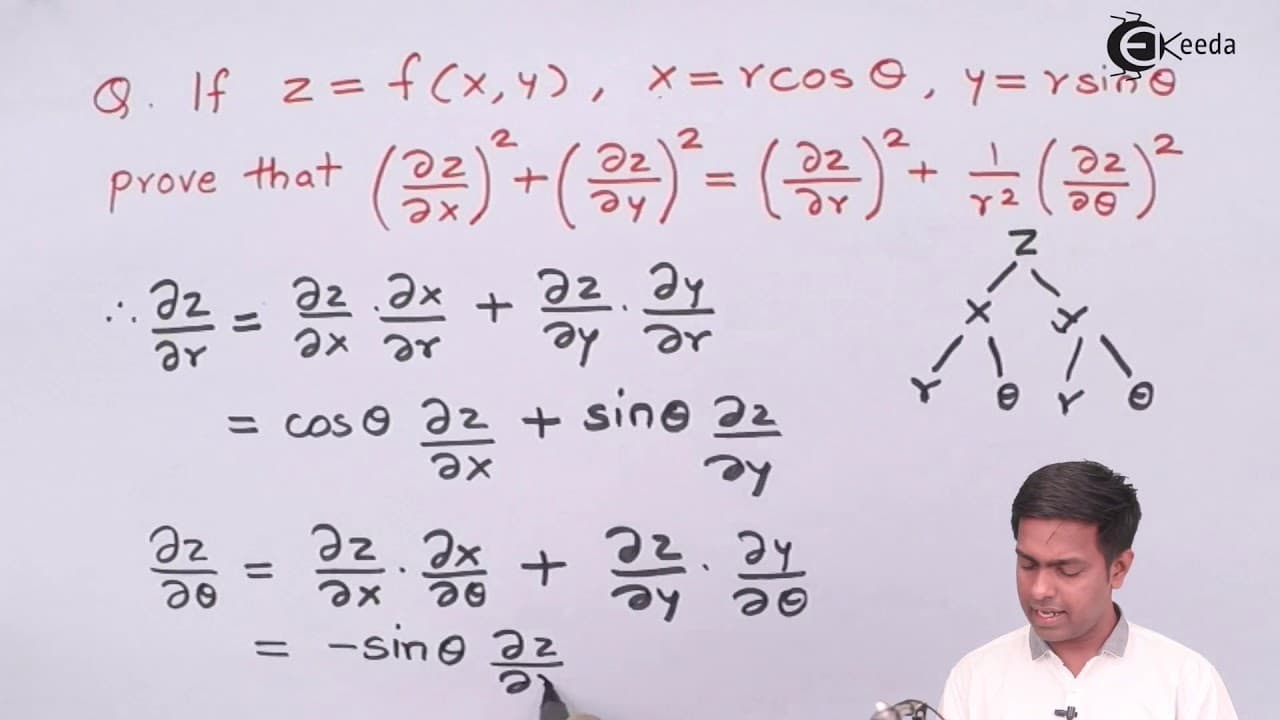
This content explains how to find the partial differentiation of a composite function using a tree diagram.
Transcript
hello students so now we are going to start with second numerical on composite function so here we will find out the partial differentiation of composite function and we'll see how to prove the result so guys here we have z as a function of x and y which is given here where x is a function of r n theta and y is also function of r and theta so it cl... Read More
Key Insights
- 😒 The use of a tree diagram simplifies the process of finding the partial differentiation of composite functions.
- 🤐 The dependent variable (z) and independent variables (r and theta) are crucial in determining the partial derivatives.
- ❣️ Differentiating intermediate variables (x and y) is not possible if they are not defined.
Install to Summarize YouTube Videos and Get Transcripts
Explore YouTube Video Summarizer or Get YouTube Transcript Extractor
Questions & Answers
Q: What is the purpose of using a tree diagram in finding the partial differentiation of a composite function?
The tree diagram helps in visualizing the relationship between the dependent and independent variables, making it easier to solve the problem.
Q: How do you determine whether to start with the left-hand side (LHS) or right-hand side (RHS) when finding the partial derivatives?
By observing the tree diagram, you can identify the dependent variable (z) and the independent variables (r and theta). Start with the RHS to find the values of the independent variables, which can then be used to calculate the LHS.
Q: How can you find the partial derivatives of the intermediate variables (x and y) in the given composite function?
Since the intermediate variables are not defined, their partial derivatives cannot be calculated. However, you can find the partial derivatives of the dependent variable (z) with respect to the independent variables (r and theta) to establish a relationship between them.
Q: How do you find the partial differentiation with respect to r and theta, given the composite function?
Using the tree diagram, differentiate the dependent variable (z) with respect to the independent variables (r and theta). Apply the chain rule and partial differentiation to find the values of del z by del r and del z by del theta.
Summary & Key Takeaways
-
The content discusses the process of finding the partial differentiation of a composite function.
-
It emphasizes the importance of using a tree diagram to solve such problems.
-
The content provides a step-by-step solution to find the partial derivatives of a given composite function.
Read in Other Languages (beta)
Share This Summary 📚
Summarize YouTube Videos and Get Video Transcripts with 1-Click
Try YouTube Summary with ChatGPT & Claude or YouTube Transcript Generator
Explore More Summaries from Ekeeda 📚






Summarize YouTube Videos and Get Video Transcripts with 1-Click
Try YouTube Summary with ChatGPT & Claude or YouTube Transcript Generator