Part 1 of proof of Heron's formula | Perimeter, area, and volume | Geometry | Khan Academy
TL;DR
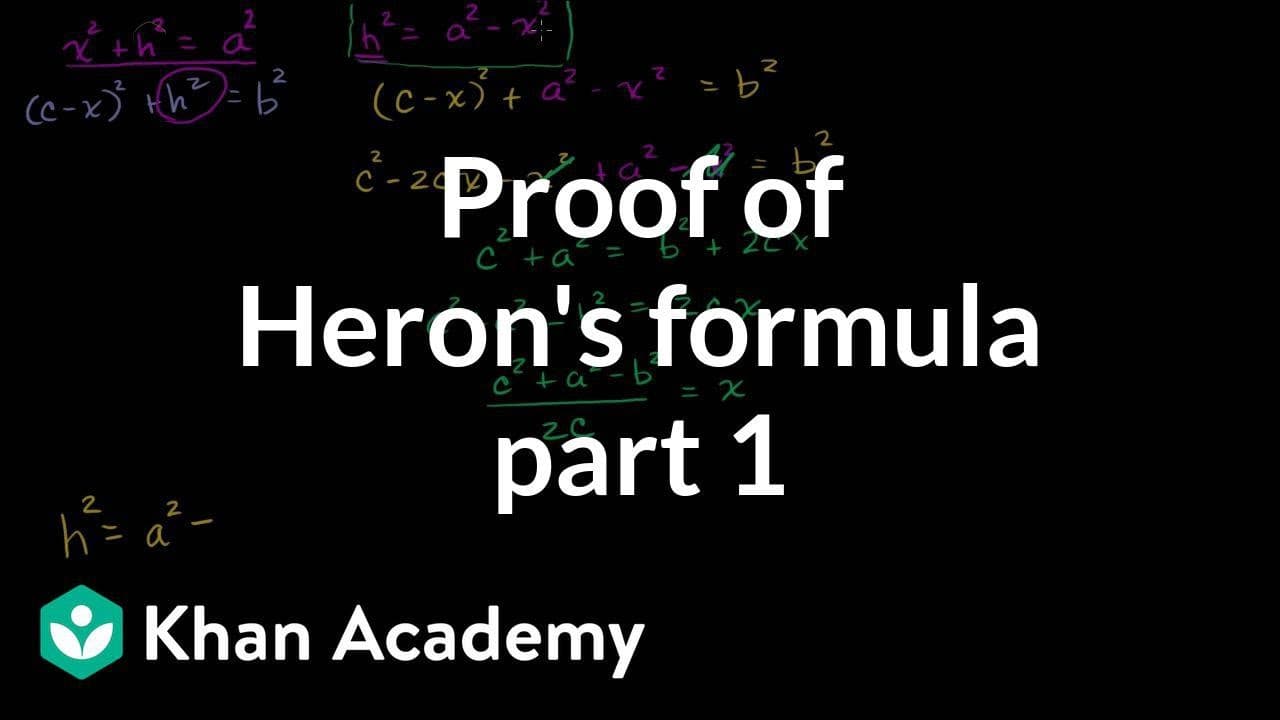
This video provides a geometric proof of the formula to find the area of a triangle using Heron's formula.
Transcript
Let's say I've got a triangle. There is my triangle right there. And I only know the lengths of the sides of the triangle. This side has length a, this side has length b, and that side has length c. And I'm asked to find the area of that triangle. So far all I'm equipped with is the idea that the area, the area of a triangle is equal to 1/2 times t... Read More
Key Insights
- 🛀 The video shows a step-by-step derivation of a formula to find the area of a triangle using only the side lengths.
- 👍 By using the Pythagorean theorem in combination with algebra, the video proves the formula's validity.
- 😒 The derived formula uses the base and height of the triangle, which are obtained through solving two Pythagorean theorem equations.
- 🛀 The formula derived in the video is shown to be equivalent to Heron's formula for calculating triangle area.
Install to Summarize YouTube Videos and Get Transcripts
Explore YouTube Video Summarizer or Get YouTube Transcript Extractor
Questions & Answers
Q: How does the video prove the formula for finding the area of a triangle?
The video starts by labeling the sides of the triangle and introducing variables. It then sets up two Pythagorean theorem equations and solves them algebraically to find the values of x and h, which represent the base and height of the triangle. These values are then substituted into the area formula to derive the final expression.
Q: What is Heron's formula, and how does it relate to the derived formula?
Heron's formula is a well-known formula for finding the area of a triangle using its side lengths. The derived formula in the video, though more complex, yields the same result as Heron's formula. In the next video, the speaker will simplify the derived formula to show its equivalence to Heron's formula.
Q: Is the derived formula difficult to memorize compared to Heron's formula?
The derived formula may be more challenging to memorize due to its complexity. However, it offers an alternative approach to calculating the area of a triangle when only the side lengths are known. If one is comfortable with algebraic manipulation and has a good understanding of the Pythagorean theorem, the derived formula can be a useful tool.
Q: Can the derived formula be used for all types of triangles?
Yes, the derived formula can be applied to any triangle where only the side lengths are known. As long as one can calculate the values of x and h using the Pythagorean theorem and substitutions, the formula can be used to find the area of the triangle accurately.
Summary & Key Takeaways
-
The video aims to prove the formula to find the area of a triangle when only the lengths of the sides are known.
-
By using the Pythagorean theorem and algebra, the video shows how to derive the height of the triangle in terms of its side lengths.
-
The video then demonstrates how to substitute the derived height into the standard area formula to calculate the area of the triangle.
-
Finally, it compares the calculated area using the derived formula with the area obtained from Heron's formula, showing that they yield the same result.
Read in Other Languages (beta)
Share This Summary 📚
Summarize YouTube Videos and Get Video Transcripts with 1-Click
Try YouTube Summary with ChatGPT & Claude or YouTube Transcript Generator
Explore More Summaries from Khan Academy 📚



Summarize YouTube Videos and Get Video Transcripts with 1-Click
Try YouTube Summary with ChatGPT & Claude or YouTube Transcript Generator