Fascism and Mussolini | The 20th century | World history | Khan Academy
TL;DR
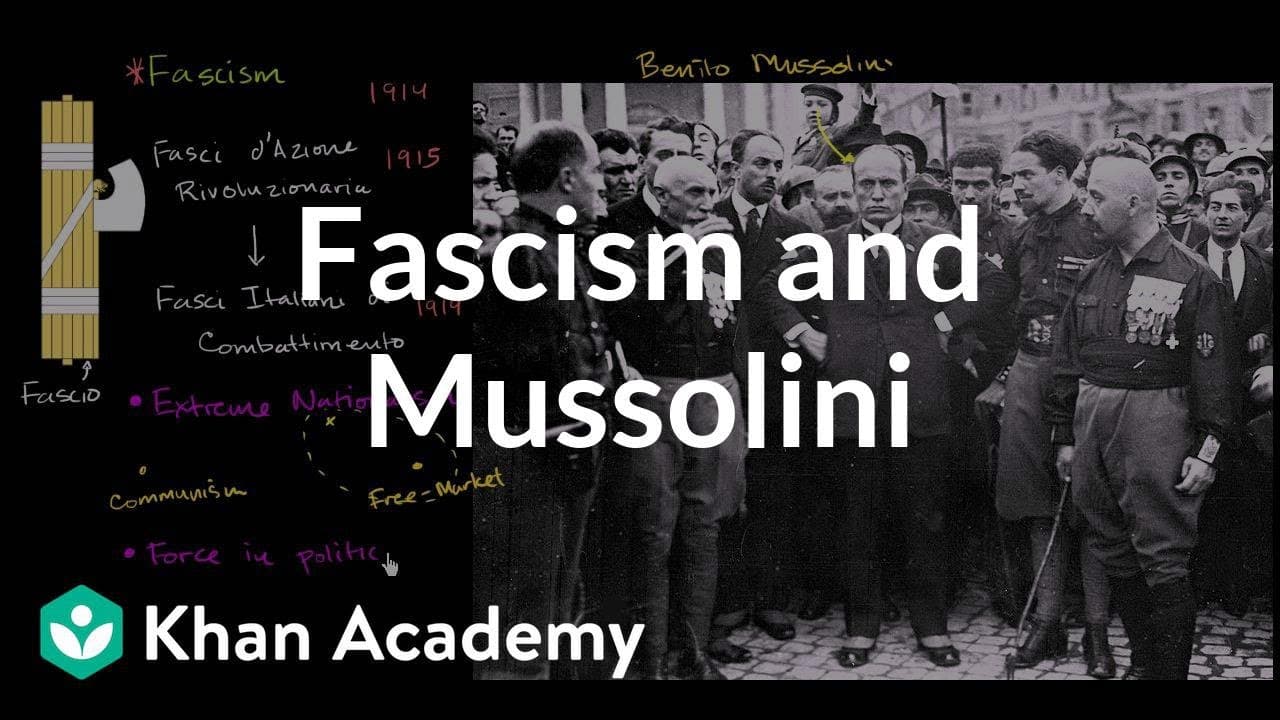
Fascism originated with Benito Mussolini and is characterized by extreme nationalism, totalitarianism, and aggressive foreign policy.
Transcript
When people use the terms "fascism" or "fascist" today, they're usually using it in a derogatory way to refer to a group, a regime, or even an individual that is overly aggressive, and controlling, and totalitarian. But its roots, actually, lie with Benito Mussolini, who was in power in Italy during the 1920s, and 1930s, and through World War II. A... Read More
Key Insights
- 📏 Fascism originated with Benito Mussolini and his rule in Italy during the 1920s and 1930s.
- 🍉 The term "fascism" comes from the Italian word "fascio," meaning a bundle, symbolizing strength in unity.
- ❓ Fascism is characterized by extreme nationalism, force in politics, opposition to democracy, subordination of the economy to the state, and aggressive foreign policy.
- 😘 Fascism is not strictly left-wing or right-wing, but it tends to align more with right-wing groups due to its anti-communist and anti-socialist ideology.
- 🫵 Fascists view themselves as a separate ideology, with the state and national interests above all else.
- 👥 Fascism emphasizes the use of force in politics, with paramilitary groups enforcing political control.
- 🥳 Fascists reject democracy in favor of strong leadership and one-party rule.
Install to Summarize YouTube Videos and Get Transcripts
Explore YouTube Video Summarizer or Get YouTube Transcript Extractor
Questions & Answers
Q: What is the origin of the term "fascism" and its symbol?
The term "fascism" comes from the Italian word "fascio," which means bundle, symbolizing strength in unity. The symbol of fascism, a bundle of sticks, predates Mussolini by thousands of years and has been used as a symbol of unity and strength throughout history.
Q: How did Mussolini establish and develop the ideology of fascism?
Mussolini founded the Fasci d'Azione Rivoluzionaria in 1915, a splinter group of the Socialist Party. Although fascism's ideology was not well-established at first, it evolved over time with a core emphasis on extreme nationalism, force in politics, opposition to democracy, and putting the interests of the state above all else.
Q: Is fascism considered a left-wing or right-wing ideology?
Fascism does not align strictly with either left-wing or right-wing ideologies. While it emphasizes subordinating everything to the state and the economy serving national interests, fascists tend to align themselves more with right-wing groups due to their strong anti-communist and anti-socialist stance.
Q: How did fascism view foreign policy and cultural superiority?
Fascism promoted aggressive foreign policy based on the belief in cultural superiority. Mussolini's fascism emphasized Italian cultural superiority, while the Nazis took it further with extreme racial superiority. Both sought to expand their territories and secure space for their superior populations to thrive.
Summary & Key Takeaways
-
Fascism traces its roots back to Benito Mussolini and his rule in Italy during the 1920s and 1930s, as well as through World War II.
-
The term "fascism" comes from the Italian word "fascio," meaning a bundle, which symbolizes strength in unity.
-
Mussolini's fascist ideology emphasized extreme nationalism, force in politics, opposition to democracy, and aggressive foreign policy.
Read in Other Languages (beta)
Share This Summary 📚
Summarize YouTube Videos and Get Video Transcripts with 1-Click
Try YouTube Summary with ChatGPT & Claude or YouTube Transcript Generator
Explore More Summaries from Khan Academy 📚



Summarize YouTube Videos and Get Video Transcripts with 1-Click
Try YouTube Summary with ChatGPT & Claude or YouTube Transcript Generator