Structure of Diamond and Graphite, Properties - Basic Introduction
TL;DR
Diamond and graphite have different molecular structures, conductivity properties, densities, and uses.
Transcript
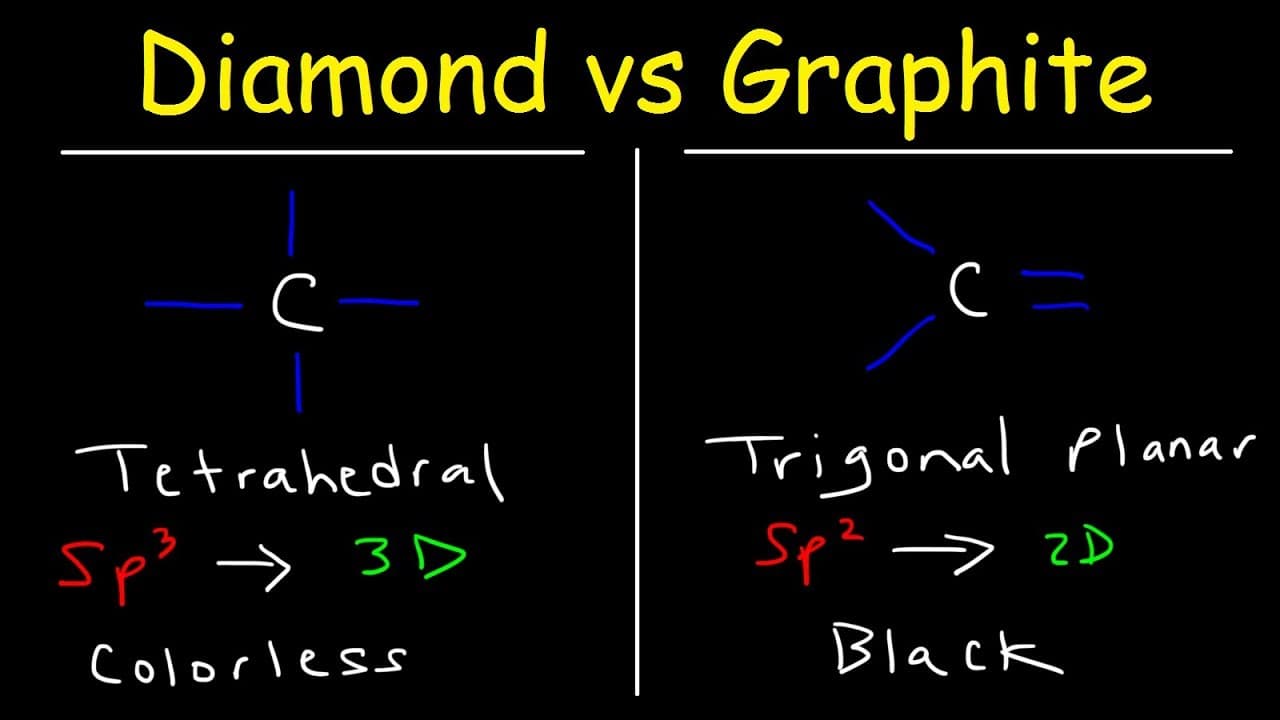
in this video i want to highlight the differences between diamond and graphite in diamond each carbon atom is surrounded by four other carbon atoms in graphite every carbon atom is surrounded by three other carbon atoms now as a result in diamond it has well let me ask you what type of molecular geometry does this carbon have if it's surrounded by ... Read More
Key Insights
- ❓ Diamond and graphite are allotropes of carbon, with different structures and properties.
- ❓ Diamond has a tetrahedral molecular geometry with sp3 hybridization, while graphite has a trigonal planar geometry with sp2 hybridization.
- 🤨 Diamond is an insulator and does not conduct electricity, while graphite is conductive due to the presence of delocalized pi electrons.
- ♦️ Diamond is harder and denser than graphite.
- 💪 Graphite's slippery nature is due to weak interlayer interactions, contrasting diamond's strong covalent bonds throughout.
- 🖤 Diamond is colorless, while graphite is black.
- ✋ Converting graphite into diamond requires high temperature and pressure.
Install to Summarize YouTube Videos and Get Transcripts
Explore YouTube Video Summarizer or Get YouTube Transcript Extractor
Questions & Answers
Q: What is the molecular geometry of carbon in diamond and graphite?
In diamond, carbon has a tetrahedral molecular geometry, while in graphite, carbon has a trigonal planar molecular geometry.
Q: Why does graphite conduct electricity while diamond doesn't?
Graphite conducts electricity due to the presence of delocalized pi electrons, which can move freely. Diamond's localized electrons restrict the flow of electric current.
Q: What are some practical uses of graphite?
Graphite is used for lubrication, marking (in pencils), and as a conductor in various electrical applications.
Q: Can graphite be converted into diamond?
Yes, graphite can be converted into diamond under high temperature (above 2,800 degrees Celsius) and pressure (over 150,000 atm) conditions.
Summary & Key Takeaways
-
Diamond has a tetrahedral molecular structure with sp3 hybridization, while graphite has a trigonal planar structure with sp2 hybridization.
-
Diamond does not conduct electricity due to localized electrons, while graphite conducts electricity due to delocalized pi electrons.
-
Diamond is harder and denser than graphite. Diamond is colorless, while graphite is black and slippery.
-
Diamond can be converted from graphite under high temperature and pressure conditions.
Read in Other Languages (beta)
Share This Summary 📚
Summarize YouTube Videos and Get Video Transcripts with 1-Click
Try YouTube Summary with ChatGPT & Claude or YouTube Transcript Generator
Explore More Summaries from The Organic Chemistry Tutor 📚



Summarize YouTube Videos and Get Video Transcripts with 1-Click
Try YouTube Summary with ChatGPT & Claude or YouTube Transcript Generator