Earth's Biosphere and Climates | Biology
TL;DR
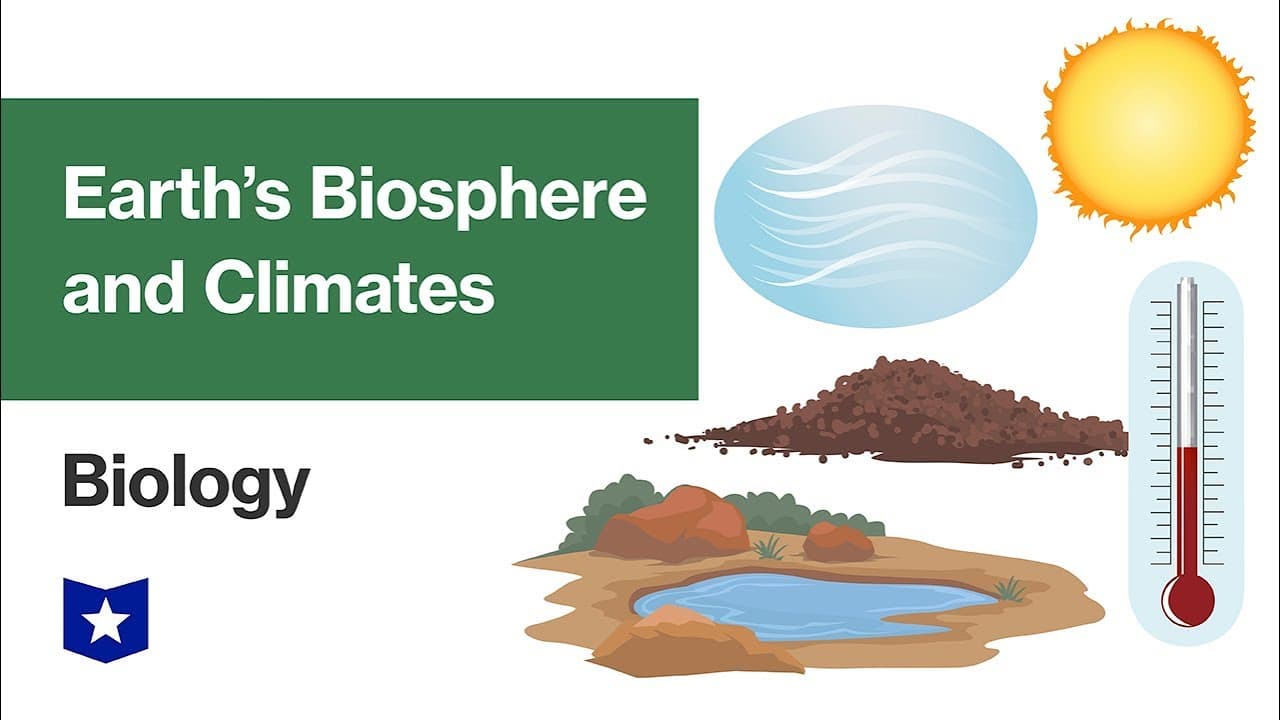
Ecology studies the interactions between organisms and their environment, with different levels of organization, including populations, communities, ecosystems, biomes, and the biosphere.
Transcript
all organisms on earth are connected and their different levels at which these connections can be studied the field of study that looks at interactions between organisms and their environment is known as ecology and there are several levels of organization that have interest in ecologist let's look at some of these levels of organization a populati... Read More
Key Insights
- 🎚️ Ecological studies involve various levels of organization, from populations to the biosphere.
- 🧑🏭 Biotic and abiotic factors influence the distribution and survival of species in different ecosystems.
- ❓ Climate is a significant determinant of ecological patterns, affecting rainfall, vegetation, and the availability of sunlight.
- 💨 Wind patterns and local effects like rain shadows also shape regional climates and ecosystem characteristics.
- 💦 Water availability, temperature, and sunlight are essential abiotic factors that affect the survival and location of organisms.
- 💦 Different organisms have evolved adaptations to cope with specific abiotic factors, such as water loss or extreme temperatures.
- 🌐 Global disturbances, like climate change, can disrupt ecosystems on a large scale, affecting species distribution and survival.
Install to Summarize YouTube Videos and Get Transcripts
Explore YouTube Video Summarizer or Get YouTube Transcript Extractor
Questions & Answers
Q: What is ecology?
Ecology is the study of the interactions between living organisms and their environment, including the relationships between different species and their surroundings.
Q: What is a population in ecology?
A population refers to a group of individuals of the same species that interbreed and occupy a specific area.
Q: How is a community defined in ecology?
A community consists of all the living organisms coexisting in a particular area, interacting with one another and their environment.
Q: What is an ecosystem?
An ecosystem encompasses all the organisms living in a specific geographic region, along with the environmental factors such as temperature and water availability that influence them.
Q: How is a biome different from an ecosystem?
A biome is a large-scale ecosystem defined by its specific climate, physical features, and dominant plant types, typically covering a wide geographical region.
Q: What does the biosphere include?
The biosphere comprises all the biomes on Earth, representing the highest level of organization in ecology. It encompasses the entire planet and influences the global distribution of ecosystems.
Q: What are biotic factors in ecosystem distribution?
Biotic factors include living elements that impact an ecosystem, such as food resources, predators, and pathogens. They can influence the distribution of species and population dynamics.
Q: How do abiotic factors affect ecosystem distribution?
Abiotic factors, including non-living elements like water, temperature, and minerals, play a crucial role in determining the geographic distribution of organisms and their adaptations to specific environments.
Summary & Key Takeaways
-
Organisms in nature are interconnected, and the study of these interactions is known as ecology.
-
Ecology includes various levels of organization, such as populations, communities, ecosystems, biomes, and the biosphere.
-
Factors like biotic (living) and abiotic (nonliving) elements determine the distribution of species in different ecosystems.
Read in Other Languages (beta)
Share This Summary 📚
Summarize YouTube Videos and Get Video Transcripts with 1-Click
Try YouTube Summary with ChatGPT & Claude or YouTube Transcript Generator
Explore More Summaries from Course Hero 📚



Summarize YouTube Videos and Get Video Transcripts with 1-Click
Try YouTube Summary with ChatGPT & Claude or YouTube Transcript Generator