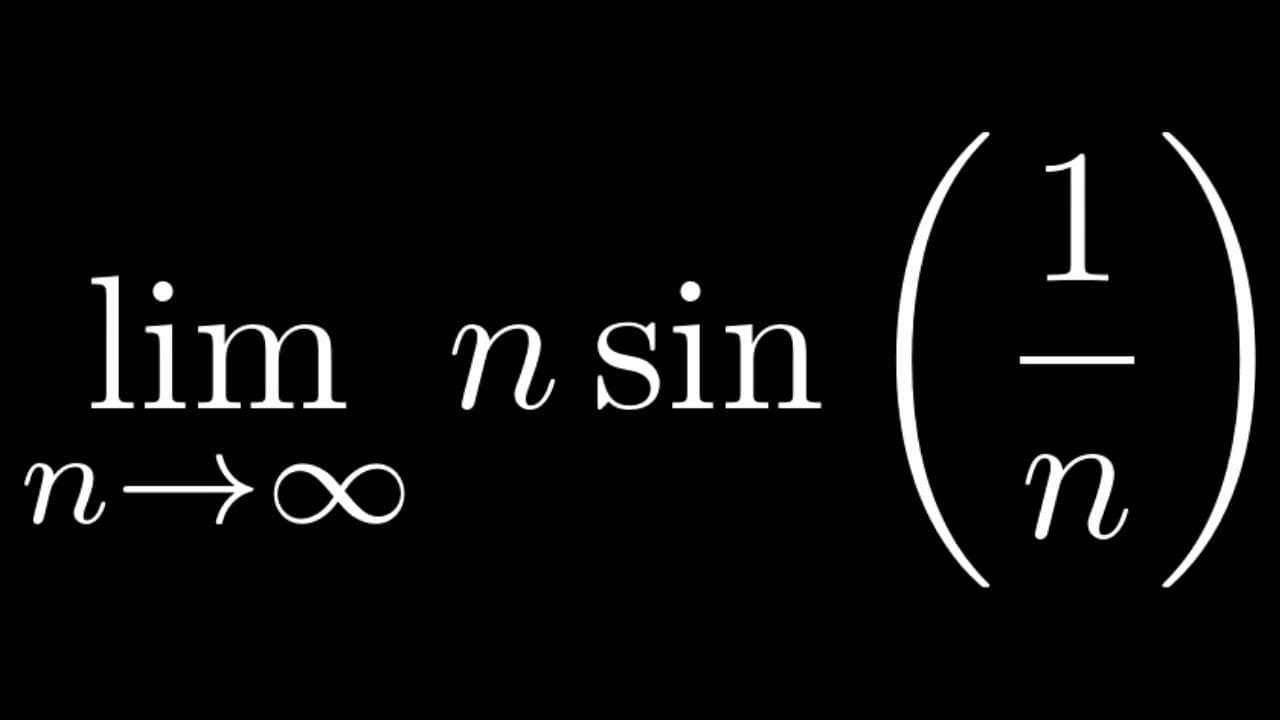
How to Determine if a Sequence Converges or Diverges: Example with n*sin(1/n)
TL;DR
The provided content explains how to determine whether a sequence converges or diverges using L'Hopital's rule and the limit of a function.
Transcript
hi in this problem we have a sequence and we're asked to determine whether it converges or diverges so this one is not tough if you know how to do it there is a trick so we'll start by doing the following we can take a sub n and we need to rewrite it in a way that will allow us to take the limit right now if you look at this as n goes to infinity n... Read More
Key Insights
- 👻 Rewriting a sequence can allow for the application of mathematical rules and principles to determine its convergence or divergence.
- 0️⃣ L'Hopital's rule is used to evaluate the limit of functions and is applicable in cases of indeterminate forms such as zero over zero.
- 📏 By applying L'Hopital's rule, the sequence can be transformed into a function and its convergence or divergence can be determined by evaluating the limit.
- ⛔ The limit of a function can be calculated using derivative rules to simplify the expression and evaluate the limit.
- ⛔ In the provided example, the sequence converges because the limit of the function is a real number.
- ⛔ The convergence or divergence of a sequence can be determined by evaluating the limit and comparing it to a real number.
- 📏 L'Hopital's rule is a useful tool in analyzing sequences and their convergence or divergence.
Install to Summarize YouTube Videos and Get Transcripts
Explore YouTube Video Summarizer or Get YouTube Transcript Extractor
Questions & Answers
Q: What is the purpose of rewriting the sequence in the given format?
By rewriting the sequence as sine of (1/n) divided by (1/n), it allows for the application of L'Hopital's rule to evaluate the limit.
Q: Why is it necessary to apply L'Hopital's rule?
L'Hopital's rule is used to evaluate the limit when there is a zero over zero scenario. It allows for the calculation of the derivative of the numerator and denominator to determine the final limit.
Q: Can L'Hopital's rule be directly applied to sequences?
L'Hopital's rule is not directly applicable to sequences. However, it can be applied to functions, and if the convergence is proven for all real values of x, it also holds for the sequence.
Q: How is the derivative of 1/n calculated?
The derivative of 1/n is calculated by bringing the exponent -1/n upstairs and differentiating it. The resulting derivative is -1/n^2.
Summary & Key Takeaways
-
The content explains the process of rewriting a sequence to allow for the application of L'Hopital's rule.
-
By applying L'Hopital's rule, the limit of the function can be evaluated to determine convergence or divergence of the sequence.
-
The sequence provided in the example converges because the limit of the function is a real number.
Read in Other Languages (beta)
Share This Summary 📚
Summarize YouTube Videos and Get Video Transcripts with 1-Click
Try YouTube Summary with ChatGPT & Claude or YouTube Transcript Generator
Explore More Summaries from The Math Sorcerer 📚

Summarize YouTube Videos and Get Video Transcripts with 1-Click
Try YouTube Summary with ChatGPT & Claude or YouTube Transcript Generator