Limits of combined functions | Limits and continuity | AP Calculus AB | Khan Academy
TL;DR
The limit of the product of two functions as x approaches zero is negative one, while the limit of the quotient of two functions does not exist.
Transcript
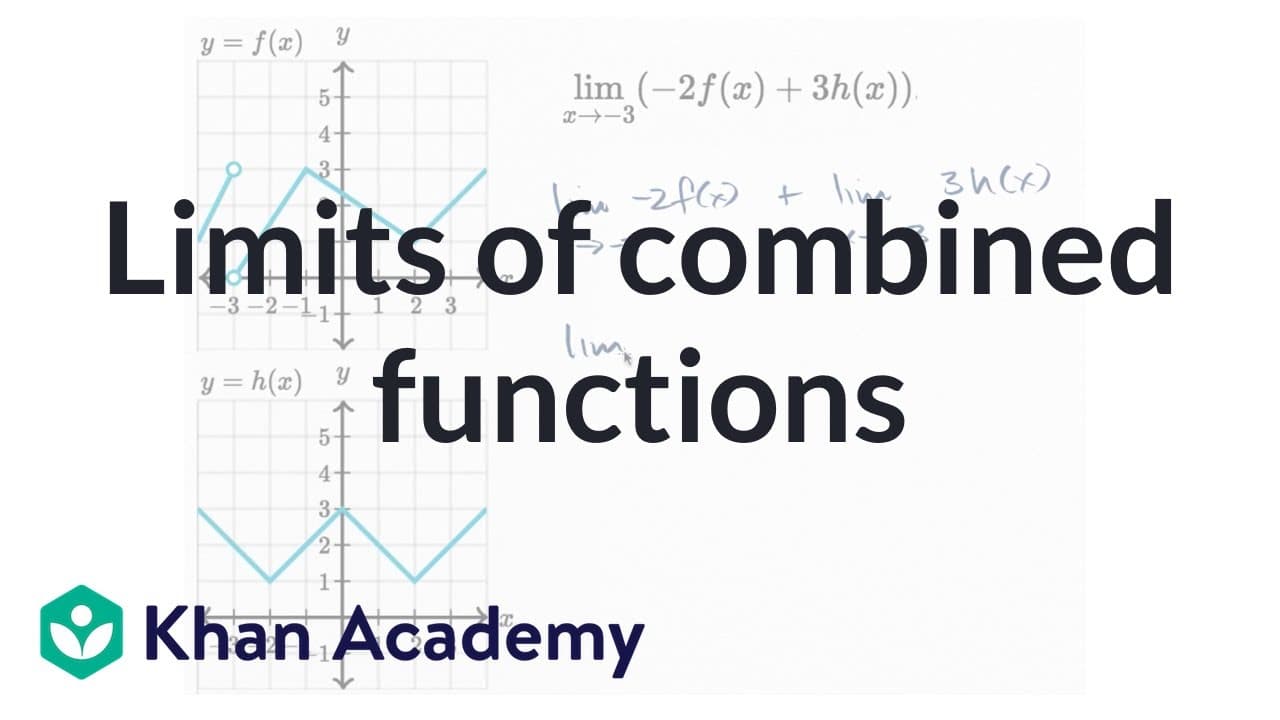
- [Instructor] Let's find the limit of f of x times h of x as x approaches zero. All right, we have graphical depictions of the graphs y equals f of x and y equals h of x. And we know, from our limit properties, that this is going to be the same thing as the limit as x approaches zero of f of x times, times the limit as x approaches zero of h of x.... Read More
Key Insights
- ⛔ The limit of the product of two functions can be found by evaluating the limits of each individual function and multiplying them together.
- ⛔ The limit of the quotient of two functions may not exist if division by zero occurs, even if the limits of the numerator and denominator functions exist individually.
- ⛔ Graphical depictions of functions can provide visual confirmation of the behavior of their limits.
Install to Summarize YouTube Videos and Get Transcripts
Explore YouTube Video Summarizer or Get YouTube Transcript Extractor
Questions & Answers
Q: How do we find the limit of the product of two functions as x approaches zero?
To find the limit of the product, we can evaluate the limits of both individual functions and multiply them together. In this case, as x approaches zero, f(x) approaches -1 and h(x) approaches 1, so the limit of the product is -1.
Q: What is the result when dividing two functions with a limit of zero at x=0?
If both h(x) and g(x) approach zero as x approaches zero, we can evaluate their limits separately. In this case, both h(x) and g(x) approach zero at x=0, but dividing them leads to an undefined result, as division by zero is not defined.
Q: Can the limit of a quotient exist if the limits of the numerator and denominator exist individually?
No, even if the limits of the numerator and denominator functions exist as x approaches zero, the limit of the quotient may not exist if division by zero occurs. This is because division by zero is undefined.
Q: How can the behavior of the functions' limits be confirmed graphically?
By plotting the graphs of the functions, the behavior of the limits can be visualized. In this case, the graph of h(x)/g(x) would clearly illustrate a vertical asymptote at x=0, indicating that the limit does not exist.
Summary & Key Takeaways
-
The limit of the product of two functions, f(x) and h(x), as x approaches zero is -1 because f(x) approaches -1 and h(x) approaches 1 at x=0.
-
The limit of the quotient of two functions, h(x) and g(x), as x approaches zero does not exist because dividing 4 by 0 is undefined.
-
Graphical depictions of the functions illustrate the behavior of the limits.
Read in Other Languages (beta)
Share This Summary 📚
Summarize YouTube Videos and Get Video Transcripts with 1-Click
Try YouTube Summary with ChatGPT & Claude or YouTube Transcript Generator
Explore More Summaries from Khan Academy 📚



Summarize YouTube Videos and Get Video Transcripts with 1-Click
Try YouTube Summary with ChatGPT & Claude or YouTube Transcript Generator