3D Rock Art Scanner - Computerphile
TL;DR
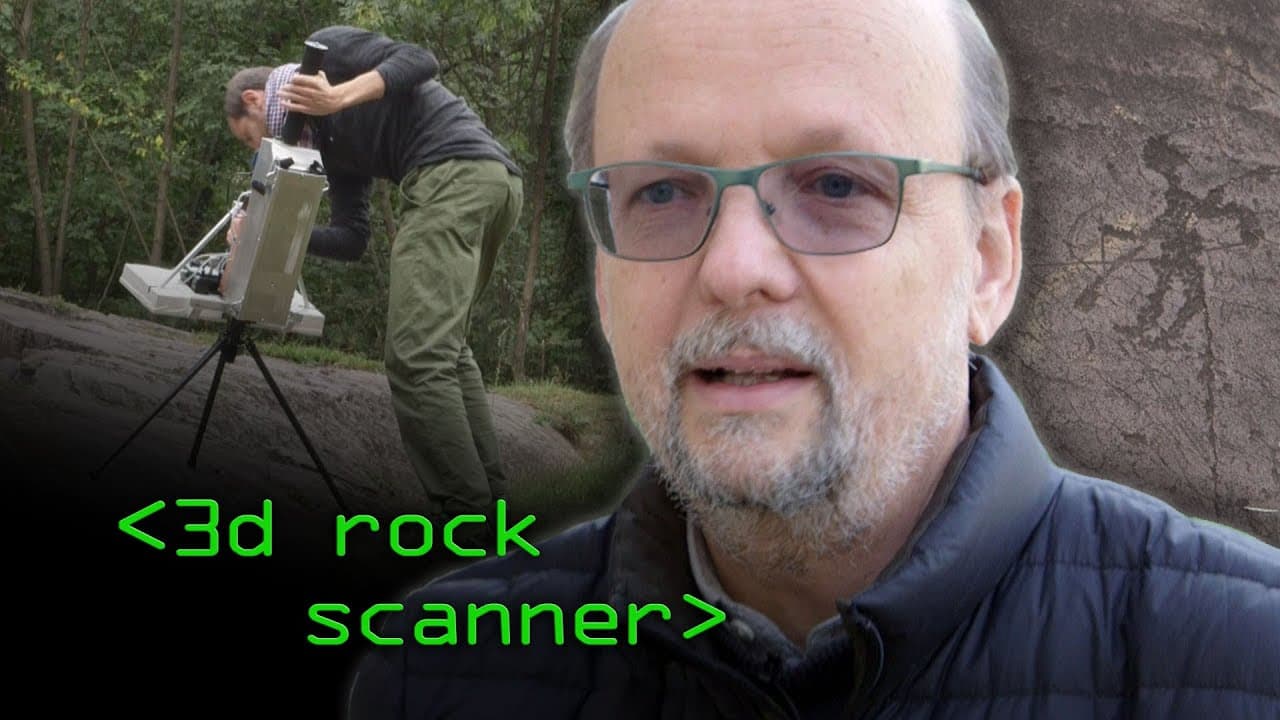
A custom-built scanner utilizes flash and custom design LEDs to capture and reconstruct 3D images of ancient rock art, eliminating shadows and enabling radiometric analysis.
Transcript
it is a scanner for micro range scanning of rock art which has deliberately been built for that purpose what you see here on the floor is a small portion of a 3d print of ancient rock art packed into large rock panels in varkamonica in italy this has been reconstructed in 3d printed and is now just used as a demonstrator object what we would do out... Read More
Key Insights
- 🧡 The scanner enables the precise capture and analysis of micro-range rock art, providing valuable insights into ancient civilizations.
- 👫 By using flash and custom LEDs, shadows and the influence of daylight can be eliminated, ensuring accurate radiometric analysis.
- 🤑 The scanner's 3D point cloud contains rich information about the surface, allowing for detailed measurements and comparisons.
- ❓ Calibration and integration with georeferenced coordinates enable the scanner to be used in archaeological campaigns for accurate spatial referencing.
- ❓ The scanner is currently a prototype, but efforts are being made to develop it into a commercial product accessible to archaeologists worldwide.
- 🫥 Future iterations may expand its capabilities, such as capturing invisible wavelengths like ultraviolet and infrared.
- 🏤 The scanner's cost is expected to be under 5,000 euros in the final commercial version.
Install to Summarize YouTube Videos and Get Transcripts
Explore YouTube Video Summarizer or Get YouTube Transcript Extractor
Questions & Answers
Q: How does the scanner eliminate shadows and the influence of daylight?
The scanner uses a combination of flash photography, custom-designed LEDs, and stereo cameras to subtract frames with and without illumination, effectively shrouding the influence of daylight and eliminating cast shadows.
Q: What additional information does the 3D point cloud carry?
In addition to radiometric and color information, the 3D point cloud also includes coordinates of each point, enabling precise measurements and distance calculations between different points on the rock surface.
Q: How does the scanner capture and process the images?
The scanner is equipped with SLR cameras controlled by a Raspberry Pi running Linux. The captured JPEGs are wirelessly transferred to a tablet PC for initial 3D reconstruction. The raw images are later used for fine radiometric evaluation and structure from motion plus stereo processing to create correctly scaled point clouds.
Q: How is the scanner calibrated and integrated with georeferenced coordinates?
The scanner utilizes a microprism that is precisely measured using a total station. By performing a few prism measurements at balanced locations, the 3D model can be translated and rotated to match georeferenced coordinates, creating a common coordinate system for comparison with other scans.
Summary & Key Takeaways
-
The scanner is specifically designed for micro-range scanning of rock art, allowing for the precise capture of intricate details.
-
By using a combination of flash photography, custom LEDs, and stereo cameras, the scanner eliminates the influence of daylight and shadows, resulting in radiometrically corrected images.
-
The scanner creates a dense 3D point cloud of the rock surface, with each point carrying radiometric and color information.
Read in Other Languages (beta)
Share This Summary 📚
Summarize YouTube Videos and Get Video Transcripts with 1-Click
Try YouTube Summary with ChatGPT & Claude or YouTube Transcript Generator
Explore More Summaries from Computerphile 📚



Summarize YouTube Videos and Get Video Transcripts with 1-Click
Try YouTube Summary with ChatGPT & Claude or YouTube Transcript Generator